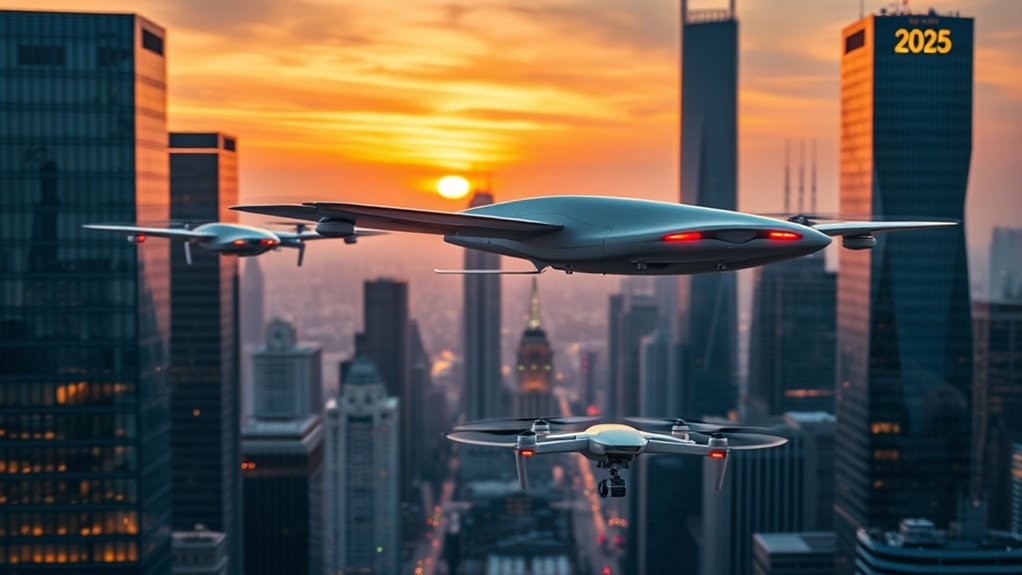

By 2025, your urban skies will be bustling with drone deliveries and air taxis, transforming how you move goods and commute. These aerial vehicles aim to make transportation faster and more efficient, but they also bring challenges like noise and regulation. Governments and companies are working to balance innovation with safety and comfort. If you’re curious about how these changes will impact daily life and what obstacles remain, there’s much more to explore ahead.
Key Takeaways
- Urban air mobility is rapidly expanding with drone deliveries and air taxis becoming common in 2025.
- Noise pollution from aerial vehicles poses challenges, prompting quieter designs and flight path regulations.
- Regulatory frameworks are evolving to ensure safety, privacy, and security for urban drone and air taxi operations.
- Pilot programs and testing zones help integrate air mobility into existing transportation systems.
- The future balances technological innovation with regulatory oversight to maintain safe, efficient, and accessible urban skies.

Drone deliveries and air taxis are transforming urban transportation by offering faster, more efficient ways to move goods and people. As these new aerial solutions become more common in 2025, you’ll notice the skies buzzing with activity, changing the way cities operate. However, with this rapid adoption come notable challenges, particularly around urban noise and regulatory hurdles. Managing urban noise is critical because drones and air taxis generate a persistent hum that can disturb residents and wildlife. Cities will need to implement noise regulation standards, possibly requiring quieter drone designs or flight path restrictions to minimize disruption. Without these measures, public acceptance could wane, and authorities might restrict or slow down deployment, stalling progress just when these innovations could be revolutionizing daily life.
Regulatory challenges are equally significant. Governments and aviation authorities are racing to develop frameworks that ensure safety, privacy, and security, but these are complex issues. You might find yourself in an environment where drone operations are highly regulated, with strict licensing requirements, designated flight zones, and operational limits. This can slow down the rollout of drone delivery services and air taxis, as companies work to meet compliance standards and navigate legal uncertainties. The process involves coordinating with multiple agencies, creating new air traffic management systems, and addressing concerns about privacy invasions or potential accidents. These regulatory challenges are necessary to prevent chaos in the skies, but they demand significant time and resources, often delaying commercial launches. Additionally, ongoing research into urban air mobility aims to develop standards that facilitate safer, more efficient integration into cities.
Despite these obstacles, progress continues. Companies are investing in quieter drone technology and working with policymakers to craft regulations that balance innovation with safety. You may see urban air mobility becoming more integrated into existing transportation systems, with designated corridors and low-noise drones designed for quieter operation. Governments are also establishing pilot programs and testing zones to better understand how to regulate these new aircraft. While it’s a slow process, the goal is to create a sustainable, safe, and efficient aerial ecosystem that benefits everyone. As a city dweller or traveler, you’ll likely experience fewer road traffic jams and faster parcel deliveries, but you’ll also need to adapt to new rules and accept some level of noise in the skies. The future of urban air transit hinges on finding that delicate balance between technological advancement and regulatory oversight, ensuring that the sky remains a safe, accessible space for all.
Frequently Asked Questions
How Will Drone Delivery Safety Be Ensured?
You’ll see safety prioritized through advanced collision avoidance systems, which help drones navigate around obstacles and other aircraft. Regulatory agencies will enforce strict standards, ensuring consistent safety practices. Public acceptance will grow as transparency improves and incidents decrease, building trust in drone delivery safety. With ongoing technology improvements and clear guidelines, you can feel confident that drone deliveries will be reliable and secure, minimizing risks in the skies.
What Regulations Govern Air Taxi Operations?
You’ll need to follow strict regulations governing air taxi operations, including standards for urban air mobility. Authorities require drone certification to guarantee safety and reliability, so your air taxis meet all safety standards. These regulations cover flight paths, altitude limits, and pilot qualifications, making sure your operations are safe, efficient, and compliant with local laws. Staying updated on these regulations helps you operate seamlessly and confidently in the evolving air mobility landscape.
How Will Privacy Concerns Be Addressed?
Addressing privacy concerns is like setting up a sturdy fence around your yard. You’re protected through strict data privacy laws and surveillance regulations that limit drone monitoring. Operators will use advanced encryption, and transparent policies will guarantee your data isn’t misused. Regular audits and real-time monitoring will keep surveillance concerns in check, giving you peace of mind as air taxis and drones operate safely without infringing on your privacy.
What Are the Environmental Impacts of Drone Fleets?
You’ll find that drone fleets can have positive environmental impacts through eco-friendly innovations, like electric propulsion reducing carbon emissions. However, noise pollution mitigation remains essential to prevent disturbances. By adopting quieter designs and optimizing flight paths, you can minimize noise and energy use. Overall, responsible deployment of drone fleets can support sustainability goals while addressing environmental concerns effectively.
How Will Air Traffic Be Managed With Increased Drone Activity?
You’ll see air traffic management evolve considerably, with over 70% of urban airspace dedicated to drones by 2025. Advanced air traffic integration systems will coordinate drone routes seamlessly, reducing congestion. Urban airspace management will involve real-time tracking and automated traffic control, ensuring safe, efficient flights. This integration will allow you to experience faster, more reliable deliveries and taxis, transforming city skies into organized, smart transportation networks.
Conclusion
By 2025, drone deliveries and air taxis will transform how you move and receive goods, making travel faster and more efficient. Imagine ordering your favorite meal and having it arrive within minutes via an air taxi, or your online shopping arriving the same day through autonomous drones. Companies like Uber Elevate are already testing these concepts, showing a future where your skies are filled with seamless, eco-friendly transportation options. The sky’s truly the limit for this exciting technological leap.