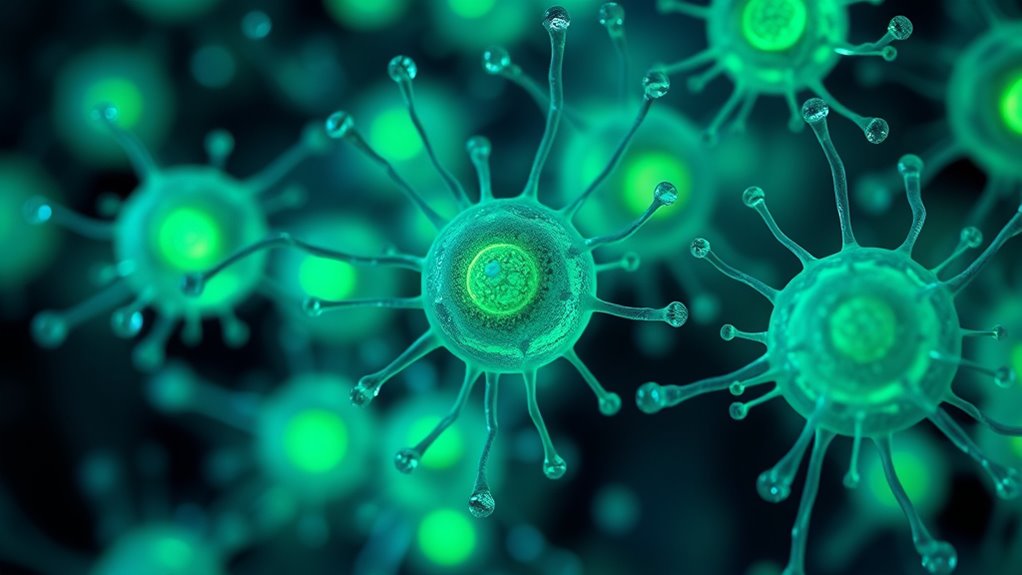

Imagine a future where living cells act as tiny computers, processing information and making decisions on their own. This is the promise of biocomputers, where biology and technology merge to create programmable, intelligent systems. As you explore how scientists engineer genetic circuits and harness cellular functions, you’ll see how these innovations could revolutionize medicine, environment, and industry—if they can overcome the challenges ahead. The potential is vast, but the journey is just beginning.
Key Takeaways
- Biocomputers utilize living cells engineered with genetic circuits to perform computational tasks.
- Cells act as biological processors, executing logic operations and decision-making based on environmental inputs.
- Synthetic biology enables programming cells to respond selectively, process information, and communicate internally.
- Computational modeling predicts circuit behavior, optimizing cell-based computation before physical implementation.
- These biological processors have applications in medicine, environmental monitoring, and bio-manufacturing.

Have you ever wondered how biology could revolutionize computing? The idea of using living cells as processors is no longer science fiction. Instead, it’s a rapidly developing field called biocomputing, where scientists are harnessing the power of synthetic biology to design biological systems that can perform computational tasks. Unlike traditional computers that rely on silicon and electronic circuits, biocomputers use living cells to process information, offering new possibilities for scalability, energy efficiency, and biocompatibility. This innovative approach hinges on understanding the complex behaviors of biological systems and manipulating them to serve computational functions.
Biocomputing combines synthetic biology and living cells to revolutionize information processing and expand technological possibilities.
Synthetic biology plays an essential role in this transformation. It allows you to engineer cells with custom genetic circuits that behave like logic gates, memory units, or even entire processing units. By designing these circuits, you can program cells to respond to specific stimuli, perform calculations, and communicate with each other. This customization makes biocomputers highly adaptable for applications like medical diagnostics, environmental monitoring, and bio-manufacturing. To achieve this, researchers employ computational modeling extensively. These models simulate how genetic circuits will behave within living cells before they’re built in the lab. Computational modeling helps predict potential outcomes, troubleshoot issues, and optimize circuit design, reducing the trial-and-error process that often slows progress in synthetic biology.
As you explore more about biocomputing, you’ll see that the integration of synthetic biology and computational modeling enables the creation of biological systems with unprecedented complexity. These systems can process multiple inputs simultaneously, make decisions based on environmental cues, and even evolve over time. Imagine a biocomputer that can detect cancer markers within the body, analyze the signals, and then produce a targeted response—all within living tissue. Such possibilities are becoming more feasible as you leverage the principles of synthetic biology to build biological processors that are not only efficient but also seamlessly integrate with living organisms. Advances in biocomputing continue to push the boundaries of what living cells can achieve as computational units.
Furthermore, the use of computational modeling provides you with a powerful toolkit to understand and control these biological processors. It helps you optimize genetic circuits for stability, speed, and reliability. You can simulate how different variables affect circuit performance, enabling you to refine designs before they’re physically created. This synergy between synthetic biology and computational modeling accelerates the development of biocomputers, bringing us closer to a future where cells themselves become the fundamental units of information processing. As you explore this frontier, you’ll discover how merging biology with computation opens up a new universe of possibilities, transforming living cells into intelligent, programmable processors.
biocomputing kits for synthetic biology
As an affiliate, we earn on qualifying purchases.
As an affiliate, we earn on qualifying purchases.
Conclusion
As you explore the domain of biocomputers, you’ll see how living cells are transforming into intelligent processors, blending biology with cutting-edge tech. This innovation, reminiscent of the Renaissance’s spark of discovery, opens doors to medical breakthroughs and environmental solutions. With continued advances, you’ll soon witness a future where cells think and decide—truly a marvel that echoes the visionary spirit of history’s greatest minds, all happening right before your eyes.

Computational Synthetic Biology & Gene Editing with Python: CRISPR Design, Genetic Circuit Modeling, and Metabolic Engineering Workflows for … … Health Science and Bioinformatics Book 9)
As an affiliate, we earn on qualifying purchases.
As an affiliate, we earn on qualifying purchases.
biological processor educational kits
As an affiliate, we earn on qualifying purchases.
As an affiliate, we earn on qualifying purchases.
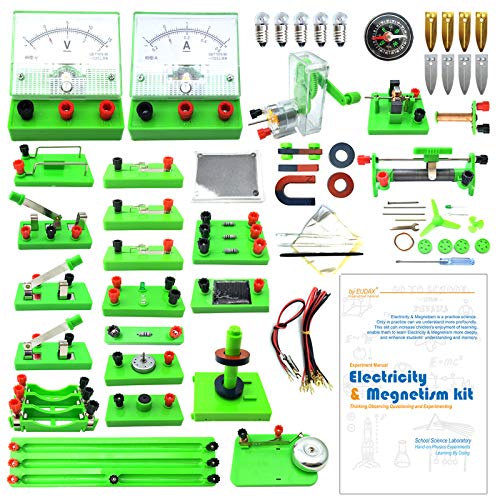
EUDAX School Physics Labs Basic Electricity Discovery Circuit and Magnetism Experiment kits for High School Students Electromagnetism Elementary Electronics
Learn basic Electricity and Magnetism experiments through full-color manuals, understand the basic principles, and help Students learn, think…
As an affiliate, we earn on qualifying purchases.
As an affiliate, we earn on qualifying purchases.