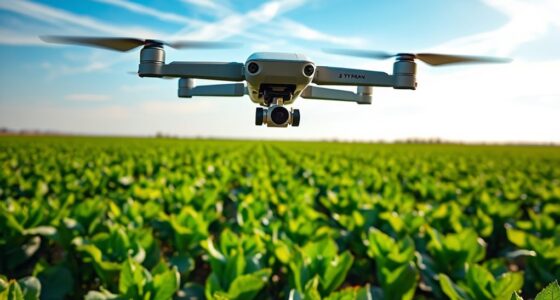
Sensors like LiDAR, radar, and beyond are shaping the future of technology by becoming smaller and smarter. With sensor miniaturization, you’ll find these devices in everything from autonomous cars to health monitors, working seamlessly together through data fusion to give a clearer picture of the environment. This synergy improves accuracy, even in bad weather or low visibility. To understand how these innovations drive smarter, more connected devices, keep exploring how they’re transforming various industries.
Key Takeaways
- Miniaturized sensors enable integration into compact devices, enhancing environmental perception for autonomous vehicles and wearables.
- Data fusion combines inputs from LiDAR, radar, and cameras to improve accuracy and reliability in complex scenarios.
- Advanced sensors support real-time processing, ensuring safer navigation and obstacle detection in challenging conditions.
- Beyond automotive, tiny sensors are used in healthcare, industrial automation, and predictive maintenance for comprehensive insights.
- Future trends focus on sensor convergence and durability, driving smarter, more connected devices with enhanced sensing capabilities.
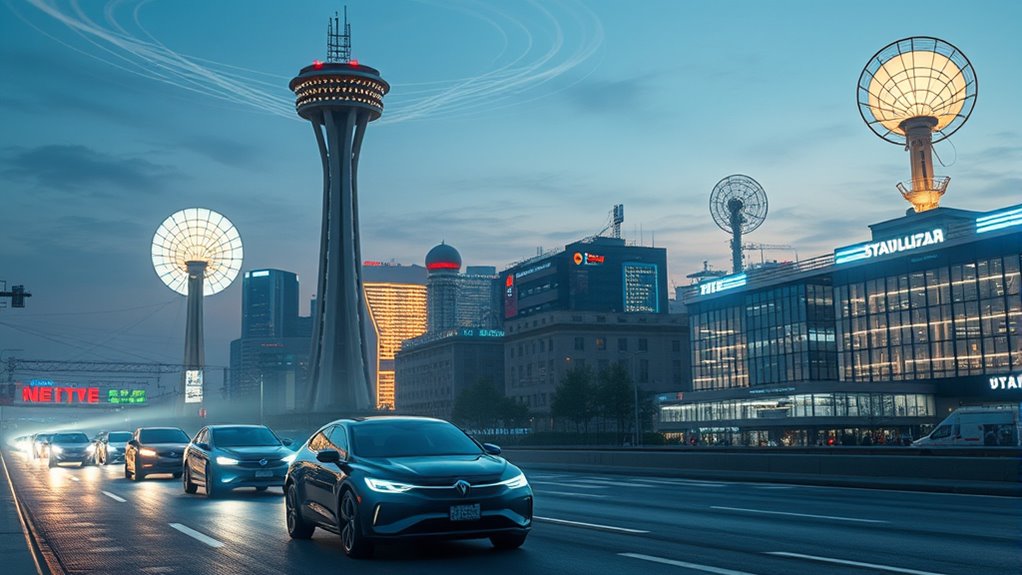
Sensors are driving the next wave of technological innovation, transforming how devices gather and interpret data. As these sensors become more advanced, their miniaturization plays a pivotal role in enabling new applications. Sensor miniaturization allows you to embed sophisticated sensing capabilities into small, lightweight devices, making them ideal for wearables, drones, and autonomous vehicles. Smaller sensors mean you can pack more into a limited space, increasing the density of data collection and improving overall system performance. This trend toward compact sensors also reduces power consumption and cost, making advanced sensing technology accessible across various industries.
Alongside miniaturization, data fusion techniques are essential for extracting meaningful insights from multiple sensor inputs. When you combine data from LiDAR, radar, cameras, and other sensors, you create a richer, more accurate picture of your environment. Data fusion helps mitigate the limitations of individual sensors, such as LiDAR’s susceptibility to adverse weather or radar’s lower resolution. By intelligently integrating these data streams, you can enhance detection accuracy, obstacle recognition, and environmental mapping. This integrated approach is particularly indispensable for autonomous vehicles, where reliable perception is key to safety and efficiency.
Data fusion combines sensor inputs like LiDAR and radar to improve accuracy and environmental understanding in autonomous systems.
As sensors become more compact, their integration into complex systems grows easier, allowing you to develop smarter, more responsive devices. For example, in self-driving cars, miniaturized sensors work together seamlessly, providing real-time data to navigation and control systems. Advanced data fusion techniques ensure that the vehicle’s perception of its surroundings remains accurate even in challenging conditions like fog, rain, or snow. This synergy between miniaturized sensors and data fusion is what makes autonomous technology viable, pushing the boundaries of what vehicles can perceive and respond to.
Beyond automotive, sensor miniaturization and data fusion are revolutionizing fields like healthcare, industrial automation, and consumer electronics. Wearable health monitors rely on tiny sensors to track vital signs continuously, with data fusion techniques combining information from multiple sources to provide comprehensive health insights. In industrial settings, small sensors embedded in machinery help detect faults early, with data fusion enabling predictive maintenance. Each application benefits from the ability to gather precise, multi-faceted data in real time, facilitating smarter decision-making.
In essence, the convergence of sensor miniaturization and data fusion techniques is shaping the future of technology. You’ll see smarter, more connected devices that can perceive their environment with unprecedented accuracy, all while fitting into smaller form factors. This evolution empowers innovation across industries, making your devices more capable, efficient, and responsive than ever before. Moreover, advancements in sensor durability ensure that these compact sensors can withstand harsh environments, expanding their potential applications even further.
Frequently Asked Questions
How Do Sensor Costs Impact Mass Adoption of Autonomous Vehicles?
Sensor costs considerably influence how quickly autonomous vehicles become mainstream. When sensor affordability improves, manufacturers can scale production more efficiently, reducing overall vehicle costs. This makes autonomous vehicles more accessible to consumers, encouraging mass adoption. As production scalability increases, sensor prices tend to decrease further, creating a positive cycle. Lower costs and higher scalability ultimately help bring autonomous vehicles into everyday life, making advanced tech available to more people.
What Are the Environmental Limitations of Lidar and Radar Sensors?
You should know that environmental limitations of LiDAR and Radar sensors include challenges like signal interference from weather conditions such as rain, fog, or snow, which can reduce accuracy. Additionally, sensor calibration is vital; poor calibration can lead to unreliable data. These factors hinder sensor performance in extreme environments, making it harder for autonomous systems to operate safely and effectively in all weather conditions.
How Secure Are Sensor Data Transmissions From Hacking Threats?
Your sensor data transmissions are like delicate whispers in a noisy room—vulnerable to hacking threats. To keep your information safe, robust sensor encryption acts as a digital lock, shielding data privacy from prying eyes. While no system is invulnerable, implementing strong encryption protocols considerably reduces risks, giving you confidence that your sensor data remains secure amid the digital chaos. Protecting this data is essential for safe, trustworthy technology.
Can Sensors Function Effectively in Extreme Weather Conditions?
Yes, sensors can function effectively in extreme weather conditions if they’re properly calibrated for specific environments, ensuring weather resilience. Regular sensor calibration helps maintain accuracy despite challenges like heavy rain, snow, or fog. Advances in sensor design also improve weather resilience, allowing them to adapt and operate reliably. With these measures, sensors continue to provide dependable data, even in harsh weather, supporting critical applications like autonomous driving and weather monitoring.
What Are the Future Developments Expected in Multi-Sensor Fusion Technology?
Imagine a symphony where each instrument harmonizes perfectly—that’s the future of multi-sensor fusion. You’ll see advancements in sensor integration and algorithm enhancements that create seamless data blending, making machines smarter and more adaptable. These developments will allow sensors to communicate more effectively, even in complex environments. As a result, your tech will become more intuitive, reliable, and capable of making split-second decisions, transforming the way you interact with the world.
Conclusion
So, imagine a world where sensors like lidar and radar aren’t just tools—they’re the heartbeat of every tech revolution. They’ll transform your daily life so profoundly that future gadgets might seem like sci-fi magic. From self-driving cars to smart cities, these sensors will do everything but read your mind. Get ready, because the future is coming faster than you think, and it’s going to be so incredible, you’ll wonder how you ever lived without it!