
TL;DR

Get the latest gadgets delivered free — and shop member deals
- Fast, free delivery on millions of items
- Access to Prime Big Deal Days deals on October 6–7
- Prime Video, Amazon Music and more included
A developer has created a guitar tuner that uses a phone’s accelerometer to detect string vibrations. The app requires pressing the phone against the guitar and works best on Android devices with high-rate IMU sensors. This innovation could simplify tuning without traditional microphones.
A developer has introduced a guitar tuner that uses a phone’s accelerometer to detect string pitch, requiring users to press the phone against the guitar body. This approach offers an alternative to traditional microphone-based tuners, potentially simplifying the tuning process for musicians.
The app works by pressing the phone firmly against the guitar and plucking a string. It then traces raw vibration data across the phone’s axes, with the combined magnitude (|a|) indicating the vibration strength. Pitch detection is achieved by analyzing the strongest axis, which is alias-corrected to identify the actual string frequency. The method requires motion permission and performs best on Android devices equipped with high-rate inertial measurement units (IMUs). According to the developer, this approach provides real-time tuning feedback without relying on audio input, which could be advantageous in noisy environments or for users with limited microphone quality.
Why It Matters
This development introduces a novel, hardware-based approach to guitar tuning, potentially making tuning more accessible and accurate in various settings. It could benefit musicians who prefer a microphone-free method or need quick, on-the-spot tuning without additional equipment. If widely adopted, it might influence future tuning apps to incorporate motion sensors as a primary input method, expanding the use of smartphone sensors in musical applications.
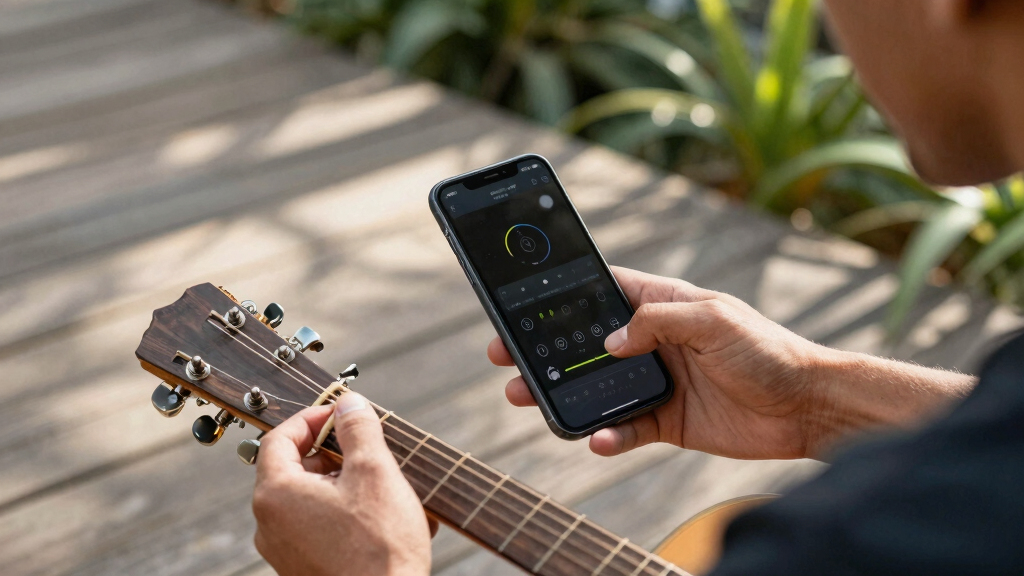
guitar tuner app with accelerometer
As an affiliate, we earn on qualifying purchases.
As an affiliate, we earn on qualifying purchases.
Background
Traditional guitar tuners typically rely on microphones or clip-on pickups to analyze string vibrations. Recent advances have seen apps using audio analysis, but these can be affected by background noise and microphone quality. The new method leverages the high-rate IMU sensors present in many modern smartphones, which are usually used for gaming or navigation, to detect vibrations directly through physical contact. The concept was shared on Hacker News, highlighting a prototype that demonstrates the feasibility of this sensor-based tuning approach. The developer notes that the app requires explicit motion permissions and is optimized for Android devices with high-rate IMUs, which are more common in newer phones.
“Press the phone firmly against the guitar body and pluck a string. Each axis trace shows raw vibration; |a| is the combined magnitude. Pitch is detected from the strongest axis (alias-corrected to the actual string frequency).”
— Developer
“Works best on Android with high-rate IMU sensors.”
— Developer
smartphone vibration guitar tuner
As an affiliate, we earn on qualifying purchases.
As an affiliate, we earn on qualifying purchases.
What Remains Unclear
It is not yet clear how accurate or reliable this method is across different smartphone models and in various environmental conditions. The user experience and ease of use compared to traditional tuners remain to be tested extensively. Further development may be needed to refine the algorithm and ensure consistent performance.
As an affiliate, we earn on qualifying purchases.
What’s Next
The developer plans to release the app for wider testing and gather user feedback. Future updates may include improvements in accuracy, user interface, and compatibility with more devices. Additional validation studies are expected to compare this method’s effectiveness against existing tuning solutions.
As an affiliate, we earn on qualifying purchases.
Key Questions
How does the accelerometer-based tuner work?
The app requires pressing the phone against the guitar and plucking a string. It captures vibration data across the phone’s axes, analyzes the strongest axis to detect the string’s pitch, and provides tuning feedback based on that analysis.
What devices are compatible with this tuner?
The method works best on Android smartphones equipped with high-rate IMU sensors. Compatibility with other devices or iPhones has not been confirmed.
Is this method as accurate as traditional microphone-based tuners?
It is currently unclear how the accuracy compares. The developer suggests promising results, but extensive testing is needed to validate its reliability across different scenarios.
Does this require special permissions or setup?
Yes, the app requires motion permissions to access the accelerometer data. Proper contact with the guitar is also necessary for effective vibration detection.
What are the advantages of this approach?
This method avoids microphone noise issues, may work better in loud environments, and eliminates the need for additional hardware like clip-on pickups.
Fall Picks
fall essentials
As an affiliate, we earn on qualifying purchases.