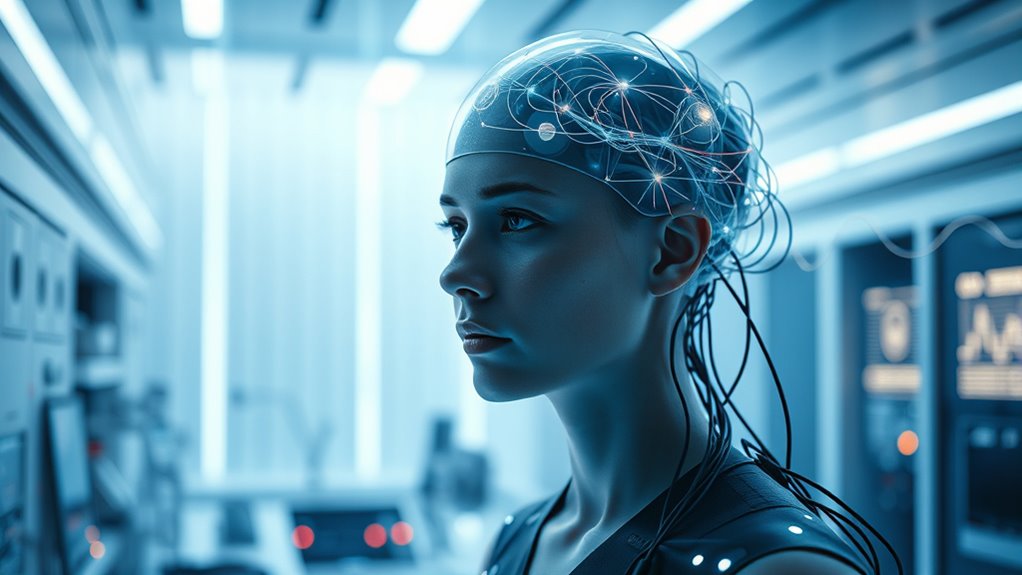

Neural interfaces are revolutionizing how you connect with technology by enabling direct brain-to-device communication. They bypass traditional inputs, allowing your neural signals to control gadgets, restore functions, and enhance thinking. As your brain adapts through neuroplasticity, controlling machines becomes more intuitive and seamless. Advances in AI and neural decoding make this integration more natural and efficient. Keep exploring, and you’ll discover how these innovations are transforming human-machine interaction into something almost second nature.
Key Takeaways
- Neural interfaces enable direct brain-to-device communication, bypassing traditional input methods.
- Neural plasticity allows the brain to adapt and rewire for efficient control of external devices.
- Learning processes strengthen neural pathways, making brain-machine control more intuitive over time.
- Advances in technology and machine learning optimize neural decoding for seamless integration.
- The merging of mind and machine promises transformative applications in mobility, communication, and cognition enhancement.
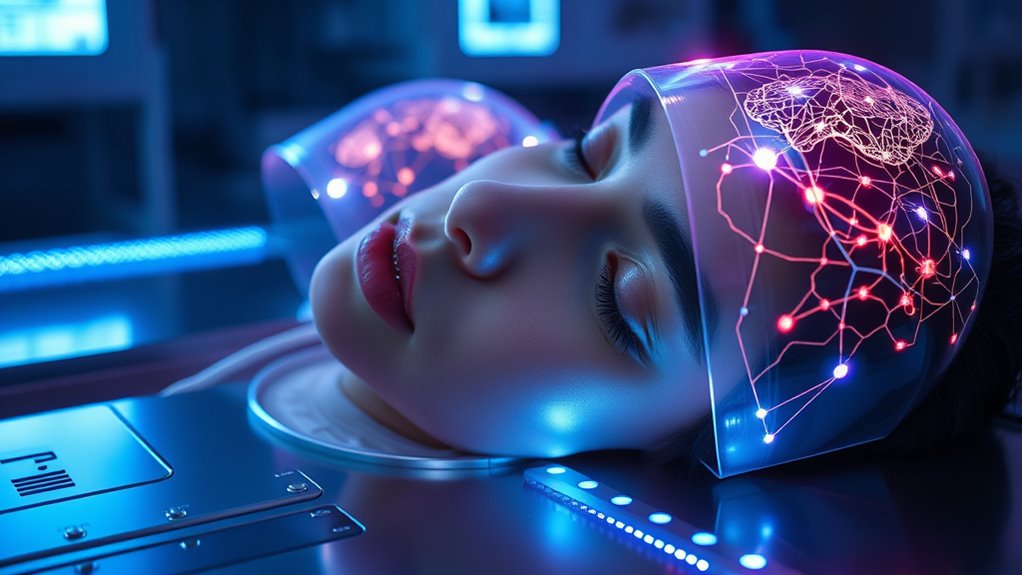
As neural interface technology advances, the line between human thought and machine increasingly blurs. You begin to realize how close we are to a future where your brain can directly communicate with computers, bypassing traditional inputs like keyboards or voice commands. This is the essence of brain computer communication, a field that harnesses neural signals to control devices, restore lost function, or even enhance cognitive abilities. At its core, neural plasticity plays a critical role, allowing your brain to adapt and rewire itself in response to these new interactions. When you use a neural interface, your brain doesn’t remain static; it learns to interpret signals from external devices, strengthening pathways and creating new ones in response to your intentions. This adaptive process means that, over time, controlling a prosthetic limb or typing on a digital interface can become almost second nature, as your neural pathways become finely tuned to these tasks.
Understanding how neural plasticity works in this scenario makes it clear why neural interfaces can be so effective. Your brain is inherently flexible, capable of reorganizing itself based on experience. When you start using a neural interface, you essentially train your brain to recognize and generate specific neural patterns that correspond to commands you want to execute. This learning process involves strengthening synaptic connections and forming new pathways, enabling more seamless brain computer communication as you gain experience. It’s like rewiring your brain to work in tandem with machines, turning neural signals into precise commands. This synergy opens the door to remarkable possibilities, from restoring mobility with brain-controlled prosthetics to enabling communication for those with paralysis or speech impairments.
Moreover, as you interact more with these systems, your brain’s ability to adapt accelerates. The plasticity not only helps you learn how to use the device effectively but also enhances your overall neural efficiency. Your brain becomes more adept at filtering relevant signals from noise, improving accuracy and response times. This ongoing process of adaptation means that neural interfaces could become more intuitive, almost invisible extensions of your own cognition. The potential for this technology to evolve alongside your brain’s natural capacity for change is enormous. It promises a future where the merging of human thought and machine isn’t just a concept but a practical reality—one that could be accelerated by advances in machine learning algorithms, which continuously optimize neural decoding techniques.
Frequently Asked Questions
What Are the Ethical Implications of Brain-Machine Merging?
When considering brain-machine merging, you must think about ethical implications like privacy concerns and identity preservation. You could face risks of your thoughts and personal data being exposed or manipulated. This technology challenges your sense of self, so you need to guarantee safeguards are in place to protect your identity. Staying informed and advocating for responsible development helps you maintain control and prevent potential misuse of your mental privacy.
How Long Do Neural Interface Devices Typically Last?
You wonder how long neural interface devices last. Typically, the device durability varies, but most have a lifespan estimation of 1 to 10 years, like a fragile thread woven into your mind’s fabric. As you imagine this delicate connection, remember that advancements aim to extend this lifespan, ensuring your neural link remains steady, reliable, and seamless. Regular maintenance and technological improvements help these devices serve you longer and better.
Can Neural Interfaces Transmit Thoughts Across Individuals?
Yes, neural interfaces can enable telepathic communication between individuals, creating a shared consciousness. By linking brains directly, you can transmit thoughts, feelings, and images instantly, bypassing speech. This technology is still in development, but it holds promise for real-time, seamless connection, allowing you to share experiences and ideas more intimately than ever before. Imagine a future where minds merge effortlessly, fostering deeper understanding and collaboration.
What Are the Risks of Neural Interface Hacking?
Hacking neural interfaces could be a nightmare, risking your thoughts becoming public data. You face serious threats to data privacy, where sensitive info could be stolen or manipulated. Device security is essential; if compromised, a hacker might control your thoughts or actions. Always stay vigilant, update security measures, and be aware of potential breaches. Protecting your mind is just as important as safeguarding your personal data online.
How Accessible Will Neural Interface Technology Become Globally?
You’ll likely see neural interface technology become more accessible globally as technological affordability improves and cultural acceptance grows. As costs decrease and societies become more open to integrating these tools, more people will adopt them. However, accessibility varies depending on economic factors, local regulations, and cultural attitudes. In some regions, adoption might be faster, while others could face hurdles due to skepticism or limited resources.
Conclusion
As you step closer to the horizon where mind blends with machine, imagine your thoughts as threads weaving into a luminous tapestry, each connection a shimmering bridge. The neural interface becomes a doorway, not just to technology but to a new domain of self-awareness. Embrace this evolving symphony, where your consciousness dances with circuits, forging a future where the boundaries between human and machine dissolve into a radiant dawn of endless possibilities.