

State management confuses you because handling asynchronous data involves many moving parts that need to work together perfectly. You must coordinate data flow, keep UI updates consistent, and prevent issues like outdated or flickering info. As apps grow more complex, managing state becomes even trickier. Understanding how data moves and how components sync isn’t easy, but if you explore further, you’ll find strategies to simplify these challenges and improve your frontend solutions.
Key Takeaways
- Asynchronous data handling introduces timing issues, race conditions, and UI inconsistencies that are hard to predict and manage effectively.
- Multiple state management approaches create confusion about which solution suits specific component or application needs.
- Complex data flows and dependencies make tracing and debugging state changes challenging for teams.
- Balancing real-time updates, error handling, and user experience requires sophisticated synchronization strategies.
- Growing application complexity demands continuous learning and adaptation, increasing the difficulty of maintaining clear state management.

Managing state in frontend development often feels like steering through a complex maze, especially as applications grow more dynamic. You’re juggling multiple data sources, user interactions, and UI updates all at once, which can quickly become overwhelming. One major challenge is handling async data—retrieving information from APIs or external sources that don’t arrive instantly. When your application depends on this data, you need to guarantee that components update correctly once it arrives, which isn’t always straightforward. If not managed properly, your UI can become inconsistent, showing outdated or incomplete information, leading to a confusing user experience. This is where component synchronization becomes critical. You have to coordinate multiple components so they reflect the current state accurately, even when data arrives at different times. Achieving this synchronization without causing race conditions or redundant renders is a delicate task.
Managing async data and component synchronization is key to maintaining a consistent, reliable user experience in dynamic applications.
You might find yourself wrestling with different approaches to managing state, from local component states to global stores. Local state is simple and quick for small, isolated features, but it can become fragmented across your app. When multiple components depend on shared data, you need a centralized state management solution to prevent inconsistencies. Tools like Redux, MobX, or newer context-based approaches help, but they introduce their own complexity. You need to understand how to assure your state predictable and how to update it efficiently to avoid unnecessary renders or stale UI. Managing async data in this context adds another layer of difficulty—fetching, caching, and updating data asynchronously requires careful handling to keep everything in sync. Additionally, understanding requirements traceability can help ensure that all parts of your system are aligned with your project goals and compliance standards. Moreover, having a clear data flow plan can significantly reduce confusion and improve system robustness. Properly handling error states is also critical to maintaining user trust and system reliability. Recognizing the importance of state consistency can help you design more reliable frontend architectures that adapt smoothly to data changes.
The real challenge is making certain that all parts of your application stay aligned as data flows through the system. When async data updates, you must decide how to handle loading states, errors, and partial data. If your component synchronization isn’t smooth, users can see flickering or inconsistent states, which diminishes their trust. Even with a solid state management library, you need to design your data flow thoughtfully. You’ll need to implement strategies like optimistic updates or fallback UI states to handle real-world scenarios gracefully. Ultimately, the core of the confusion lies in balancing complexity and simplicity. Managing async data and ensuring component synchronization demands careful planning and practice. It’s not just about choosing the right tools; it’s about understanding how data moves through your app and how to keep your UI in sync with that data. As applications grow, so does the challenge, making state management an ongoing puzzle for frontend teams.
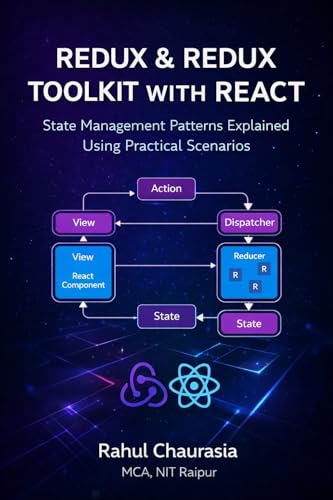
Redux & Redux Toolkit With React: State Management Patterns Explained Using Practical Scenarios
As an affiliate, we earn on qualifying purchases.
As an affiliate, we earn on qualifying purchases.
Frequently Asked Questions
How Do Different State Management Tools Compare?
Different state management tools vary in how they handle data synchronization and maintain state consistency. For example, Redux provides a single source of truth, making data synchronization straightforward but sometimes complex. MobX offers more flexibility with automatic updates, easing state consistency. Vuex and Context API are simpler but may need more manual effort. Choose based on your app’s complexity and your team’s familiarity to keep data synchronized and states consistent.
What Are Common Pitfalls in Implementing State Management?
Ever tried to keep multiple components in sync? Common pitfalls include poor state synchronization, which causes data inconsistencies, and confusing event handling, leading to unpredictable UI behavior. You might also overlook the importance of managing side effects or overcomplicate your architecture, making it hard to maintain. To avoid these issues, focus on clear data flow, consistent state updates, and well-structured event handling, ensuring your app remains reliable and easy to debug.
How Does State Management Affect Application Performance?
State management directly impacts your application’s performance by affecting data synchronization and memory optimization. When you manage state efficiently, you guarantee smooth updates across your app, reducing lag and unnecessary re-renders. Poor state handling can cause data inconsistencies, slow down your app, and increase memory usage. By optimizing how you handle state, you improve responsiveness, enhance user experience, and keep your app running smoothly, even as it scales.
When Should I Consider Using Global vs. Local State?
You should consider using global state when multiple components need to share and synchronize data, ensuring contextual synchronization and a consistent user experience. Use local state for isolated, component-specific data that doesn’t impact others, keeping your app more manageable. Balancing both helps optimize performance and clarity, so evaluate how data flows through your app and where centralized management improves user experience without complicating your codebase.
How Can Teams Effectively Learn New State Management Frameworks?
To effectively learn new state management frameworks, you should prioritize learning adoption and framework compatibility. Embrace hands-on practice, explore thorough documentation, and participate in community discussions. Focus on understanding core concepts, experimenting with small projects, and aligning tools with your team’s existing tech stack. By staying consistent, seeking feedback, and adapting your approach, you guarantee smoother mastery, better integration, and long-term success in managing application states efficiently.

React From Component to Creation: A Beginner's Guide to Building Interactive UIs with Hooks, State Management, and the Modern React Ecosystem
As an affiliate, we earn on qualifying purchases.
As an affiliate, we earn on qualifying purchases.
Conclusion
Exploring state management can feel like finding your way through a maze, but with patience and practice, it becomes less intimidating. While the landscape may seem complex at first, embracing the nuances and experimenting with different approaches will gradually clear the fog. Remember, even seasoned developers continue to learn and adapt. So, keep exploring, stay curious, and trust that each step brings you closer to mastering the art of seamless frontend experiences.

error fetching data
Float charger won’t overcharge batteries
As an affiliate, we earn on qualifying purchases.
As an affiliate, we earn on qualifying purchases.
frontend state synchronization library
As an affiliate, we earn on qualifying purchases.
As an affiliate, we earn on qualifying purchases.