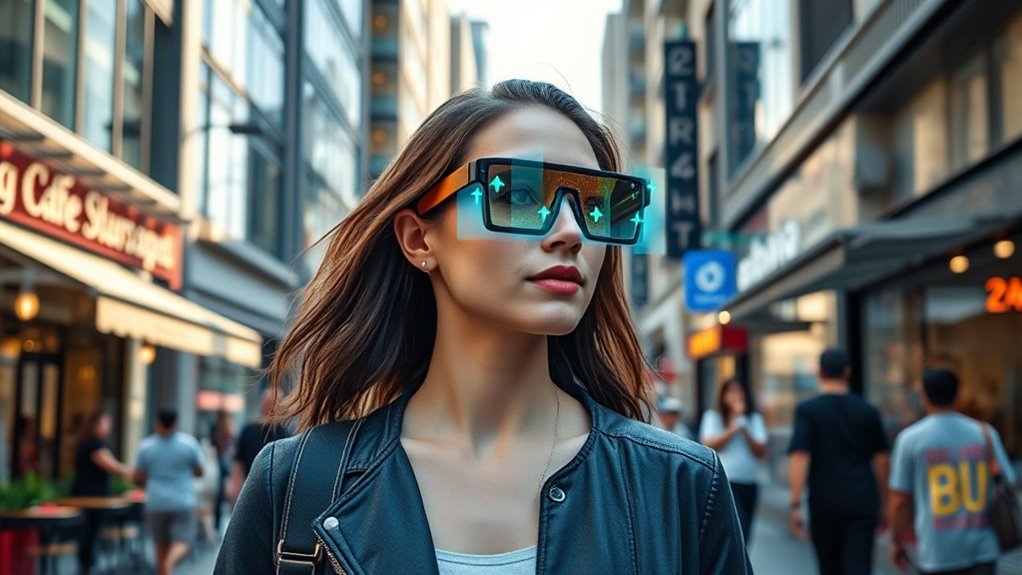

By 2025, AR glasses are expected to become a big part of your daily life, seamlessly integrating virtual interfaces into your routines. They’ll help you access information instantly, communicate hands-free, and stay aware of your surroundings with context-aware displays. As technology advances, these devices will become more immersive and personalized, making everyday tasks easier and safer. Keep exploring to discover how this revolution could transform your world even further.
Key Takeaways
- Widespread AR glasses adoption is projected to peak around 2025, integrating seamlessly into daily routines.
- Advances in virtual interfaces will enhance multitasking and real-time information access for everyday activities.
- Increased reliance on hands-free communication and context-aware overlays will improve safety and productivity.
- Technological progress will make AR devices more immersive, intuitive, and unobtrusive, encouraging mass adoption.
- Experts foresee 2025 as a pivotal year for AR glasses becoming a standard part of personal and professional life.

Augmented reality (AR) glasses are quickly becoming a seamless part of daily life, transforming how you work, communicate, and steer your surroundings. With virtual interfaces layered directly into your field of vision, you gain instant access to information without interrupting your flow. Instead of fumbling through screens or shifting your focus, you see notifications, maps, or data overlays right in front of you. This integration makes multitasking more natural, allowing you to stay connected and informed without breaking stride. Whether you’re in a meeting, on the move, or simply exploring your environment, AR glasses keep essential details at your fingertips—literally.
Hands-free communication is a major advantage of these devices. You can speak commands or have conversations without holding a phone or device, freeing your hands for other tasks. For example, during a workout, you might check your schedule or receive directions without stopping or reaching for a device. When working on a project, AR glasses can relay instructions or collaborate with colleagues remotely, making teamwork more efficient. Voice control becomes intuitive, allowing you to focus on the task at hand rather than fiddling with buttons or screens. This hands-free setup enhances safety during activities like driving or cycling, where distraction can be dangerous, and guarantees you’re always connected without sacrificing mobility.
AR glasses enable hands-free, intuitive communication—perfect for staying connected safely during workouts, commutes, and collaboration.
The virtual interfaces built into AR glasses are designed to be unobtrusive yet informative. They adapt to your context, providing relevant information precisely when you need it. For instance, if you’re guiding a city, the glasses display turn-by-turn directions directly on your field of view, eliminating the need to glance at a separate device. When working in a warehouse or factory, AR interfaces can highlight specific items or instructions, streamlining processes and reducing errors. This seamless blend of digital and real-world environments boosts productivity and minimizes cognitive load, making everyday tasks smoother. Additionally, as the technology continues to evolve, these interfaces will become even more immersive and context-aware, further enhancing user experience.
Moreover, the integration of virtual interfaces and hands-free communication fosters a more intuitive user experience. You don’t have to learn complicated controls or steer clear of cluttered menus; simple voice commands or gestures suffice. Over time, as the technology matures, these glasses will become even smarter, anticipating your needs and offering proactive assistance. If 2025 truly becomes the tipping point for AR adoption, you’ll find yourself relying on these devices more and more—whether for work, entertainment, or social interaction—making daily life more connected, efficient, and effortless.
Frequently Asked Questions
How Do AR Glasses Impact User Privacy and Data Security?
AR glasses impact your privacy and data security by collecting personal information through sensors and cameras. You should ensure data encryption to protect this data from breaches. It’s also vital that you give informed user consent before sharing your data or using features that track your activities. By staying aware of these factors, you can help safeguard your privacy while enjoying the benefits of AR technology.
ARe AR Glasses Suitable for Children and Teenagers?
Like Pandora’s box, AR glasses for children and teens offer exciting possibilities but come with risks. They can enhance teen engagement and learning, yet concerns about child safety remain. You should carefully evaluate the content and features to guarantee they’re appropriate. Always supervise usage, set boundaries, and prioritize privacy. When used responsibly, AR glasses can be a valuable tool, but your focus must be on protecting young users.
What ARe the Environmental Impacts of Manufacturing AR Glasses?
The environmental footprint of manufacturing AR glasses is significant, mainly due to high manufacturing emissions and resource use. You should be aware that producing these devices involves energy-intensive processes, rare materials, and complex supply chains, which contribute to pollution and resource depletion. As AR technology advances, companies are working to reduce manufacturing emissions, but environmental impacts still pose concerns for sustainable development of AR glasses.
How Do AR Glasses Integrate With Existing Smart Devices?
Think of your AR glasses as the bridge connecting your world. You control them with gesture controls, making interactions seamless. They integrate smoothly with your existing smart devices, syncing notifications and apps. Battery life is essential here; it powers this harmony. With efficient energy use, your glasses become an extension of your digital life, like a second brain, effortlessly enhancing daily tasks and keeping you connected without missing a beat.
Can AR Glasses Be Customized for Different Professional Fields?
Yes, AR glasses can be customized for different professional fields. You can leverage professional customization to tailor field-specific applications, making them more effective for your work. Whether you’re in healthcare, manufacturing, or design, these glasses adapt to your industry’s needs, providing relevant tools and data right in your line of sight. This flexibility guarantees you get the most out of AR technology, enhancing productivity and accuracy in your daily tasks.
Conclusion
As you stand at the cusp of 2025, AR glasses are becoming as common as your morning coffee. They’re no longer just futuristic gadgets but everyday companions, blending seamlessly into your life. Think of them as the bridge connecting your present to a smarter, more connected future. Embrace this shift, because missing out would be like trying to read a map with blurred vision—you’re missing the bigger picture waiting just around the corner.