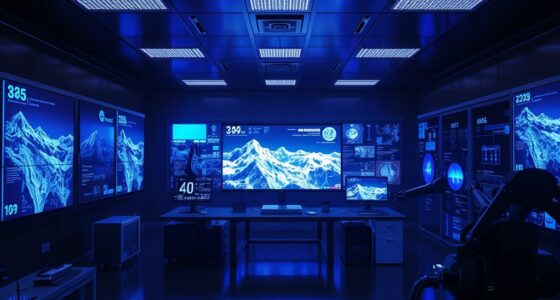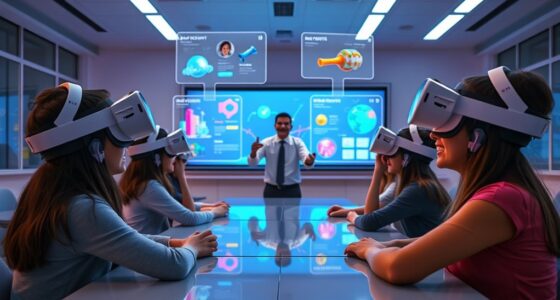
Augmented reality in industry lets you visualize digital info over real-world settings, improving training, repair, and design tasks. You can access real-time instructions, safety alerts, and collaborate remotely with team members, boosting efficiency and accuracy. AR helps you troubleshoot faster, reduce mistakes, and enhance safety. It also offers immersive learning experiences that speed up skill development. Keep exploring to discover how AR can transform your workflows and safety standards even further.
Key Takeaways
- AR provides immersive training simulations to accelerate skill development and improve retention for industrial workers.
- It enables remote troubleshooting and repair guidance, reducing downtime and travel costs.
- AR overlays digital models onto physical objects, aiding in design visualization and collaborative review processes.
- Safety protocols and hazard alerts are displayed in real-time, enhancing workplace safety during complex tasks.
- Integration with projectors and digital displays creates interactive environments for efficient planning and decision-making.
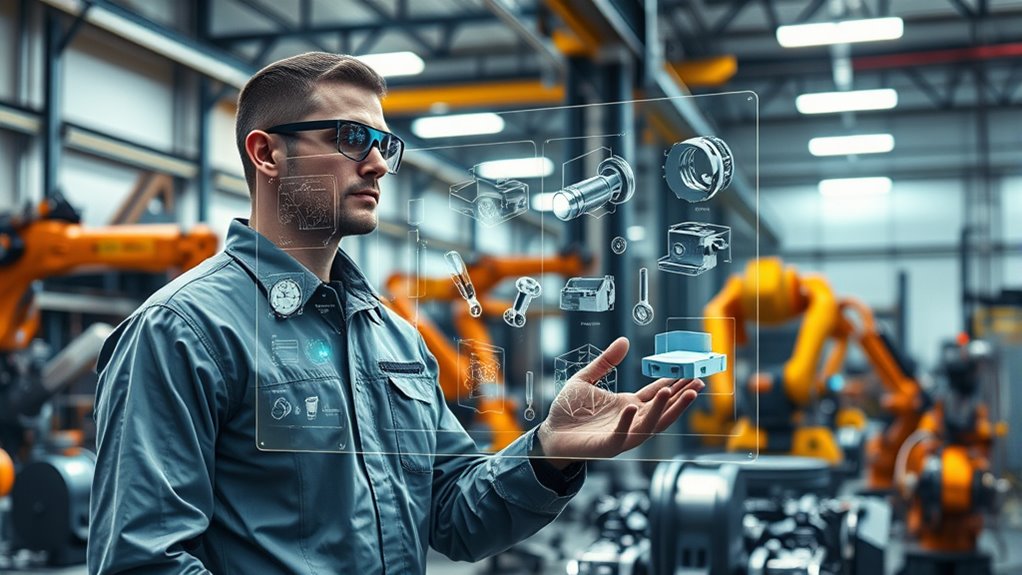
Augmented reality (AR) is transforming how industries operate by overlaying digital information onto the physical world. This technology enables you to visualize complex data, instructions, or designs directly within your real-world environment, making tasks more efficient and precise. One of the key benefits of AR is its ability to facilitate remote collaboration. Instead of being physically present, you can connect with colleagues or experts anywhere in the world and work together seamlessly. Through AR, you can share real-time views of your workspace, highlight specific areas, and receive guidance instantly. This reduces travel costs, accelerates decision-making, and guarantees everyone is on the same page. Whether troubleshooting equipment or designing a prototype, you and your team can collaborate as if you’re in the same room, even when separated by thousands of miles. Additionally, integrating high-quality projectors can enhance the clarity and effectiveness of AR displays in certain industrial applications, providing a more immersive experience. Safety enhancements also stand out as a significant advantage of AR in industry settings. When performing complex or dangerous tasks, AR provides you with critical safety information overlayed onto your view of the work environment. For example, during equipment maintenance or repairs, AR can display step-by-step instructions, hazard alerts, or safety checklists directly onto your goggles or device. This minimizes mistakes, reduces the risk of accidents, and helps guarantee compliance with safety protocols. Additionally, AR guides can prevent you from making errors that could lead to costly damage or injuries, ultimately creating a safer workspace. The ability to visualize potential risks and safety procedures before starting a task helps you prepare mentally and physically, boosting overall safety standards. In the domain of training, AR offers an interactive and immersive experience that accelerates learning curves. Instead of traditional training manuals or videos, you can practice repairs, assembly, or operational procedures in a simulated environment that mimics real-world conditions. This hands-on approach allows you to develop skills more quickly and retain information longer. For example, new employees can learn how to operate machinery or troubleshoot issues without the risk of damaging expensive equipment. AR training modules can be customized to suit various skill levels, making onboarding more efficient and effective. As you gain confidence, you can shift from virtual practice to real-world application with minimal downtime.
Frequently Asked Questions
How Cost-Effective Is Implementing AR in Industrial Settings?
Implementing AR in industrial settings can be quite cost-effective when you do a thorough cost analysis and ROI evaluation. While initial investments for hardware and software might seem high, you often save time, reduce errors, and improve training efficiency. These benefits lead to faster operations and fewer mistakes, ultimately increasing your return on investment. With proper planning, AR can markedly lower long-term costs and boost productivity in your industry.
What ARe the Main Challenges of Integrating AR With Existing Systems?
You might find system compatibility and user training to be gentle hurdles when integrating AR into your existing setup. Ensuring your systems work seamlessly with AR tools can require thoughtful adjustments, while effective user training helps staff embrace the new technology. By addressing these challenges proactively, you make the progression smoother, paving the way for AR’s benefits to truly shine in your industry operations.
How Is Data Security Maintained During Ar-Enabled Industrial Operations?
You maintain data security during AR-enabled industrial operations by implementing robust cybersecurity protocols and data encryption. These measures protect sensitive information from cyber threats and unauthorized access. You regularly update security systems, monitor network activity, and enforce strict access controls. By doing so, you guarantee that all AR data remains confidential, integrity is preserved, and operations stay secure against evolving digital threats.
What Industries ARe Most Benefiting From AR Adoption Currently?
You’ll find industries like aerospace and automotive diagnostics benefiting most from AR adoption now. In aerospace, AR drives innovations by enhancing maintenance and training, reducing errors and downtime. Meanwhile, automotive diagnostics leverage AR for real-time troubleshooting and repairs, improving efficiency and accuracy. These sectors embrace AR to streamline processes, boost safety, and accelerate product development, making them leaders in augmented reality integration in industry today.
How Does AR Impact Worker Safety and Productivity?
Imagine you’re in a sci-fi movie—AR boosts your safety and productivity by enhancing hazard awareness and worker engagement. It provides real-time data, helping you spot risks early and perform tasks more efficiently. With AR, you stay focused, reduce errors, and handle hazards confidently. This tech transforms your work environment into a safer, more engaging space, ultimately leading to fewer accidents and higher productivity.
Conclusion
As you embrace augmented reality in industry, you open new possibilities—training becomes immersive, repairs faster, and designs more precise. Yet, amidst these innovations, challenges like costs and technical hurdles remind you that progress isn’t always seamless. Just as AR transforms your work with vivid overlays, it also demands adaptability and patience. So, while the technology offers exciting advantages, remember that balancing innovation with realism keeps you ahead in this rapidly evolving landscape.