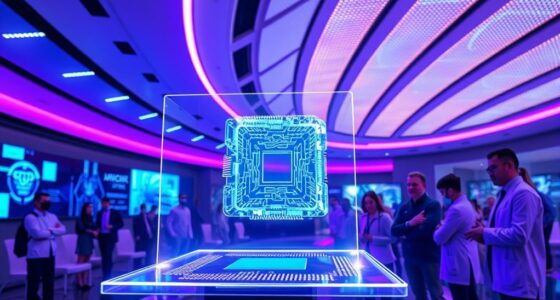
Quantum encryption has the potential to considerably reduce data breaches by using quantum keys and the principles of superposition and entanglement to detect eavesdropping instantly. It guarantees that any interception disturbs the quantum states, immediately alerting you to security threats. Its foundation in physics rather than computational complexity promises a new level of data protection. If you want to understand how this revolutionary technology is working and evolving, explore further insights coming up.
Key Takeaways
- Quantum encryption uses quantum keys and properties like superposition to detect and prevent eavesdropping.
- It offers theoretically unbreakable security based on physical laws, not computational complexity.
- Quantum key distribution ensures secure sharing and instant breach detection, enhancing data protection.
- Technical challenges and hardware limitations currently restrict widespread implementation.
- Advances in quantum technology could revolutionize cybersecurity, potentially ending data breaches.

Have you ever wondered how we can protect sensitive information in the age of digital threats? As cyberattacks become more sophisticated, traditional encryption methods sometimes fall short, leaving data vulnerable. That’s where quantum encryption comes into play, promising a new level of security rooted in the strange, fascinating laws of quantum physics. At its core, quantum encryption uses quantum keys—special sequences of quantum bits, or qubits—that are fundamentally secure against eavesdropping. Unlike classical keys, which can be intercepted and copied, quantum keys leverage principles like superposition and entanglement to guarantee that any attempt to intercept the key immediately alters its state, alerting you to a breach.
Quantum encryption uses secure quantum keys that detect eavesdropping, ensuring unprecedented data protection rooted in quantum physics.
The process begins with the generation of a quantum key through quantum algorithms designed for this purpose. These algorithms create keys that are truly random and impossible to predict, making them far more secure than classical cryptographic keys. When you share a quantum key with someone, the laws of quantum mechanics guarantee that any interception or measurement by a third party will disturb the key’s quantum state. This disturbance can be detected instantly, giving you the confidence that your communication remains private. This feature, called quantum key distribution, is one of the most promising aspects of quantum encryption and is already being tested in real-world scenarios.
Quantum algorithms play a vital role here. They’re used not only to generate secure keys but also to optimize the entire process of quantum communication. These algorithms take advantage of quantum properties to perform complex calculations rapidly, ensuring that the generation and distribution of quantum keys are both efficient and reliable. Because quantum algorithms can process information differently than classical ones, they help establish unbreakable cryptographic systems that could withstand even the most powerful computers, including future quantum machines. This resilience stems from the fact that, unlike classical encryption that relies on computational difficulty, quantum encryption’s security is based on the fundamental laws of physics.
While quantum encryption offers unparalleled security in theory, deploying it on a broad scale still faces technical challenges. Nonetheless, ongoing advances in quantum algorithms and hardware are bringing us closer to a future where data breaches could become a thing of the past. If you’re concerned about safeguarding your sensitive information, understanding the role of quantum keys and quantum algorithms is essential—they’re shaping the next generation of secure communication. As this technology continues to evolve, it promises to revolutionize how we protect privacy in an increasingly digital world, making data breaches far less likely and much easier to detect when they do occur. The development of quantum hardware is crucial for overcoming current limitations and achieving widespread adoption of quantum encryption technology.
Hardware for Quantum Computing
As an affiliate, we earn on qualifying purchases.
As an affiliate, we earn on qualifying purchases.
Frequently Asked Questions
How Soon Will Quantum Encryption Be Commercially Available?
Quantum encryption is expected to become commercially available within the next few years, likely around 2025 to 2030. You’ll see it implemented through advanced encryption protocols that leverage quantum key distribution, making data breaches substantially more difficult. As technology advances, organizations will adopt these quantum encryption solutions to protect sensitive information, but widespread use depends on ongoing research, regulatory developments, and industry readiness.
Can Quantum Encryption Be Hacked With Future Technologies?
Think of quantum encryption as a vault guarded by unbreakable locks, but beware of quantum hacking, the master locksmith of the future. While it’s designed to be highly secure, future vulnerabilities could emerge as technology evolves. You might worry about quantum computers cracking these codes someday, but ongoing research aims to stay ahead of such threats. So, while not invincible, quantum encryption remains a formidable barrier—yet, no system is entirely future-proof.
What Are the Costs Associated With Implementing Quantum Encryption?
You’ll face significant costs when implementing quantum encryption, including a thorough cost analysis of equipment and infrastructure upgrades. The implementation challenges involve upgrading existing systems, training staff, and ensuring compatibility with current technology. While the initial investment may be high, you gain enhanced security. Be prepared for ongoing maintenance and potential scalability expenses, but remember, these costs could be offset by the long-term protection against data breaches.
How Does Quantum Encryption Compare to Traditional Security Methods?
You’ll find that quantum encryption, especially quantum key distribution, offers markedly higher security than classical encryption methods. Unlike traditional systems, quantum encryption detects eavesdropping instantly, making breaches nearly impossible. While classical encryption relies on complex algorithms, quantum methods leverage the laws of physics for security. This means your data stays safer, reducing the risk of breaches. However, integrating quantum encryption requires substantial investment and technological updates compared to traditional security solutions.
Are There Ethical Concerns Surrounding Quantum Encryption?
Like Pandora’s box, quantum encryption raises ethical questions you can’t ignore. You might wonder about quantum ethics and privacy implications. While it promises unmatched security, it could also enable surveillance or misuse of sensitive data. You need to reflect on who controls this powerful tech, ensuring it’s used responsibly. Balancing innovation with ethical safeguards protects your privacy and prevents potential abuses, so you stay secure without sacrificing your rights.

Physical-Layer Security, Quantum Key Distribution and Post-quantum Cryptography
As an affiliate, we earn on qualifying purchases.
As an affiliate, we earn on qualifying purchases.
Conclusion
As you hold the key to tomorrow’s security, remember that quantum encryption is like a fortress built on unbreakable glass—transparent yet invulnerable. It promises to guard your data like a lighthouse piercing through the darkest storms, guiding you safely past threats. While no system is flawless, embracing this technology is like planting a seed of hope in the garden of digital trust. Stay vigilant, for in this quantum dawn, your data’s safety is within reach—if you choose to access it.

Post-Quantum Cryptography: Preparing Your Systems for the Next Generation of Attacks
As an affiliate, we earn on qualifying purchases.
As an affiliate, we earn on qualifying purchases.

Random Number Generator – Incorporates a Visual Laboratory Grade Random Number Generator (RNG) Designed specifically for PSI Testing. Test for Psychokinesis (PK), Precognition and Telepathy.
THE RANDOM NUMBER GENERATOR (RNG-01) is a laboratory quality instrument that uses the immutable randomness of radioactivity decay…
As an affiliate, we earn on qualifying purchases.
As an affiliate, we earn on qualifying purchases.