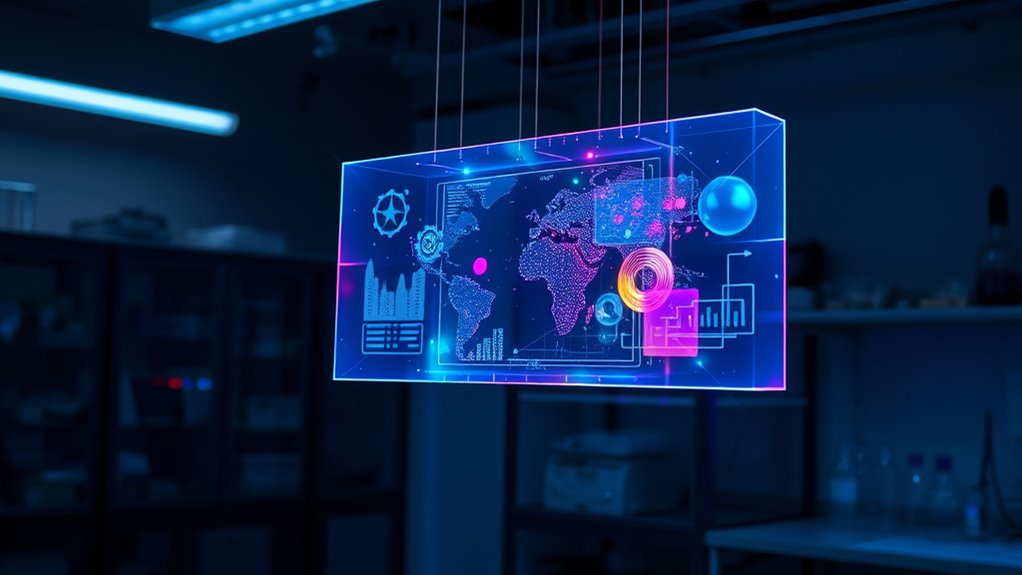

Imagine stepping into a future where images float effortlessly in space, blurring the line between digital and physical worlds. Holographic displays are finally breaking free from lab experiments, bringing this vision closer to reality. They use intricate light patterns and advanced optics to create three-dimensional visuals you can interact with. But how exactly do these technologies work, and what makes them so revolutionary? The answers might surprise you.

Get the latest gadgets delivered free — and shop member deals
- Fast, free delivery on millions of items
- Access to Prime Big Deal Days deals on October 6–7
- Prime Video, Amazon Music and more included
Key Takeaways
- Holographic displays create 3D images by manipulating light using techniques like laser interference and spatial light modulators.
- They produce floating, stable images visible without glasses, suitable for various environments including medical and entertainment settings.
- These displays enable real-time interaction, allowing users to manipulate, rotate, and zoom holograms naturally.
- Advances in optics and light encoding have transitioned holography from experimental labs to practical applications.
- The technology is expected to become widespread, transforming visualization, communication, and immersive experiences.

Have you ever imagined seeing three-dimensional images floating in the air without any screens or glasses? That’s the magic of holographic displays finally leaving the lab and heading into real-world applications. These displays create vivid, lifelike images that seem to hover in space, transforming how we visualize information. No longer confined to the domain of science fiction, holographic technology is advancing rapidly, thanks to breakthroughs in how light and data are manipulated. At the core of these innovations lies the ability to project complex, three-dimensional visuals that can be viewed from different angles, offering a more immersive experience than traditional screens. This capability is especially promising for fields like augmented reality, where blending digital images with the physical world enhances our interactions and understanding of data.
Holographic displays bring 3D images to life, transforming visualization and interaction without screens or glasses.
In medicine, holographic displays are making a significant impact, particularly in medical imaging. Imagine surgeons preparing for complex procedures with a three-dimensional hologram of a patient’s anatomy floating right above the operating table. These holograms provide a detailed view of organs, blood vessels, and other structures, all in real time. This allows for more precise planning and execution, potentially reducing risks and improving outcomes. Medical professionals can manipulate these images, rotating and zooming in on specific areas to get a better sense of spatial relationships. Such applications are transforming diagnostics, surgical planning, and even patient education, making complex medical data more accessible and understandable. Additionally, advances in projector technology are enabling these holograms to be rendered with increasing clarity and stability.
The technology behind holographic displays involves sophisticated techniques like laser interference, spatial light modulators, and advanced optics. These methods work together to encode and project light in a way that creates a convincing three-dimensional image visible to the naked eye. Unlike traditional 3D displays or virtual reality headsets, holographic displays don’t require glasses or headgear, making them more accessible and comfortable for everyday use. This advancement means that holograms can be integrated into various environments—business presentations, entertainment venues, medical facilities—without complicated equipment. The key is the ability to generate stable, high-quality images that can be interacted with naturally, opening up endless possibilities for communication, visualization, and learning.
As holographic displays continue to evolve, they promise to revolutionize how we see and interact with digital information. Whether it’s enhancing augmented reality experiences or revolutionizing medical imaging, these displays are poised to become a staple in both professional and personal settings. With ongoing innovation, holograms will soon be as common as screens are today, seamlessly blending digital and physical worlds in ways we’ve only just begun to imagine.
As an affiliate, we earn on qualifying purchases.
Conclusion
So, don’t worry if holographic displays seem complex—they’re actually becoming easier and more practical every day. As they move beyond labs into real-world use, you’ll soon experience stunning 3D images that you can interact with naturally. This technology isn’t just futuristic; it’s here to enhance how you work, play, and connect. Get ready to see your digital world come alive—no glasses needed, just pure immersion.
As an affiliate, we earn on qualifying purchases.
As an affiliate, we earn on qualifying purchases.
As an affiliate, we earn on qualifying purchases.
Fall Picks
fall essentials
As an affiliate, we earn on qualifying purchases.

![I 3D Printed Origami [video]](https://geeksalad.org/wp-content/uploads/2026/05/i-3d-printed-origami-video-featured-560x300.jpg)