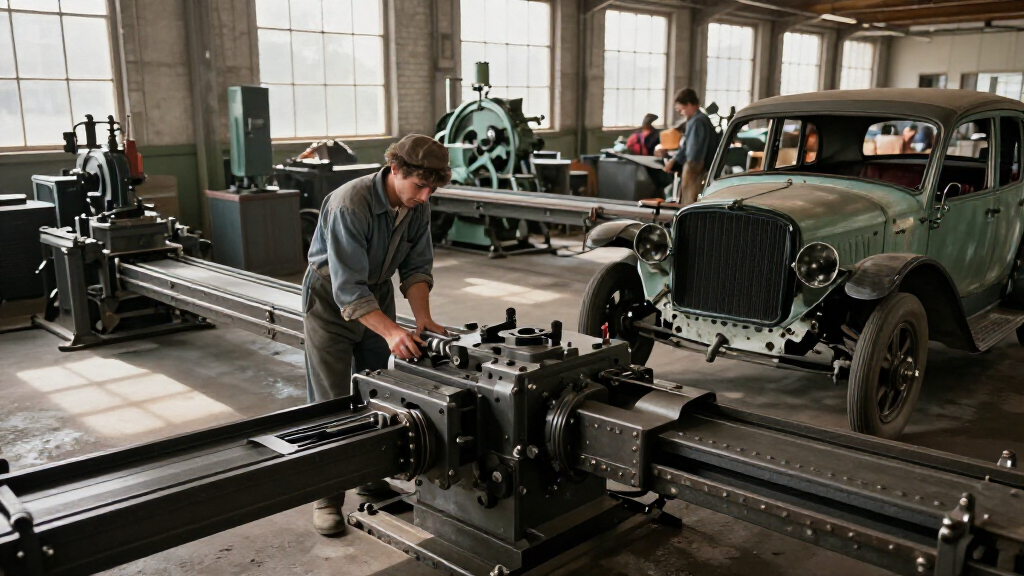
🔍 Read the full analysis: The Five-Dollar Day’s Place In The History Of The Assembly Line on ThorstenMeyerAI.com

Get the latest gadgets delivered free with Prime
- Fast, free delivery on millions of items
- Prime Video, Amazon Music and more included
- Member-only deals all year
TL;DR
Ford introduced its five-dollar minimum daily pay in January 1914, after assembly-line production sharply reduced the labor time needed to build a Model T chassis while the company faced high worker turnover. The figures and explanations come largely from Henry Ford’s account and later historical research; they show a response to a labor-retention problem, not proof that Ford raised wages so workers could buy its cars.
Ford Motor Co. introduced a five-dollar minimum daily wage and an eight-hour workday on January 5, 1914, after its Highland Park plant in Detroit struggled to retain workers as production shifted to the moving assembly line. The wage change followed a year in which Ford reportedly hired tens of thousands of people to maintain a much smaller average workforce, making the episode a landmark in the history of industrial work as well as car manufacturing.
The production shift was dramatic. Ford’s own figures, published in Henry Ford’s 1922 book My Life and Work, put the labor needed to assemble a Model T chassis at 12 hours and 28 minutes when the vehicle remained stationary. By early 1914, the moving line had reduced that figure to 1 hour and 33 minutes. The change cut labor time per chassis by about 88%, though Ford’s account is a company source rather than an independent audit.
The line developed through experiments. Ford wrote that the company first tried a moving assembly process on the flywheel magneto in April 1913. Dividing the task into separate operations and moving the part between workers cut the assembly time, according to his account. The approach was then adapted to the chassis: workers handled narrower tasks as the vehicle moved along the line. Ford described the aim as reducing “the necessity for thought on the part of the worker” and minimizing movements.
Production efficiency did not mean workforce stability. Figures gathered by economists Daniel Raff and Lawrence Summers for a 1987 study put Ford’s 1913 turnover at 370%: 50,448 hires were needed to maintain an average workforce of 13,623. Ford later said the company had been hiring at a rate of about 53,000 a year to keep roughly 14,000 workers. On January 5, 1914, Ford cut the working day from nine hours to eight and raised minimum daily pay from $2.34 to $5 through a profit-sharing plan with conditions. The reported turnover rate fell to 54% in 1914.
A Wage Policy to Keep Workers
The five-dollar day matters because it links a celebrated production innovation to a less celebrated management problem. The line made output faster by breaking jobs into repeated tasks, but Ford’s reported hiring figures show how costly it could be to keep those jobs staffed. The wage change was not simply a reward for higher productivity: it was also a way to reduce the expense and disruption of repeatedly recruiting and replacing workers.
The distinction matters for understanding the policy’s legacy. The familiar story that Ford raised wages chiefly so workers could afford to buy Ford cars is not supported by the account presented here. At the time, the company’s immediate challenge was workers leaving and missing shifts, while Ford was already producing cars at scale. The five-dollar day is therefore part of the history of both mass production and employer efforts to stabilize a workforce.
The assembly line also changed the character of industrial work. Ford’s description of workers performing narrowly divided tasks makes clear that the gains in speed came alongside tighter control over movement and pace. The episode is relevant today as factories increasingly use automation: production systems can change faster than the questions of who does the work, how jobs are organized and what workers are paid.
Products Worth Considering

DJI Mic 3 Wireless Microphone Kit (2 Transmitters, 1 Receiver, Charging Case)

Kindle Paperwhite Signature Edition 32GB (2024) – Auto-adjusting front light, wireless charging, weeks of battery life – Metallic Black

Jackery HomePower 3600 Plus Portable Power Station, 3584Wh, 3600W
As an affiliate, we earn on qualifying purchases.
From Magnetos to Model T Chassis
Before Ford’s moving line, workers assembled a car around a stationary chassis, bringing tools and parts to the vehicle. Ford’s account says the Highland Park plant’s best average for chassis assembly under that arrangement was 12 hours and 28 minutes of labor. The company began with a smaller component, the flywheel magneto, before applying the method to the full chassis.
Ford credited the general idea to overhead rails used by Chicago meatpackers, where carcasses moved past workers. The comparison helps explain the mechanical principle, but the assembly process at Ford was developed through factory trials rather than copied wholesale. The company’s reported magneto assembly time fell from about 20 minutes per unit to 13 minutes and 10 seconds after work was divided into 29 operations. Later adjustments reduced it further, according to Ford.
These numbers require source context. Ford’s production figures come from his 1922 account, while the turnover estimates cited here were assembled by Raff and Summers in a 1987 economic study using earlier labor research and company records. They are useful evidence of the scale of the changes, but the sources differ in date and purpose.
““the reduction of the necessity for thought on the part of the worker and the reduction of his movements to a minimum.””
— Henry Ford, in My Life and Work (1922)
Limits of the Historical Record
The figures do not settle every question about why workers left or what conditions they faced on the line. The source report says a March 1913 company survey found about 7,300 workers left that month; it categorizes 18% as fired, 11% as formal quits and 71% as “five-day men,” counted as having quit after five consecutive unexplained absences. Those categories reflect the company’s records and definitions, not a complete account of each worker’s reasons.
There is also a small difference between estimates: Raff and Summers’ study reports 370% turnover for 1913, while the Henry Ford museum gives about 380%. Ford’s own later account uses a hiring rate of about 53,000 to sustain a workforce of 14,000. The exact rate depends on the source and calculation. The available material also does not fully specify every condition attached to the profit-sharing plan or establish how many workers qualified for the full five-dollar payment.
How the Story Is Reassessed
The historical account is best read alongside its underlying sources: Ford’s 1922 book for the company’s production narrative, contemporary labor records for turnover, and Raff and Summers’ 1987 study for an economic analysis of the wage policy. Comparing those records helps distinguish Ford’s stated rationale and measurements from later interpretation.
No new policy announcement or developing event is described in the source material. The next step for readers seeking a fuller account is to examine how the five-dollar plan’s eligibility rules worked in practice and how workers themselves described line work, pay and turnover. The figures establish the broad sequence—production changes, labor instability, then higher pay—but do not capture every worker’s experience.
Key Questions
When did Ford introduce the five-dollar day?
Ford announced the policy on January 5, 1914, alongside a reduction of the working day from nine hours to eight. The five-dollar minimum was offered through a profit-sharing plan with conditions.
How much faster did the moving line make chassis assembly?
According to Henry Ford’s 1922 account, labor time per Model T chassis fell from 12 hours and 28 minutes with the chassis stationary to 1 hour and 33 minutes on the moving line by early 1914. These are company-reported figures.
Why did Ford raise wages?
The account points to severe worker turnover and absenteeism as central problems. A widely repeated explanation—that Ford raised pay mainly so employees could buy his cars—is not established by the evidence presented here.
What does the 370% turnover figure mean?
It is the 1913 turnover rate reported in a 1987 study by Daniel Raff and Lawrence Summers. Their figures say Ford hired 50,448 people to maintain an average workforce of 13,623; the percentage is a turnover measure, not the share of workers who left at one time.
Are all the historical figures independently verified?
No single source establishes every figure. Ford’s production measurements come from his 1922 account, while later labor researchers compiled turnover estimates from earlier studies and company records. The Henry Ford museum reports a slightly different turnover estimate, about 380%.
Source: ThorstenMeyerAI.com