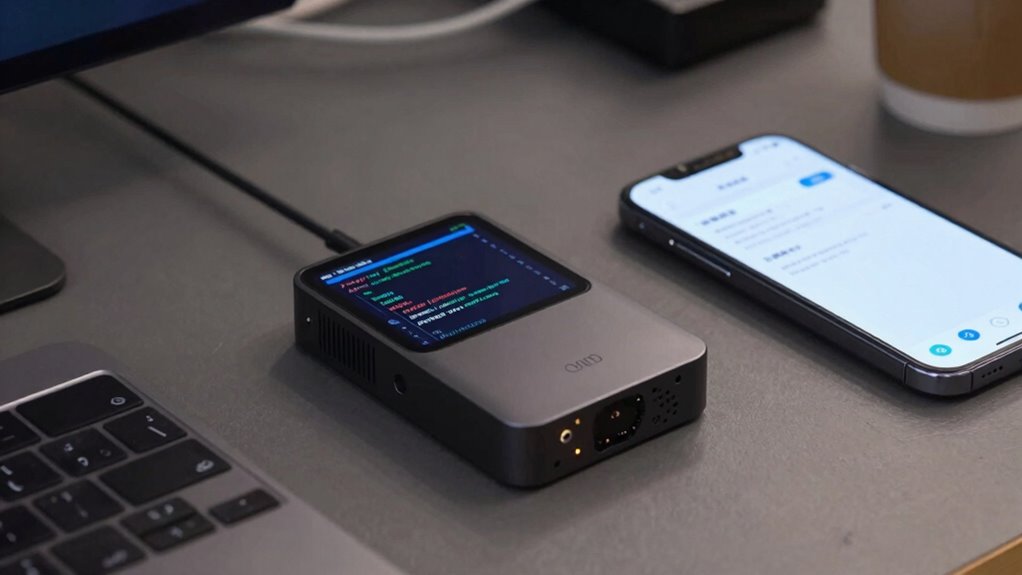

Small language models matter for edge devices because they let you access AI features directly on your smartphones, wearables, or home gadgets without needing internet or cloud support. They’re lightweight, energy-efficient, and designed for local use, which means your data stays private and secure. Plus, they personalize interactions to fit your routines, making technology more intuitive. Keep exploring to discover how these models are transforming everyday experiences and boosting privacy, efficiency, and personalization.

Get the latest gadgets delivered free — and shop member deals
- Fast, free delivery on millions of items
- Access to Prime Big Deal Days deals on October 6–7
- Prime Video, Amazon Music and more included
Key Takeaways
- Enable deployment on resource-constrained devices like smartphones and wearables, eliminating reliance on cloud computing.
- Enhance user privacy by processing data locally, reducing exposure and transmission risks.
- Improve energy efficiency, extending battery life for portable, always-on devices.
- Facilitate personalized, context-aware interactions tailored to individual user preferences.
- Promote broader AI accessibility and innovation through on-device processing and model compression techniques.

As edge devices become more prevalent, deploying large language models locally often isn’t practical due to their size and resource demands. These models require considerable computational power, vast storage, and high energy consumption, which most edge devices simply can’t handle. That’s where small language models come into play, offering a smarter, more efficient solution. They’re designed to be lightweight, enabling deployment directly on devices like smartphones, wearables, or home automation systems. This shift makes it possible for you to access AI-driven features without relying on constant internet connectivity or cloud-based processing.
One of the key advantages of small language models is their ability to deliver personalized experiences. Because they run locally, they can learn your preferences, habits, and routines over time, adapting responses to suit your specific needs. This personalization benefits you by providing more relevant suggestions, smarter notifications, and tailored interactions that feel natural and intuitive. Instead of generic responses generated by a distant server, small models can interpret your unique context, making your interactions more meaningful and efficient. This local customization also means your data stays on your device, reducing the need to transmit sensitive information over the internet.
Privacy enhancements are another critical reason why small language models matter. When data stays on your device, the risk of exposure or misuse diminishes considerably. You don’t have to worry about third parties accessing your personal conversations or sensitive details stored in the cloud. This is especially important in today’s privacy-conscious world, where data breaches and misuse are common concerns. Small models empower you to retain control over your information, fostering trust and confidence in your devices. Plus, since these models process data locally, they can operate faster, with lower latency, ensuring your commands and queries are handled swiftly. Additionally, advancements in model compression techniques are helping to further optimize small models, making them even more suitable for resource-constrained environments.
Moreover, small language models contribute to energy efficiency, which is essential for battery-powered devices. They consume less power than their larger counterparts, prolonging device usability without frequent recharging. This is especially important considering the computational demands of large models and the need for energy-efficient solutions. They enable you to enjoy smarter, more responsive technology throughout your day without sacrificing battery life. Furthermore, ongoing research into hardware optimization is making these models increasingly capable of running efficiently on a variety of devices. In essence, small language models are transforming the way edge devices connect with you. They make AI more accessible, personal, and secure, all while reducing reliance on cloud infrastructure. By enabling on-device processing, they open up new possibilities for privacy, personalization benefits, and energy efficiency, ultimately making your interactions with technology more seamless and tailored to your needs.
small language models for smartphones
As an affiliate, we earn on qualifying purchases.
As an affiliate, we earn on qualifying purchases.
Frequently Asked Questions
How Do Small Language Models Compare in Accuracy to Larger Models?
Small language models generally have lower accuracy compared to larger models because of the model size and the accuracy trade offs involved. However, they are designed to perform well within their scope, offering faster responses and lower resource consumption. You can often find a good balance between size and accuracy, making them suitable for edge devices. While they may not match big models in complexity, they excel in efficiency and practicality.
What Are the Main Technical Challenges in Deploying Small Models?
Deploying small models is like fitting a spaceship into a bottle—you face big technical hurdles. You struggle with model compression, which shrinks the model without losing accuracy, and latency optimization, ensuring quick responses. Balancing these elements is tough because reducing size can hurt performance, and speeding up responses can compromise quality. Overcoming these challenges requires clever techniques and careful tuning to make small models both efficient and effective on edge devices.
Can Small Models Learn From New Data on Edge Devices?
Yes, small models can learn from new data on edge devices through model adaptation techniques. You can update the model using edge data locally, which helps it stay current without relying on cloud connections. This process allows your device to adapt to new information quickly, improving accuracy and personalization. Keep in mind, however, that limited resources on edge devices may require efficient algorithms to perform effective model adaptation.
How Secure Are Small Language Models Against Privacy Breaches?
Small language models offer better privacy protection because they process data locally, reducing exposure to privacy concerns. However, they’re not entirely immune to breaches, especially if sensitive data isn’t properly encrypted. Implementing data encryption during storage and transmission strengthens security. While small models limit data sharing, you should still stay vigilant, regularly update security protocols, and consider additional privacy measures to safeguard against potential breaches.
What Industries Benefit Most From Small Language Models?
You’ll find industries like healthcare, retail, and manufacturing benefit most from small language models. Their customization flexibility allows these sectors to tailor solutions to specific needs, while resource efficiency means they don’t require extensive computing power. This enables real-time insights and improved customer interactions without hefty infrastructure costs. By adopting small language models, these industries can enhance operations and innovate more quickly, all within their resource constraints.
As an affiliate, we earn on qualifying purchases.
Conclusion
You might be surprised to learn that small language models can run efficiently on edge devices, reducing latency and preserving privacy. In fact, these tiny models often require up to 90% less power than their larger counterparts, making them ideal for everyday applications. By embracing small language models, you can enjoy faster, more secure, and energy-efficient experiences right at your fingertips. So, next time you use a smart device, remember how much these compact models are revolutionizing your tech.
As an affiliate, we earn on qualifying purchases.
As an affiliate, we earn on qualifying purchases.
Fall Picks
fall essentials
As an affiliate, we earn on qualifying purchases.