Smart home projectors combine a big-screen image with built-in streaming, wireless connections, and setup features such as autofocus. My best overall pick is the X9 PRO 4K Smart Projector, which pairs VIDAA OS with a stated 920 ISO ANSI lumens and AI autofocus. The HAPPRUN Native 1080P with Google TV stands out for a familiar streaming interface, while the Aurzen D1R Air suits buyers who value USB-C power and portability. The main tradeoffs are brightness, native resolution, built-in app support, and how easily a projector adapts to different rooms. Read on for the full breakdown of all 15 options and guidance on choosing the right match.

Get the latest gadgets delivered free with Prime
- Fast, free delivery on millions of items
- Prime Video, Amazon Music and more included
- Member-only deals all year
Complete the kit



Key Takeaways
- The X9 PRO leads on the listed feature mix: its stated 920 ISO ANSI lumens, VIDAA OS, and AI autofocus make it the most balanced pick for buyers who want a smart home cinema setup without relying only on a separate streaming stick.
- Streaming platforms separate several close contenders: the HAPPRUN Google TV model and Roku-equipped Aurzen and HAPPRUN models prioritize familiar app interfaces, while VIDAA options emphasize their own built-in platform.
- Rotating stands recur across the lineup: the VIDAA Smart Projector, XuanPad, and Pemoon offer different stand ranges, making flexible aiming a standout convenience for renters and multi-room use.
- Portability has more than one meaning: the Aurzen D1R Air adds USB-C power, while compact Roku and mini models focus on portable form factors; buyers should check power needs as well as size.
- Native 1080p is not the same as 4K decoding: several models list native 1080p alongside 4K decoding or compatibility, so buyers seeking finer detail should distinguish input support from the projector’s actual display resolution.
| VIDAA Smart Projector with 4K Decoding, Native 1080p, Wi-Fi 6, Dolby Audio, Auto Focus, and Rotatable Stand |  | Best All-in-One Smart Setup | Operating system: VIDAA Smart OS | Streaming: Netflix, YouTube, Prime Video, Disney+, Hulu; 1,000+ live TV channels | Resolution: Native 1080p; 4K decoding | VIEW LATEST PRICE | See Our Full Breakdown |
| Auking Roku TV Smart Mini Projector with WiFi and Bluetooth |  | Best for Roku-First Beginners | Operating system: Roku TV | Display technology: LCD | Resolution: Listed as “High Resolution”; pixel count not specified | VIEW LATEST PRICE | See Our Full Breakdown |
| X9 PRO 4K Smart Projector with VIDAA OS, 920 ISO ANSI Lumens, Dolby Audio, and AI Auto Focus |  | Best for Apple Smart-Home Integration | Operating system: VIDAA OS | Resolution: Native 1080p with 4K decoding | Brightness: 920 ISO ANSI lumens | VIEW LATEST PRICE | See Our Full Breakdown |
| Aurzen D1R Portable 1080p Roku Projector |  | Best for Voice-Assistant Compatibility | Operating system: Roku | Resolution: Native and maximum 1920 × 1080 | Screen size: 40–150 inches | VIEW LATEST PRICE | See Our Full Breakdown |
| HAPPRUN H1 Native 1080p Portable Projector with Bluetooth 5.3 |  | Best for Simple Device-Based Setups | Display technology: LCD | Native resolution: 1920 × 1080 | Brightness: 300 ANSI lumens | VIEW LATEST PRICE | See Our Full Breakdown |
| NexAurea 4K Smart Projector with VIDAA Live TV |  | Best for Built-In TV and Family Viewing | Native resolution: 1920 × 1080 | Maximum white brightness: 700 ANSI lumens | Display type: LCD | VIEW LATEST PRICE | See Our Full Breakdown |
| Smart Outdoor Projector with Built-In Apps, 180° Gimbal, and Dolby Audio |  | Best for Flexible Placement | Native resolution: 1920 × 1080 | Maximum display resolution: 3840 × 2160 pixels | Display type: LCD | VIEW LATEST PRICE | See Our Full Breakdown |
| XuanPad Mini Smart Projector with Wi-Fi 6, Bluetooth 5.2, Native 1080p, Dolby Audio, and 210° Rotating Stand |  | Best Compact Projector | Native resolution: 1920 × 1080 | Display type: LCD | Connectivity: Wi-Fi 6, Bluetooth 5.2, HDMI, USB, 3.5mm audio | VIEW LATEST PRICE | See Our Full Breakdown |
| ELEPHAS Roku Smart Projector with Wi-Fi and Bluetooth |  | Best for Roku Users on a Tight Setup | Native resolution: 1280 × 720 | Brightness: 150 ANSI lumens | Display type: LCD | VIEW LATEST PRICE | See Our Full Breakdown |
| HAPPRUN Native 1080P Bluetooth Projector with Official Licensed Google TV |  | Best for Google TV Streaming | Native resolution: 1920 × 1080 | Maximum supported resolution: 4K decoding | Brightness: 400 ANSI lumens | VIEW LATEST PRICE | See Our Full Breakdown |
| Aurzen Roku TV D1R Air Portable Projector with USB-C Power |  | Best for Portable Roku Viewing | Native resolution: 1080p | Brightness: 300 ANSI lumens | Built-in audio: Dual 5W speakers with Dolby Audio | VIEW LATEST PRICE | See Our Full Breakdown |
| Portable Mini Projector with Wi-Fi 6, Bluetooth 5.4, and Auto Keystone |  | Best for Lightweight Flexible Placement | Native resolution: 1280 × 720 | Maximum image size: 100 in | Brightness: 300 ANSI lumens | VIEW LATEST PRICE | See Our Full Breakdown |
| HAPPRUN Roku TV Smart Mini Projector with WiFi and Bluetooth for Portable |  | Best for Roku and Smart-Home Voice Control | Display type: LCD | Maximum display resolution: HD; pixel resolution not specified | Contrast ratio: 1800:1 | VIEW LATEST PRICE | See Our Full Breakdown |
| Pemoon Smart 1080p Projector with Google TV Stick, Wi-Fi 6, Bluetooth 5.2, Auto Focus and 360° Rotating Stand |  | Best for Brighter, Flexible Home Setups | Native resolution: 1920 × 1080 | 4K support: Decoding | Brightness: 3000 ANSI lumens | VIEW LATEST PRICE | See Our Full Breakdown |
| YGSKK Mini Projector with Wi-Fi 6, Bluetooth 5.3, and Built-In Apps |  | Best for Remote Electric Focus | Resolution: Native 1080p; compatible with 4K input via HDMI | Brightness: 300 ANSI lumens | Image size: 50–200 in | VIEW LATEST PRICE | See Our Full Breakdown |
| smart home projector | Brightness | Native resolution |
|---|---|---|
| VIDAA Smart Projector with 4K | — | — |
| Auking Roku TV Smart Mini Proj | 200 ANSI lumens | — |
| X9 PRO 4K Smart Projector with | 920 ISO ANSI lumens | — |
| Aurzen D1R Portable 1080p Roku | — | — |
| HAPPRUN H1 Native 1080p Portab | 300 ANSI lumens | 1920 × 1080 |
| NexAurea 4K Smart Projector wi | — | 1920 × 1080 |
| Smart Outdoor Projector with B | — | 1920 × 1080 |
| XuanPad Mini Smart Projector w | — | 1920 × 1080 |
| ELEPHAS Roku Smart Projector w | 150 ANSI lumens | 1280 × 720 |
| HAPPRUN Native 1080P Bluetooth | 400 ANSI lumens | 1920 × 1080 |
| Aurzen Roku TV D1R Air Portabl | 300 ANSI lumens | 1080p |
| Portable Mini Projector with W | 300 ANSI lumens | 1280 × 720 |
| HAPPRUN Roku TV Smart Mini Pro | — | — |
| Pemoon Smart 1080p Projector w | 3000 ANSI lumens | 1920 × 1080 |
| YGSKK Mini Projector with Wi-F | 300 ANSI lumens | — |
More Details on Our Top Picks
VIDAA Smart Projector with 4K Decoding, Native 1080p, Wi-Fi 6, Dolby Audio, Auto Focus, and Rotatable Stand
For buyers who want streaming, setup assistance, and sound in one unit, this projector is the most self-contained option in this group. Its VIDAA Smart OS includes major streaming apps and more than 1,000 live TV channels, while auto focus, keystone correction, obstacle avoidance, and screen fit reduce manual adjustments when moving it between rooms. The rotatable stand adds placement flexibility that the more basic HAPPRUN H1 lacks, and its 40W Dolby Audio speakers offer more built-in sound output than the Aurzen D1R’s dual 5W speakers. The tradeoff is that 4K refers to decoding, not native display resolution: the image is 1080p. It also needs about 2.2 m to project a 100-inch image, so it is less suited to very tight spaces.
Pros:- VIDAA includes major streaming apps and more than 1,000 live TV channels.
- Auto focus, keystone correction, obstacle avoidance, and screen fit simplify setup.
- 40W speakers with Dolby Audio reduce the need for separate speakers.
- Rotatable built-in stand and AirPlay 2 and Miracast casting support flexible viewing.
Cons:- Native resolution is 1080p; 4K content is decoded rather than displayed natively.
- A 100-inch image requires about 2.2 m of projection distance.
Best for: Households that want built-in streaming, strong onboard audio, and automated setup without adding a streaming box or speakers.
Not ideal for: Buyers who need native 4K projection or a large image from a very short distance.
- Operating system:VIDAA Smart OS
- Streaming:Netflix, YouTube, Prime Video, Disney+, Hulu; 1,000+ live TV channels
- Resolution:Native 1080p; 4K decoding
- HDR:HDR10
- Wireless:Wi-Fi 6; Bluetooth 5.2
- Audio:40W speakers with Dolby Audio
- Throw and image size:1.0:1 throw ratio; 100 inches from 2.2 m
- Setup and stand:Auto focus, auto keystone, obstacle avoidance, auto screen fit; 360° rotatable gimbal stand
Our verdict“Choose this if you want a self-contained smart projector with flexible placement and strong built-in sound, but not if native 4K is a requirement.”
Auking Roku TV Smart Mini Projector with WiFi and Bluetooth
This Auking makes the most sense for buyers who want a familiar streaming interface and a compact setup, not for viewers chasing a bright, highly detailed picture. Built-in Roku TV gives direct access to streaming apps without a separate stick, and dual-band Wi-Fi, Bluetooth 5.2, HDMI, and USB leave room for other devices. Its 26 dB noise level is a practical plus in a small bedroom, where fan sound can distract during quiet scenes. Compared with the VIDAA projector, though, setup is less hands-off: this model uses manual focus and does not list the same range of automatic image adjustments. The 200 ANSI-lumen brightness also makes it better suited to a darkened room than a bright living space, and its resolution is described only as “High Resolution,” without a specific pixel count.
Pros:- Built-in Roku TV provides streaming access without a separate streaming device.
- Quiet listed operation at 26 dB suits bedrooms and low-volume viewing.
- Dual-band Wi-Fi, Bluetooth 5.2, HDMI, USB, and 3.5mm audio offer flexible connections.
- Dust-proof filter and compact design support portable use.
Cons:- Brightness is 200 ANSI lumens, limiting use in rooms with substantial ambient light.
- Manual focus requires user adjustment rather than automatic setup.
- The listed resolution is only “High Resolution,” with no specific pixel count.
Best for: Roku users setting up a compact projector in a bedroom or darkened room who value simple app access and quiet operation.
Not ideal for: Buyers who need a clearly specified native resolution, bright-room viewing, or autofocus for frequent repositioning.
- Operating system:Roku TV
- Display technology:LCD
- Resolution:Listed as “High Resolution”; pixel count not specified
- Brightness:200 ANSI lumens
- Image size:40–120 inches
- Throw distance:3.6–8 feet
- Wireless and ports:2.4G/5G Wi-Fi, Bluetooth 5.2, HDMI, USB, 3.5mm audio
- Audio and noise:Dual Dolby Audio speakers; 26 dB listed noise level
Our verdict“Pick this for quiet, Roku-based viewing in a dark room, but choose a brighter, more clearly specified model for a main living-room setup.”
X9 PRO 4K Smart Projector with VIDAA OS, 920 ISO ANSI Lumens, Dolby Audio, and AI Auto Focus
The X9 PRO is the strongest fit here for Apple households that want projector controls and casting to sit alongside their smart-home setup. It pairs AirPlay 2 and HomeKit with VIDAA streaming apps and more than 1,000 live TV channels, giving it a more connected role than the Roku-based Auking or Aurzen D1R. At 920 ISO ANSI lumens, it also offers a stated brightness level that makes it a more capable choice for dim rooms than the Auking’s 200 ANSI lumens, though neither spec guarantees satisfying performance in a bright room. AI autofocus, 6D keystone correction, and obstacle avoidance help when the projector’s position changes. The main limitation is resolution: this is native 1080p with 4K decoding, not native 4K, and its sizable built-in speakers add less value if you already use a sound system.
Pros:- AirPlay 2 and HomeKit add useful Apple smart-home and casting support.
- VIDAA includes streaming apps and more than 1,000 live TV channels.
- AI autofocus, 6D keystone correction, and obstacle avoidance ease placement changes.
- Dual 20W Dolby Audio speakers provide 40W total listed speaker output.
Cons:- Native resolution is 1080p; 4K is handled through decoding.
- The listed 920 ISO ANSI lumens may not suit bright-room viewing.
- Built-in speaker output may matter less to buyers who already use an external audio system.
Best for: Apple households that want AirPlay 2 and HomeKit alongside built-in streaming, automated image setup, and substantial onboard audio.
Not ideal for: Buyers who require native 4K display or plan to watch in a brightly lit room.
- Operating system:VIDAA OS
- Resolution:Native 1080p with 4K decoding
- Brightness:920 ISO ANSI lumens
- HDR and color:HDR10; 130% NTSC color gamut
- Wireless:Wi-Fi 6; Bluetooth 5.4
- Smart-home and casting:AirPlay 2 and HomeKit
- Audio:Two 20W speakers with Dolby Audio
- Connections and setup:HDMI with ARC/CEC, USB, 3.5mm jack; AI autofocus and 6D keystone
Our verdict“Choose the X9 PRO for Apple-oriented smart-home features and automated setup, provided native 4K and bright-room performance are not your priorities.”
Aurzen D1R Portable 1080p Roku Projector
Among these five, the Aurzen D1R stands out for connecting a portable projector to several major smart-home ecosystems: it lists compatibility with Apple HomeKit, Siri, Alexa, and Google Assistant. That makes it a more flexible household fit than the Apple-focused X9 PRO, while built-in Roku streaming gives it a straightforward route to apps without a separate streaming stick. Its native 1080p resolution is clearly specified, unlike the Auking’s generic “High Resolution” listing, and autofocus plus keystone correction helps when setting up on a tabletop or stand. The compromises are practical: the dual 5W speakers are modest beside the VIDAA models’ 40W systems, Roku activation requires an account and internet access, and the fan is audible during use. It also needs clearance around the body, which can limit cramped placements.
Pros:- Lists compatibility with HomeKit, Siri, Alexa, and Google Assistant.
- Built-in Roku provides streaming access without a separate streaming stick.
- Native 1080p resolution and a screen range up to 150 inches.
- Autofocus, auto keystone, dual-band Wi-Fi, Bluetooth 5.2, and AirPlay support flexible setup.
Cons:- Dual 5W speakers provide less listed output than the 40W VIDAA projectors.
- Roku activation requires an account and an internet connection.
- The cooling fan produces audible sound, and the projector needs clearance around its sides and rear.
Best for: Households using mixed voice-assistant platforms that want Roku streaming and a portable, native-1080p projector.
Not ideal for: Buyers who need powerful built-in audio, silent operation, or a projector that can sit close against furniture or a wall.
- Operating system:Roku
- Resolution:Native and maximum 1920 × 1080
- Screen size:40–150 inches
- Throw distance:3.71–18.58 feet
- Wireless:Dual-band Wi-Fi; Bluetooth 5.2; AirPlay
- Smart-home compatibility:Apple HomeKit, Siri, Alexa, and Google Assistant
- Audio:Dual 5W speakers
- Weight and setup:2.1 kg; autofocus and auto keystone correction
Our verdict“Choose the D1R if broad voice-assistant compatibility and portable Roku streaming matter more than quiet operation or robust built-in sound.”
HAPPRUN H1 Native 1080p Portable Projector with Bluetooth 5.3
The HAPPRUN H1 is the straightforward choice for buyers who already have a laptop, console, or streaming device and do not need a projector operating system. Its native 1080p resolution is clearly stated, and the listed image range reaches 200 inches, larger than the Aurzen D1R’s stated 150-inch maximum. Bluetooth 5.3 lets it send audio to compatible speakers or headphones, but it does not cast video; streaming still depends on a connected device, and phone playback can run into adapter or HDCP restrictions. That makes it less convenient for an all-in-one smart-home setup than the VIDAA models or either Roku projector. The listed 300 ANSI lumens also favor darkened spaces, while its simple desktop, tripod, or ceiling-mount options suit buyers willing to handle placement themselves.
Pros:- Native 1920 × 1080 resolution is specified.
- Supports image sizes from 40 to 200 inches.
- Bluetooth 5.3 can send audio to compatible speakers or headphones.
- Offers desktop, tripod, and ceiling-mount placement options.
Cons:- A streaming stick or other video source must be supplied separately.
- Bluetooth supports audio output, not video casting.
- Listed brightness of 300 ANSI lumens suits darkened rooms better than bright spaces.
Best for: Buyers with an HDMI streaming device, laptop, or game console who want native 1080p and a large image without built-in smart TV software.
Not ideal for: People who want built-in streaming apps, automatic wireless video casting, or brighter-room viewing without extra devices.
- Display technology:LCD
- Native resolution:1920 × 1080
- Brightness:300 ANSI lumens
- Image size:40–200 inches
- Throw distance:1.2–7 m
- Connectivity:HDMI, USB, 3.5mm jack, Bluetooth, IR
- Bluetooth:Version 5.3; audio output
- Mounting:Desktop, tripod, or ceiling mount
Our verdict“Pick the H1 if you already have a video source and want a large native-1080p image, but choose a Roku or VIDAA model for built-in streaming and easier smart-home use.”
NexAurea 4K Smart Projector with VIDAA Live TV
The NexAurea is the strongest fit here for households that want a projector to behave more like a connected TV. Its VIDAA interface, live TV channels, and built-in streaming apps reduce reliance on an external stick, while AirPlay and Wi-Fi 6 add flexible ways to send content. Compared with the HAPPRUN Google TV projector, it emphasizes live TV and family controls; the HAPPRUN instead offers a familiar Google TV platform. Automatic focus, 6D keystone, screen fit, and obstacle avoidance make changing rooms or setting up outdoors less fiddly. Its native resolution is 1080p, not 4K, despite 4K decoding, and the stated 700 ANSI lumens still call for a dim room. The large built-in speakers are convenient, but a compatible sound system remains an option through eARC.
Pros:- VIDAA includes streaming apps and live TV channels without a separate streaming stick.
- Auto focus, 6D keystone, screen fit, and obstacle avoidance simplify placement.
- AirPlay, Wi-Fi 6, Bluetooth 5.4, and HDMI eARC give flexible connection options.
- Dual 40W speakers and family controls support shared home viewing.
Cons:- Native resolution is 1080p; 4K refers to decoding support.
- 700 ANSI lumens are better suited to dim rooms than daylight viewing.
- The large speaker output and extensive smart features do not replace the need for a dim viewing space.
Best for: Families who want built-in streaming, live TV, parental controls, and automatic setup for dim-room movie nights.
Not ideal for: Buyers who need true 4K resolution or a bright picture for daytime outdoor viewing.
- Native resolution:1920 × 1080
- Maximum white brightness:700 ANSI lumens
- Display type:LCD
- Smart platform:VIDAA OS
- Connectivity:Wi-Fi 6, Bluetooth 5.4, HDMI, USB, VGA
- Audio:Dual 40W speakers; Dolby Audio and DTS:X support
- Image size:30–300 inches
- Focus and alignment:Auto focus, 6D keystone, auto screen fit, obstacle avoidance
Our verdict“Choose the NexAurea if built-in live TV, family features, and convenient setup matter more than native 4K or bright-room performance.”
Smart Outdoor Projector with Built-In Apps, 180° Gimbal, and Dolby Audio
The standout here is the 180° gimbal: it lets me aim the picture toward a wall or ceiling without balancing the projector on a stack of books or buying a separate mount. That flexibility makes this a particularly practical pick for bedrooms and temporary outdoor setups. Automatic focus, 6D keystone, obstacle avoidance, and screen alignment help when the projector is moved between spots. Compared with the XuanPad Mini, this model has a less dramatic 180° range, but adds an included screen and eARC for a more adaptable home-theater setup. Built-in apps and Wi-Fi 6 support streaming without an extra device, though outdoor use still needs power, and some services or casting functions have compatibility limits. Its portable LCD design is convenient, but the listing does not provide brightness, so I would not choose it for a sunlit space.
Pros:- 180° gimbal makes wall and ceiling projection easier without extra mounting hardware.
- Automatic focus, keystone correction, obstacle avoidance, and screen alignment reduce setup work.
- Built-in apps, Wi-Fi 6, Bluetooth 5.4, and eARC support flexible streaming and audio.
- Included projection screen and stated long-term support add setup and service options.
Cons:- Outdoor use requires access to mains power.
- Brightness is not specified in the supplied product information.
- Casting and some streaming services may have device or content restrictions.
Best for: Renters and bedroom viewers who want to project onto a wall or ceiling and frequently reposition their setup.
Not ideal for: Buyers seeking a documented brightness level for daylight use or a projector that works outdoors without a power outlet.
- Native resolution:1920 × 1080
- Maximum display resolution:3840 × 2160 pixels
- Display type:LCD
- Weight:3.14 lb
- Dimensions:9.19 × 7.87 × 3.07 inches
- Gimbal:180°
- Connectivity:Wi-Fi 6, Bluetooth 5.4, eARC
- Setup features:Auto focus, auto 6D keystone, obstacle avoidance, screen alignment
- Included:Projection screen
Our verdict“Pick this model if a tilting gimbal and quick repositioning are more useful to you than a published brightness rating.”
XuanPad Mini Smart Projector with Wi-Fi 6, Bluetooth 5.2, Native 1080p, Dolby Audio, and 210° Rotating Stand
The XuanPad is the most placement-flexible compact option in this group. Its 210° rotating stand supports unusual angles, including ceiling projection, while the 1.76-pound body is easier to move from a bedroom to a trip than the larger NexAurea. Native 1080p and a preinstalled Netflix app give it a more complete starting point than the ELEPHAS Roku projector, whose native resolution is 720p. Autofocus, auto keystone, obstacle avoidance, and screen-fit alignment also cut down on manual adjustments. The tradeoff is scale: its image tops out at 150 inches, half the NexAurea’s stated maximum, and the product data does not establish how well its brightness holds up in ambient light. I’d treat it as a portable, dim-room projector rather than a substitute for a large, bright living-room display.
Pros:- Compact 1.76-pound design is easy to move between rooms.
- 210° rotating stand supports flexible tabletop, wall, and ceiling positioning.
- Native 1080p and preinstalled Netflix provide a straightforward smart viewing setup.
- Autofocus, auto keystone, obstacle avoidance, and screen fit help with quick placement.
Cons:- Maximum stated image size is 150 inches, smaller than the NexAurea’s 300-inch claim.
- Brightness is not listed in the supplied specifications, making ambient-light performance hard to judge.
- Bluetooth 5.2 is an older version than the Bluetooth 5.4 support listed for the gimbal projector.
Best for: People who want a small 1080p projector for bedrooms, travel, or ceiling viewing and value flexible placement.
Not ideal for: Buyers who want a very large image, a fixed bright-room setup, or a documented brightness figure.
- Native resolution:1920 × 1080
- Display type:LCD
- Connectivity:Wi-Fi 6, Bluetooth 5.2, HDMI, USB, 3.5mm audio
- Stand rotation:210°
- Weight:1.76 lb
- Dimensions:4.6 × 4.72 × 6.69 inches
- Maximum image size:150 inches
- Focus and correction:TOF autofocus, auto keystone, obstacle avoidance, screen-fit alignment
- Zoom:50–100%
Our verdict“Choose the XuanPad if portability and a rotating stand matter more than projecting beyond 150 inches.”
ELEPHAS Roku Smart Projector with Wi-Fi and Bluetooth
The ELEPHAS makes the most sense for someone who already likes Roku’s interface and wants streaming built into a small home projector. Roku apps, free channels, AirPlay, and compatible voice controls give it a familiar connected-TV feel without an external player. Against the HAPPRUN Google TV projector, though, the ELEPHAS gives up sharpness and brightness: it is native 720p and rated at just 150 ANSI lumens, while the HAPPRUN is native 1080p with 400 ANSI lumens. That puts the ELEPHAS firmly in the dim-room category, especially as image size grows. Manual focus also asks for more adjustment than the autofocus systems on the NexAurea and XuanPad. Its flexible mounting and wireless options are useful, but the lower-resolution picture is the key compromise to accept.
Pros:- Built-in Roku provides streaming apps and free channels without a separate player.
- AirPlay and compatible Siri, Alexa, and Google Assistant voice controls add convenient ways to operate it.
- Dual-band Wi-Fi and Bluetooth 5.2 support wireless connections.
- Multiple mounting options allow tabletop, floor, foldable-stand, or ceiling placement.
Cons:- Native 720p resolution is lower than the 1080p HAPPRUN and XuanPad models.
- 150 ANSI lumens limit it to dark viewing conditions.
- Manual focus requires adjustment, unlike the automatic focus on several alternatives.
Best for: Roku households seeking a simple streaming projector for a small, dark bedroom or occasional indoor viewing.
Not ideal for: Movie fans who want native 1080p, a large picture with more brightness, or hands-off automatic focus.
- Native resolution:1280 × 720
- Brightness:150 ANSI lumens
- Display type:LCD
- Maximum image size:150 inches
- Contrast ratio:1000:1
- Connectivity:Dual-band Wi-Fi, Bluetooth 5.2, HDMI, USB, 3.5mm jack
- Audio:Built-in speaker with Dolby Audio
- Throw distance:3.35–12.53 feet
- Focus:Manual focus
Our verdict“Pick the ELEPHAS only if Roku convenience outweighs its modest 720p resolution and low brightness.”
HAPPRUN Native 1080P Bluetooth Projector with Official Licensed Google TV
For buyers who want a mainstream smart-TV interface on a projector, the HAPPRUN’s officially licensed Google TV is its clearest advantage. It gives direct access to supported apps such as Netflix and YouTube, with voice assistance and Wi-Fi 6 built in. The ELEPHAS Roku projector is a simpler alternative for Roku users, but its 720p resolution and 150 ANSI lumens are lower than this HAPPRUN’s 1080p and 400 ANSI lumens. That said, 400 ANSI lumens still suit dim rooms better than daylight, and the 5W speaker may need help in an open backyard. The HAPPRUN decodes 4K content but displays at native 1080p, so it is not a true 4K projector. Its broad mounting options make it easier to fit into different home layouts.
Pros:- Official Google TV provides direct access to supported streaming apps without an external stick.
- Native 1080p resolution is sharper than the ELEPHAS projector’s 720p image.
- Wi-Fi 6, Bluetooth 5.2, and Google voice assistance support convenient connections and control.
- Ceiling, desktop, tripod, and wall mounting options fit varied setups.
Cons:- 400 ANSI lumens may struggle in bright rooms or before dark outdoors.
- 4K support is decoding only; native output is 1080p.
- The built-in 5W speaker may not carry across a large outdoor area.
Best for: Google TV users who want built-in streaming and a portable native-1080p projector for dim indoor rooms or evening viewing.
Not ideal for: Buyers who need a bright outdoor image, true 4K projection, or powerful sound for a large open space.
- Native resolution:1920 × 1080
- Maximum supported resolution:4K decoding
- Brightness:400 ANSI lumens
- Contrast ratio:2000:1
- Smart platform:Officially licensed Google TV
- Connectivity:Wi-Fi 6, Bluetooth 5.2, HDMI, USB, 3.5mm audio
- Audio:5W speaker with Dolby sound effects
- Image size:50–300 inches
- Throw distance:5.48–22 feet
Our verdict“Choose the HAPPRUN if you want native 1080p and Google TV in one device, and can provide a dim viewing space.”
Aurzen Roku TV D1R Air Portable Projector with USB-C Power
The Aurzen Roku TV D1R Air is a good fit for buyers who want Roku streaming in a projector that can move easily between rooms or travel setups. Its native 1080p resolution gives it a detail advantage over the 720p Portable Mini Projector, while built-in Roku avoids relying on a separate streaming stick. The rotating gimbal, TOF autofocus, and auto keystone reduce setup work when projecting from changing positions. USB-C power adds flexibility, but it requires a compatible 65W-or-higher supply and the specified cable, so a phone charger may not do the job. Its 300 ANSI lumens also limit it to dark or dim settings, rather than daytime viewing. I’d choose it over the HAPPRUN Roku TV Smart Mini when native resolution and USB-C power matter most; skip it if you need a bright room projector.
Pros:- Roku TV is built in for direct access to streaming apps and free live channels.
- Native 1080p resolution provides more image detail than the 720p Portable Mini Projector.
- TOF autofocus, auto keystone, and a rotating gimbal simplify repositioning.
- USB-C PD power and HDMI, USB, and audio-out ports support portable setups and external devices.
Cons:- The 300 ANSI lumens brightness is best for dim or dark viewing.
- Portable power requires a compatible 65W-or-higher USB-C PD source and 5A E-Marker cable.
- Roku activation requires an account and internet connection.
Best for: Roku users who want a lightweight, native-1080p projector for dark-room movie nights, backyard viewing, or travel with access to a 65W USB-C PD power source.
Not ideal for: Buyers who need clear images in daylight, want to use an ordinary low-wattage USB-C charger, or prefer not to create a Roku account.
- Native resolution:1080p
- Brightness:300 ANSI lumens
- Built-in audio:Dual 5W speakers with Dolby Audio
- Wireless connectivity:Dual-band Wi-Fi (2.4GHz/5GHz), Bluetooth 5.2
- Ports:HDMI, USB, audio out, USB-C
- Power requirement:65W or higher USB-C PD, 20V/3.25A
- Focus and correction:TOF autofocus and auto keystone
- Dimensions and weight:5.35 × 4.33 × 10.12 in; 2.60 lb
Our verdict“Choose the Aurzen D1R Air for portable Roku streaming and native 1080p in dark settings, provided you have the right USB-C power source.”
Portable Mini Projector with Wi-Fi 6, Bluetooth 5.4, and Auto Keystone
This mini projector prioritizes low carrying weight and flexible placement over image detail. At 0.8 lb, it is easier to pack than the Aurzen Roku TV D1R Air, and its listed mounting options span tabletop, ceiling, wall, bracket, and tripod setups. Built-in Android TV apps and Wi-Fi 6 keep streaming simple, while Bluetooth 5.4 can connect compatible audio gear. The main compromise is its native 720p resolution: its stated 4K maximum is playback support, not a 4K projected image. The 3W speaker is also modest, so headphones or an external audio setup may suit movie watching better. Compared with the D1R Air, this is the lighter, more mounting-friendly pick, but the Aurzen delivers native 1080p and stronger built-in speakers.
Pros:- At 0.8 lb, it is lighter to carry than the Aurzen Roku TV D1R Air.
- Built-in Android TV apps reduce reliance on an external streaming device.
- Wi-Fi 6 and Bluetooth 5.4 provide wireless streaming and audio connectivity.
- Tabletop, ceiling, wall, bracket, and tripod mounting support varied setups.
Cons:- Native 720p resolution is less detailed than native-1080p options in this roundup.
- The 3W stereo speaker may be underpowered for group viewing.
- The 300 ANSI lumens brightness calls for a dark or dim room.
Best for: Students, renters, and frequent travelers who want a very light projector with built-in apps and multiple mounting choices for occasional viewing in dark rooms.
Not ideal for: Buyers who want native 1080p detail, stronger onboard sound, or a projector for bright rooms and larger daytime gatherings.
- Native resolution:1280 × 720
- Maximum image size:100 in
- Brightness:300 ANSI lumens
- Contrast ratio:15000:1
- Display type:LCD
- Wireless and wired connectivity:Wi-Fi 6, Bluetooth 5.4, HDMI, USB
- Speaker:3W RMS stereo
- Weight and dimensions:0.8 lb; 6 × 3 in
Our verdict“Pick this mini projector if minimal carry weight and flexible mounting matter more than native 1080p resolution or robust built-in sound.”
HAPPRUN Roku TV Smart Mini Projector with WiFi and Bluetooth for Portable
The HAPPRUN Roku TV Smart Mini is aimed at buyers who want a familiar streaming interface plus voice-control options in a portable setup. Built-in Roku entertainment, AirPlay support, and compatibility with Roku Smart Home, Siri, Alexa, and Google Assistant give it broader smart-home appeal than the Portable Mini Projector, whose listing emphasizes Android TV apps and mounting flexibility instead. Its 270-degree rotating stand can point the image toward a wall or ceiling without requiring a separate mount. The available product data does not state native resolution or brightness, so I would not choose it over the Aurzen Roku TV D1R Air when confirmed 1080p detail or specified low-light performance is a priority. It has HDMI ARC and dual-band Wi-Fi, but buyers should check regional Roku availability before relying on its smart features.
Pros:- Built-in Roku provides access to streaming apps without a separate stick.
- Works with Roku Smart Home, Siri, Alexa, and Google Assistant.
- Official AirPlay and instant iOS casting support simplify Apple-device streaming.
- The 270-degree stand and HDMI ARC support flexible placement and audio connections.
Cons:- Native resolution and brightness are not specified in the supplied product data.
- Roku smart features are listed as supported only in the U.S., Canada, and Mexico.
- The 42W listed wattage and portable form do not establish USB-C battery-powered operation.
Best for: Roku households that want voice-assistant compatibility, AirPlay casting, and a rotating stand for flexible bedroom or travel viewing.
Not ideal for: Buyers who need confirmed native resolution and brightness specifications, or who live outside the listed Roku-supported regions of the U.S., Canada, and Mexico.
- Display type:LCD
- Maximum display resolution:HD; pixel resolution not specified
- Contrast ratio:1800:1
- Wireless connectivity:Dual-band Wi-Fi (2.4G/5G), Bluetooth 5.2
- Ports:HDMI with ARC, USB 2.0, 3.5 mm audio
- Maximum image size:120 in
- Maximum throw distance:17.43 ft
- Stand and mounting:270-degree rotating stand; ceiling, tripod, tabletop, wall, and floor mounting listed
- Power:42 W
Our verdict“Choose this HAPPRUN for Roku, voice-assistant, and AirPlay convenience, but favor the Aurzen D1R Air if confirmed native 1080p specifications are a priority.”
Pemoon Smart 1080p Projector with Google TV Stick, Wi-Fi 6, Bluetooth 5.2, Auto Focus and 360° Rotating Stand
The Pemoon stands apart from the compact 300-lumen models here by listing 3000 ANSI lumens, making it the more plausible choice for a living room that is not fully blacked out. It pairs native 1080p resolution with an included Google TV Stick and voice remote, so streaming does not depend on a phone or separate purchase. Auto focus, keystone correction, and a 360-degree stand help when the projector has to serve more than one position or room. Compared with the Aurzen Roku TV D1R Air, it claims far more brightness and offers a Google TV interface, while the Aurzen specifies USB-C power and built-in Roku. The Pemoon’s 4K feature is decoding rather than native 4K projection, and the supplied data gives no speaker details, so buyers who value integrated audio should verify their needs.
Pros:- The listed 3000 ANSI lumens exceeds the 300-lumen ratings of the Aurzen D1R Air and YGSKK.
- Native 1080p projection provides full-HD detail.
- Included Google TV Stick and voice remote provide a ready-made streaming setup.
- Autofocus, keystone correction, digital zoom, and a 360-degree stand aid flexible placement.
Cons:- 4K support is decoding, not native 4K resolution.
- The supplied specs do not state built-in speaker details or dimensions.
- Its feature set is less clearly travel-oriented than the USB-C-powered Aurzen D1R Air.
Best for: Households seeking a native-1080p projector for flexible living-room use, with an included Google TV Stick and a stated high-brightness specification.
Not ideal for: Buyers who need native 4K projection, a documented built-in speaker setup, or a compact USB-C-powered projector for travel.
- Native resolution:1920 × 1080
- 4K support:Decoding
- Brightness:3000 ANSI lumens
- Display type:LED
- Streaming device:Google TV Stick included
- Wireless connectivity:Wi-Fi 6, Bluetooth 5.2
- Image adjustment:Autofocus, keystone correction, 50–100% digital zoom
- Stand and mounting:360° rotating stand; 1/4-inch-20 screw holes
Our verdict“Choose the Pemoon if its stated brightness and included Google TV setup suit your home, while treating 4K as decoding support rather than projected resolution.”
YGSKK Mini Projector with Wi-Fi 6, Bluetooth 5.3, and Built-In Apps
The YGSKK is a practical choice for buyers who value simple image adjustment and built-in streaming more than high brightness. Its electric focus via remote lets viewers sharpen the image without reaching the projector, and the 210-degree rotating base can help with ceiling projection. Native 1080p resolution puts it ahead of the 720p Portable Mini Projector for detail, while built-in apps reduce dependence on an HDMI streaming stick. Its 300 ANSI lumens rating, however, places it in the same dim-room category as the Aurzen D1R Air, not the brighter-claiming Pemoon. The 4K input is handled through HDMI and does not change the native resolution. Bluetooth 5.3 is limited to audio devices rather than smartphones, and Android phone mirroring requires a separate program.
Pros:- Native 1080p resolution offers more detail than the 720p Portable Mini Projector.
- Electric focus can be adjusted by remote without moving the projector.
- Built-in apps and Wi-Fi 6 support streaming without a separate streaming device.
- The 210-degree rotating base supports flexible aiming, including ceiling projection.
Cons:- The 300 ANSI lumens brightness is best suited to dark or dim rooms.
- Bluetooth connects to audio devices but does not support smartphone connections.
- Android phone mirroring requires downloading a program, and 4K playback requires an HDMI-connected device.
Best for: Viewers who want native 1080p, built-in apps, remote-controlled electric focus, and a rotating base for occasional ceiling projection in a dark room.
Not ideal for: Daytime viewers, buyers seeking native 4K, or people who expect Bluetooth to connect directly to a smartphone for mirroring.
- Resolution:Native 1080p; compatible with 4K input via HDMI
- Brightness:300 ANSI lumens
- Image size:50–200 in
- Wireless connectivity:Wi-Fi 6; 2.4 GHz and 5 GHz
- Bluetooth:Bluetooth 5.3; audio devices only, not smartphones
- Ports:HDMI, USB, 3.5 mm audio
- Focus:Electric focus via remote control
- Rotation:210-degree rotating base
- Audio:Built-in stereo speakers
Our verdict“Pick the YGSKK for remote electric focus and built-in apps in a dark-room 1080p setup, not for bright-room viewing or direct Bluetooth phone mirroring.”
How We Picked
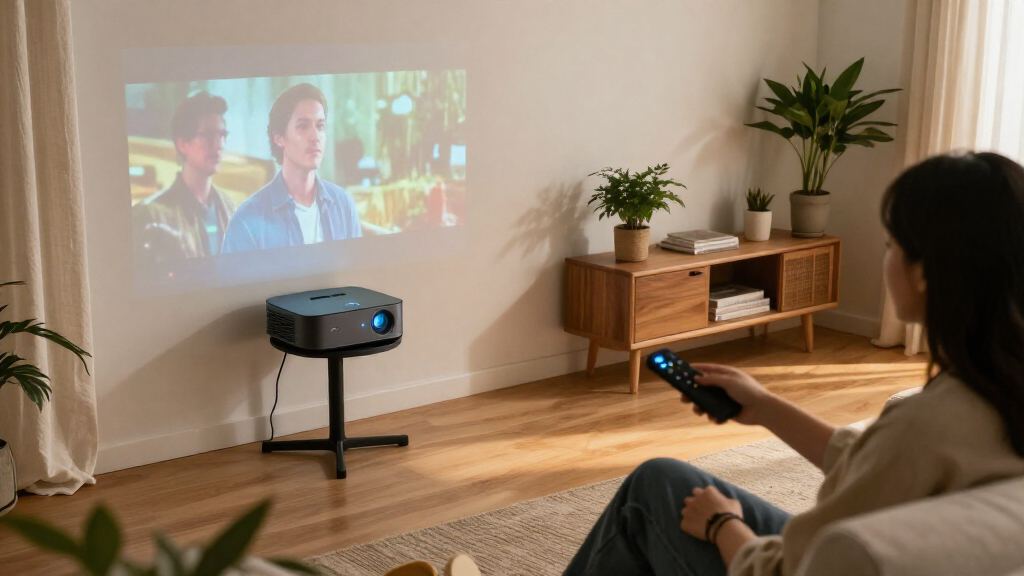
I compared the listed models on the details that shape day-to-day use in a smart home: native resolution, stated brightness where available, built-in streaming platform, wireless connectivity, audio features, autofocus and keystone support, stand movement, and power or portability features. I gave more weight to features that reduce setup friction or make the projector useful across more rooms than to broad compatibility claims that do not specify the delivered picture quality.
The ranking favors a balanced combination of smart functionality, practical setup, and clearly stated picture specifications. That puts the X9 PRO first for its stated brightness and autofocus, while other models rank higher for narrower needs such as Roku or Google TV access, USB-C power, or an adjustable stand. Many listings provide limited brightness, speaker, or placement details, so I avoid treating missing specifications as proof of performance; buyers should verify those details before choosing.
Factors to Consider When Choosing Smart Home Projectors
A smart projector purchase involves more than picking a streaming platform. I would start with the room and viewing habits, then check whether the model’s native resolution, power setup, and placement options fit that use.
Match Brightness to the Room
Projector brightness matters most when you cannot fully control room light. For daytime viewing or a room with uncovered windows, a projector may look washed out even if its resolution is high. A darker room lets you prioritize other features, such as a rotating stand or a built-in streaming platform. Compare brightness figures only when they use the same measurement standard; a number without a stated standard is difficult to compare directly. Also remember that a larger projected image spreads light over more area and can appear less vivid. If a listing does not state brightness clearly, avoid assuming it will suit a bright living room.
Check Native Resolution, Not Just 4K Language
Terms such as “4K decoding” usually describe the signal a projector can accept, not necessarily the resolution it displays. A model with native 1080p can play compatible 4K content while still projecting at 1080p. That may be a sensible tradeoff for casual streaming, but buyers focused on fine detail should look for an explicit native-resolution specification. Screen size and viewing distance also affect how visible resolution differences are. Before paying extra for a 4K claim, check what the projector’s imaging system actually outputs. Treat vague resolution wording as a prompt to verify the specification, not as evidence of native 4K.
Choose a Streaming Setup That Fits Your Household
Built-in Roku, Google TV, and VIDAA can reduce the need for a separate streaming device, but each platform has its own interface and app availability. Check that your preferred services are available in the projector’s region and that the device receives software support. A separate streaming stick can offer a familiar interface or a wider app selection, though it uses a port and may add another remote or power requirement. Do not assume that wireless screen mirroring replaces native apps: casting support and app licensing are different things. For shared households, a platform people already know can matter more than a long feature list. Verify whether the listed streaming features are built into the projector or supplied by an included accessory.
Plan Placement Before Relying on Auto Setup
Autofocus and keystone correction can save time, but they do not remove the need for a suitable projection position. Digital keystone correction reshapes the image and can reduce usable picture detail, so a projector placed square to the screen is often preferable. A rotating stand helps aim the lens, yet it cannot compensate for every ceiling height, wall angle, or obstruction. Measure the distance from the intended projector location to the screen and check the supported image-size range before buying. For a permanent room setup, lens placement and throw distance may matter more than fast automatic adjustments. For flexible use, stands and autofocus can make small placement changes less frustrating.
Treat Portability as a Power and Sound Question
A compact body is only one part of portability. Check the power input and whether a model can run from a power bank or USB-C source before planning outdoor or travel use. Built-in speakers may be convenient for a quick setup, but a larger room or outdoor gathering can call for an external speaker; confirm which Bluetooth or audio connections are supported. Wireless features also depend on a stable network, so a projector intended for outdoor use may need a nearby access point or downloaded content option. Consider the projector, power supply, cables, and sound device as one carryable setup. A small projector that still needs several accessories may be less convenient than its size suggests.
Compare the Full Setup, Not a Single Feature
It is easy to focus on a standout spec and miss the costs of the complete viewing setup. A smart platform may save a streaming device, while a built-in stand may reduce the need for a mount; either can make a model more useful even if another projector offers a feature you prefer. On the other hand, a listed feature such as Dolby Audio does not specify speaker size or guarantee room-filling sound. Check ports, included accessories, adjustment limits, and whether external audio is straightforward. Buyers who watch occasionally may value quick setup more than extensive connectivity. Frequent viewers should prioritize the parts they will use every session rather than a long list of rarely used functions.
Frequently Asked Questions
Does a projector with 4K decoding display a native 4K image?
Not necessarily. 4K decoding generally means the projector can accept or process a 4K video signal, while the projected image may still be limited to its native resolution. Several models in this roundup pair 4K-related wording with native 1080p, so those specifications should not be treated as equivalent. Check the native resolution separately before choosing based on sharpness. If the listing does not state it clearly, seek confirmation from the manufacturer.
Should I choose Roku, Google TV, or VIDAA built into the projector?
Start with the apps and interface your household already uses, then confirm that the services are available on the specific projector. Roku and Google TV may feel familiar to people who already use those platforms, while VIDAA provides another built-in route to streaming. App availability and software support can vary by model and region. A separate streaming stick remains an option if you prefer a different interface, but it adds a device and may use a port. The best choice is the one that supports your regular viewing without extra steps.
Can I use one of these projectors outdoors?
Many portable projectors can be used outdoors, but a projector designed for indoor streaming is not automatically suited to every outdoor setting. You need a power source, a sufficiently dark viewing area, a stable surface, and a reliable network or offline playback plan. Built-in speakers may not carry well in open spaces, so plan for external audio if the gathering is larger. Check the model’s power requirements and avoid exposing it to moisture or dust unless the manufacturer specifies protection. For occasional backyard viewing, convenience may matter more than maximum image size.
Are autofocus and keystone correction enough to place a projector anywhere?
No. These features can speed up focusing and straighten some angled images, but they cannot make every position work well. Digital correction may reduce picture detail, and autofocus does not change the projector’s throw distance or remove obstructions. Aiming the projector close to square with the screen usually gives a cleaner result. Measure your room and confirm the supported projection distance before buying. Treat automatic adjustments as setup aids rather than substitutes for placement planning.
When is a separate streaming device or speaker still worthwhile?
A separate streaming device can make sense if the projector lacks an app you need, has an interface your household dislikes, or receives limited platform support. It can also be replaced later without changing the projector. An external speaker is useful when built-in audio cannot cover your room or outdoor space, though you should check supported audio connections first. Both additions mean more equipment, cables, and setup. If simplicity is your priority, favor a model whose built-in apps and audio meet your everyday needs.
Conclusion
For the broadest balance of smart features and stated picture specifications, I recommend the X9 PRO 4K Smart Projector as best overall. Buyers seeking a strong feature set without paying for premium positioning should compare the VIDAA Smart Projector and XuanPad Mini as value-oriented alternatives, particularly if a rotating stand and native 1080p matter. For a premium-feeling smart setup, the HAPPRUN Google TV model is the pick for buyers who prioritize a familiar app platform, while the Pemoon adds broad stand movement. Beginners should start with a Roku or Google TV option, such as the Aurzen D1R or HAPPRUN Google TV projector, to keep streaming straightforward. For portable power flexibility, choose the Aurzen D1R Air; for an adjustable stand, compare XuanPad, Pemoon, and the VIDAA model. My final advice is to confirm native resolution, brightness, app support, and placement fit before deciding between models with overlapping feature lists.