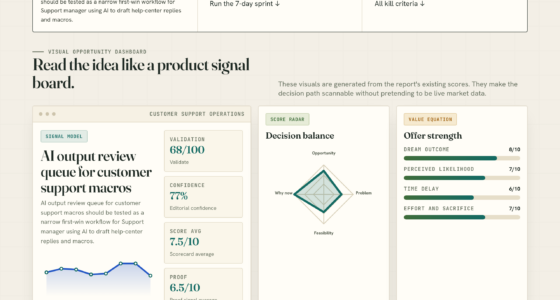

📊 Full opportunity report: Unpacking The Adoption Of Mixture-of-Experts In Frontier AI on ThorstenMeyerAI.com — validation score, market gap, and execution plan.

Get the latest gadgets delivered free — and shop member deals
- Fast, free delivery on millions of items
- Access to Prime Big Deal Days deals on October 6–7
- Prime Video, Amazon Music and more included
TL;DR
Mixture-of-experts (MoE) models are increasingly adopted in frontier AI for their ability to scale knowledge without proportional increases in cost. This approach separates total model size from per-token compute, enabling trillion-parameter models to run efficiently. Industry experts highlight why MoE is a key driver of current AI advancements and deployment challenges.
In 2026, industry leaders and researchers are increasingly adopting mixture-of-experts (MoE) models to enable trillion-parameter AI systems to run efficiently, balancing total capacity with per-token compute costs. This shift addresses the economic and technical challenges of scaling dense models and is shaping the future of large-scale AI deployment.
MoE models divide their capacity into many smaller sub-networks called experts, with a router selecting only a handful of experts for each token processed. This approach allows models like Kimi K3, with 2.8 trillion total parameters, to activate only about 104 billion parameters per token, significantly reducing per-token compute costs while maintaining extensive knowledge. The key advantage is the separation of total parameters—which influence memory requirements—from active parameters, which determine speed and compute expenses.
Industry experts note that the memory cost is driven by total parameters, as all experts must be loaded into RAM, even if most remain inactive for a given token. Conversely, speed depends on the number of experts activated per token, making MoE models more efficient than dense models at large scales. This efficiency is why MoE models have become dominant in open-weight AI development, enabling models with trillions of parameters to be feasible for deployment.
Every serious open model this year quotes two parameter counts instead of one — a huge total and a much smaller active. That split is the single highest-leverage concept for reasoning about how these models run, what they cost, and why they behave as they do.
Instead of one monolith where everything activates for every token, an MoE splits its capacity into many parallel experts. For each token, a small fast router selects only a handful to run. The rest stay dormant.
A dense model welds capability and running-cost together — every added parameter is paid for on every token, forever. MoE breaks the lockstep.
- All 70B run to answer “capital of France?”
- Capability and cost rise in lockstep
- Past a few hundred billion, the per-token bill becomes absurd
- Breadth of a giant model at the per-token compute of a small one
- Grow capability by adding experts, not per-token cost
- The only way trillion-parameter open models are serveable at all
This is the source of the most common expensive mistake in local inference. The two counts are paid to two different pieces of hardware.
The same model, seen through the two-number lens: what fits, and how fast.
Read those two numbers as two questions and you can predict a model before downloading it.
Why Mixture-of-Experts Models Are Game-Changers
The adoption of MoE models in 2026 marks a significant shift in AI development, allowing models to scale knowledge dramatically without incurring prohibitive costs. This enables more powerful AI systems to be accessible for research and commercial use, fostering innovation. However, it also introduces new hardware considerations, as organizations must manage separate memory and compute strategies for total versus active parameters. The widespread industry shift underscores MoE's role in overcoming the limitations of traditional dense models and shaping the future of scalable AI.
As an affiliate, we earn on qualifying purchases.
The Evolution Toward Mixture-of-Experts in Large Language Models
Prior to 2026, dense transformer models dominated AI development, but their size and cost grew exponentially with parameters. The industry faced a practical ceiling around hundreds of billions of parameters due to compute and memory constraints. The emergence of MoE models addressed this by splitting model capacity into many experts, each selectively activated, enabling models like Kimi K3 to reach trillions of parameters while maintaining manageable per-token costs. This approach gained rapid industry adoption as it unlocked new possibilities for large-scale AI applications.
"The core advantage of MoE is that it separates total model size from per-token compute, making trillion-parameter models feasible at a fraction of the cost of dense models."
— Thorsten Meyer
high performance RAM for AI development
As an affiliate, we earn on qualifying purchases.
As an affiliate, we earn on qualifying purchases.
Outstanding Questions About MoE Deployment and Optimization
While MoE models are widely adopted, questions remain about optimal expert routing, load balancing, and the impact on model interpretability. Additionally, it is unclear how these models will evolve to address potential issues like expert specialization and emergent behaviors. The long-term hardware and software infrastructure needed for widespread MoE deployment is still under development, and industry standards are not yet fully established.
As an affiliate, we earn on qualifying purchases.
Next Steps for Industry Adoption and Technical Refinement
Researchers and companies will focus on refining expert routing algorithms, improving load balancing, and reducing latency in MoE models. Standardization efforts are expected to emerge around best practices for hardware architecture and training techniques. Additionally, new applications and benchmarks will test the limits of MoE scalability, while hardware providers develop optimized infrastructure to support these models at scale.
As an affiliate, we earn on qualifying purchases.
Key Questions
What is a mixture-of-experts model?
A mixture-of-experts (MoE) model splits its capacity into many smaller sub-networks called experts, with a router selecting only a few experts to activate per token, enabling large models to run efficiently by activating only parts of the network at a time.
Why are MoE models important in 2026?
MoE models allow AI systems to scale to trillions of parameters without proportional increases in compute and memory costs, making large-scale models more feasible for research and deployment.
What are the main challenges with MoE models?
Challenges include optimizing expert routing, ensuring load balancing, managing hardware infrastructure, and understanding emergent behaviors and interpretability issues associated with large, complex models.
How does MoE differ from traditional dense models?
Unlike dense models that activate all parameters for each token, MoE models activate only a small subset of experts per token, significantly reducing per-token compute while maintaining large overall capacity.
What does this mean for AI hardware requirements?
Hardware must support large memory loads to store all experts simultaneously, even if only a few are active at a time, and must optimize for fast routing and expert selection to minimize latency.
Source: ThorstenMeyerAI.com
Fall Picks
fall essentials
As an affiliate, we earn on qualifying purchases.