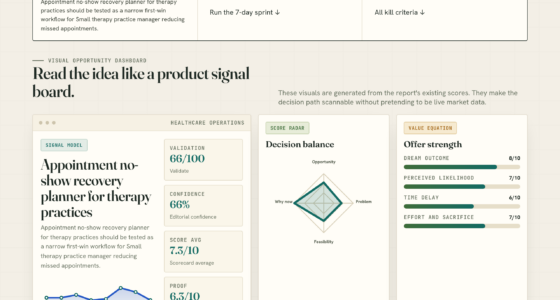

📊 Full opportunity report: The Smart Investor’s Tool: Fee-Transparency Calculator For Your Portfolio on IdeaNavigator AI — validation score, market gap, and execution plan.

Get the latest gadgets delivered free with Prime
- Fast, free delivery on millions of items
- Prime Video, Amazon Music and more included
- Member-only deals all year
TL;DR
A newly launched fee-transparency calculator allows retail investors to see the real dollar impact of advisory and fund fees over their investment horizon. It aims to help fee-conscious investors compare costs and make informed choices, amid rising fee awareness and regulatory shifts.
The fee-transparency calculator, designed for retail investors, has been introduced as a free, easy-to-use online tool that quantifies the total dollar amount lost to investment fees over a specified horizon. This development responds to increasing fee awareness among individual investors and aims to address the common challenge of understanding the real cost of fees in dollar terms, which are often obscured by percentage figures.
The calculator allows users to input their current portfolio balance, monthly contributions, investment time horizon, expected annual return, and fee components such as expense ratios and advisory fees. It then outputs the total dollar loss attributable to fees over the specified period, the difference in ending balances compared to a low-cost baseline, and the share of retirement withdrawals consumed by fees. The tool is accessible via a single webpage, requiring no login, and generates a shareable PDF or chart for easy comparison and discussion.
This tool is targeted at fee-conscious DIY investors, often aged 35-60, who hold index funds or work with small advisory firms charging around 1% AUM. It aims to make the hidden costs of fees tangible, helping investors decide whether to switch providers or question ongoing advisory costs. The calculator’s initial deployment focuses on driving traffic from personal finance forums like r/personalfinance and Bogleheads, with plans to monetize through referrals to low-cost advisors, premium portfolio audits, and licensing to financial services firms.
Why the Calculator Changes Investor Cost Awareness
This development matters because it directly addresses a key barrier to fee transparency: investors often underestimate or overlook the long-term dollar impact of fees. By providing a clear, quantifiable view of how fees erode wealth over decades, the calculator empowers retail investors to make more informed choices. As regulatory environments shift—such as the vacated fiduciary rule—and low-cost investment options become more mainstream, understanding fee drag is increasingly critical for retirement planning and wealth accumulation. The tool also responds to a growing demand for transparency in the financial advisory industry, potentially influencing provider competition and pricing transparency.
As an affiliate, we earn on qualifying purchases.
Background on Fee Awareness and Regulatory Changes
Over the past decade, the rise of low-cost index funds and robo-advisors has heightened investor awareness of investment fees, which can significantly reduce long-term returns. Despite this, many retail investors struggle to quantify the actual dollar impact of fees, often relying on percentage figures that feel trivial but compound over time. The 2024 Department of Labor fiduciary rule, which aimed to regulate conflicts of interest in retirement advice, was vacated in 2026, restoring the legality of commission-based and AUM fees for non-fiduciary advisors. This regulatory shift has increased the importance of fee transparency for consumers, who now bear more responsibility for understanding costs associated with their investments.
Previously, tools for fee analysis were either complex, requiring detailed portfolio data, or limited to professional advisors. The new calculator aims to fill this gap by offering a simple, accessible way for retail investors to visualize the long-term dollar costs of their fees and compare them against low-cost alternatives, fostering more fee-aware decision-making.
As an affiliate, we earn on qualifying purchases.
Unclear Aspects of the Calculator’s Effectiveness
It is not yet clear how widely the calculator will be adopted or whether it will significantly influence investor behavior. The actual impact depends on user engagement, the accuracy of input assumptions, and subsequent actions taken by investors. Additionally, the extent to which financial advisors and firms will incorporate or promote the tool remains uncertain, as does its ability to reach diverse investor segments beyond early adopters on personal finance forums.
financial advisory fee comparison tool
As an affiliate, we earn on qualifying purchases.
As an affiliate, we earn on qualifying purchases.
Next Steps for Deployment and Impact Measurement
The initial phase involves launching the calculator and tracking user engagement, completion rates, and clicks on recommended low-cost options. Success metrics include the number of users who compare fees and consider switching providers or questioning ongoing advisory costs. Future updates may include integrating actual portfolio data via CSV uploads, expanding educational content, and partnering with financial advice platforms. Monitoring feedback and usage patterns will guide further development and potential scaling.
As an affiliate, we earn on qualifying purchases.
Key Questions
How does the calculator estimate the lifetime dollar cost of fees?
The calculator uses user inputs such as initial balance, monthly contributions, expected return, and fees to project the total dollar amount lost to fees over the selected time horizon, considering compounding effects.
Can I compare different fee scenarios with this tool?
Yes, users can input multiple fee components and see how different fee levels impact their final balance and total dollar loss, helping them evaluate trade-offs.
Is this calculator suitable for professional financial advisors?
The tool is primarily designed for retail investors but can be used by advisors as a prospecting asset or educational aid. Premium features include detailed portfolio fee audits, which may appeal to professionals.
Will the calculator account for variable fees over time?
Currently, the calculator assumes static fees over the investment horizon. Future versions may incorporate variable fee scenarios based on market conditions or fee adjustments.
How accurate are the projections from the calculator?
The projections depend on user inputs and assumptions about returns and fees. While it provides a useful estimate, actual results may vary due to market fluctuations and fee changes.
Source: IdeaNavigator AI
Halloween Picks
halloween
As an affiliate, we earn on qualifying purchases.