TL;DR
Nvidia announced Rubin HPC at SC26 on Nov. 16, describing it as a GPU for scientific, engineering and analytics workloads that is expected in 2028. The company says it will have more than 50,000 CUDA cores, but has not released key specifications or independent benchmark results.
Rubin HPC is part of Nvidia’s Vera Rubin platform. In a company blog post, Nvidia said the GPU is designed to accelerate scientific and engineering workloads, including simulations that can test proposed materials, molecules or designs before lab work or prototype construction. The announcement came during SC26, which runs in Chicago from Nov. 15 to 20.

Get the latest gadgets delivered free with Prime
- Fast, free delivery on millions of items
- Prime Video, Amazon Music and more included
- Member-only deals all year
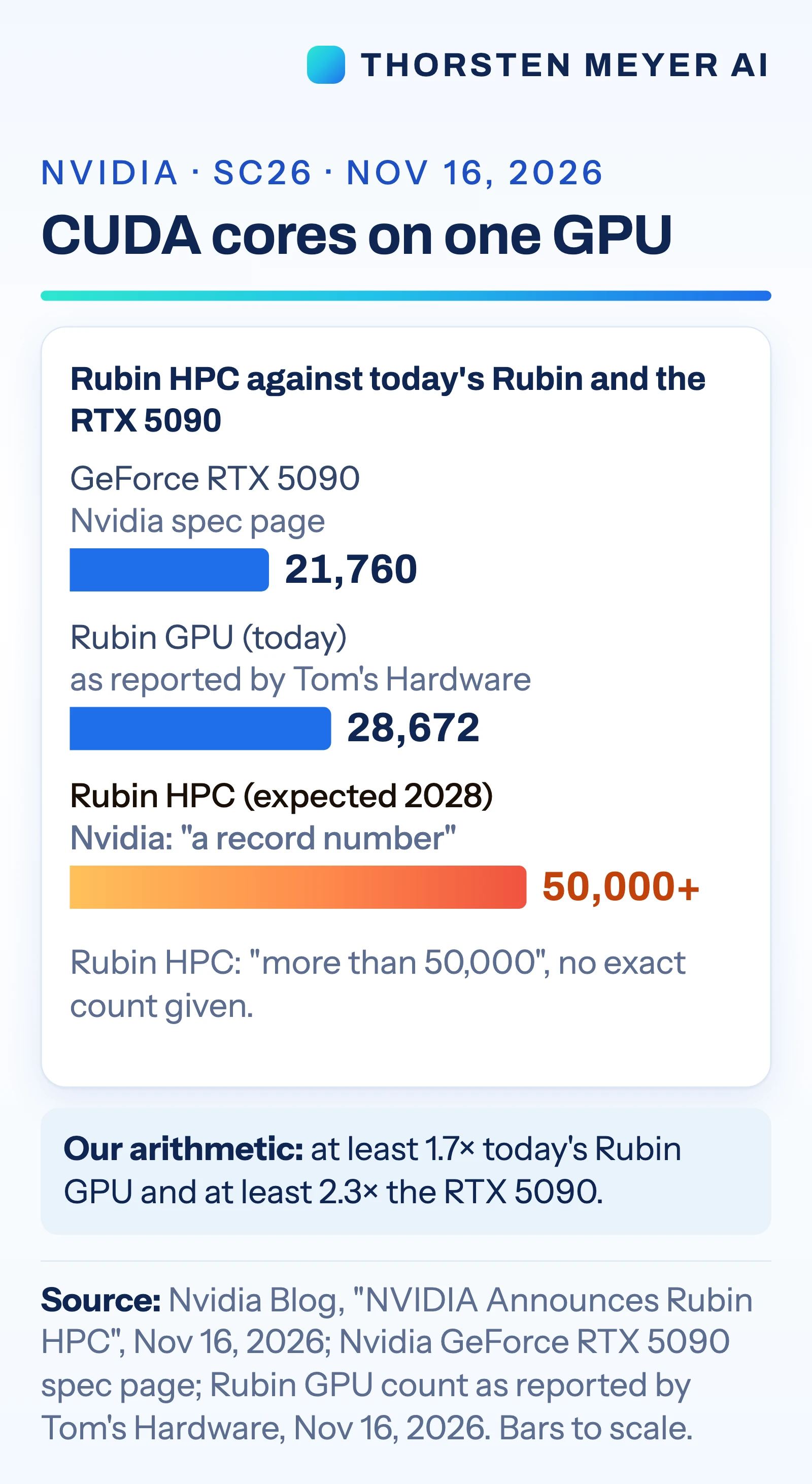
Nvidia’s headline specification is more than 50,000 CUDA cores on one GPU. The company called this a record, but did not give an exact core count. It also said the design combines compute with data movement, includes a sparse data acceleration capability, and uses seventh-generation NVLink to connect GPUs. Nvidia has not explained how the sparse-data feature works.
The company said Rubin HPC is expected in 2028. It did not disclose the chip’s FP64 performance, memory capacity or bandwidth, power consumption, price, or the systems in which it will ship. No independent benchmark results were cited in the announcement.
Faster Simulation for Research
Nvidia is pitching Rubin HPC at a stage of scientific work where a proposed idea must be tested against a computational model. For workloads such as climate modeling, engineering analysis or genomic research, simulations can involve repeated calculations alongside large datasets. Nvidia’s argument is that improving both computation and data movement could shorten the time between proposing an idea and refining it.
The announcement also connects the GPU to AI agents that generate candidate designs or hypotheses. Those suggestions still need to be evaluated through simulation, according to Nvidia. If the chip performs as intended, faster simulation could let research teams test candidates sooner. The announcement does not provide measured results to establish how large that effect might be.
For buyers planning scientific computing infrastructure, the core count alone is not enough to estimate practical performance or cost. FP64 throughput, memory capacity and bandwidth, power use, system configuration and price will help determine whether Rubin HPC suits a particular workload. Those details remain unpublished.
Products Worth Considering

Apple Watch Series 12 GPS 46mm Smartwatch

Bose Portable Smart Speaker with Alexa and Google Assistant, Black

LG 27GR83Q-B 27-inch Ultragear QHD IPS Gaming Monitor
As an affiliate, we earn on qualifying purchases.
Nvidia’s Core Count in Context
Nvidia did not compare Rubin HPC’s core count with other products in its announcement. For reference, Tom’s Hardware reports that the current Rubin GPU has 28,672 CUDA cores; Nvidia’s technical blog confirms that GPU has 224 streaming multiprocessors. Nvidia lists 21,760 CUDA cores for the GeForce RTX 5090.
Using those figures, the announced floor of more than 50,000 cores is at least about 1.7 times the reported Rubin count and about 2.3 times the RTX 5090 count. These are arithmetic comparisons of core counts, not performance comparisons; the products target different uses, and Nvidia has not released an exact Rubin HPC count or benchmark data.
Tom’s Hardware suggested the core count might point to a configuration similar to the four-die Rubin Ultra GPU, while also reporting that Nvidia had not disclosed Rubin HPC’s physical layout. That is an outlet’s inference, not a confirmed description of the chip. Nvidia’s blog post, by Dan Ernst, senior director of supercomputing products, is the source of the announced features and expected availability date.
““designed to accelerate simulation and data processing for science, engineering and analytics workflows.””
— Nvidia
Specifications Still Pending
Nvidia has not published FP64 performance figures, memory size or bandwidth, power requirements, pricing, named systems, or independent benchmarks for Rubin HPC. These omissions leave researchers and computing buyers without enough information to compare its expected performance, operating costs or suitability for specific simulations.
The precise core count and the chip’s physical layout are also unknown. Nvidia has described a sparse-data acceleration capability and seventh-generation NVLink, but has not explained the former’s implementation or provided measurements showing how either feature affects performance. The 2028 availability date is the company’s expectation; the announcement does not give a specific launch date or shipping configuration.
Details to Watch Before 2028
Nvidia says Rubin HPC is expected to become available in 2028. Before then, researchers and infrastructure planners will need product specifications and performance results to assess it against existing systems. Relevant details include FP64 throughput, memory configuration, power draw, system design and pricing.
Further announcements may clarify how Rubin HPC fits into the Vera Rubin platform and which systems will use it. Until Nvidia publishes those details, the announced core count and workload targets describe the company’s plans, not independently verified performance.
Key Questions
What is Nvidia Rubin HPC?
Rubin HPC is a GPU Nvidia announced for simulation and data processing in science, engineering and analytics. The company says it is part of the Vera Rubin platform and is expected in 2028.
How many CUDA cores will Rubin HPC have?
Nvidia says the GPU will have more than 50,000 CUDA cores on a single chip. It has not published an exact count.
Will Rubin HPC be faster than current GPUs?
Nvidia has not released independent benchmarks or enough performance data to establish how Rubin HPC compares on specific workloads. Core-count comparisons alone do not show how quickly a GPU completes a simulation.
What technical details has Nvidia not disclosed?
The announcement does not give FP64 performance, memory capacity or bandwidth, power use, price, named systems, or independent benchmarks. Nvidia also has not explained how its sparse-data acceleration capability works.
When is Rubin HPC expected to be available?
Nvidia says Rubin HPC is expected in 2028. It has not announced a specific availability date or system configuration.
Source: Thorsten Meyer AI