TL;DR
CISA urged organizations on November 17, 2026, to patch Java4Shell, a memory-corruption flaw in certain Java runtimes. The reported exposure is limited to affected Java versions on x86-64 processors with AVX-512 VBMI when outside data reaches the Base64 decoder; CISA’s record listed no exploitation as of November 17.
CISA urged organizations on November 17 to immediately patch CVE-2026-114938, a memory-corruption flaw dubbed Java4Shell in the Base64 decoder of certain Java runtimes. The agency says specially crafted input could crash the Java virtual machine and allow unauthenticated remote code execution; exposure depends on the Java version, processor features and whether outside data reaches the decoder.

Get the latest gadgets delivered free with Prime
- Fast, free delivery on millions of items
- Prime Video, Amazon Music and more included
- Member-only deals all year
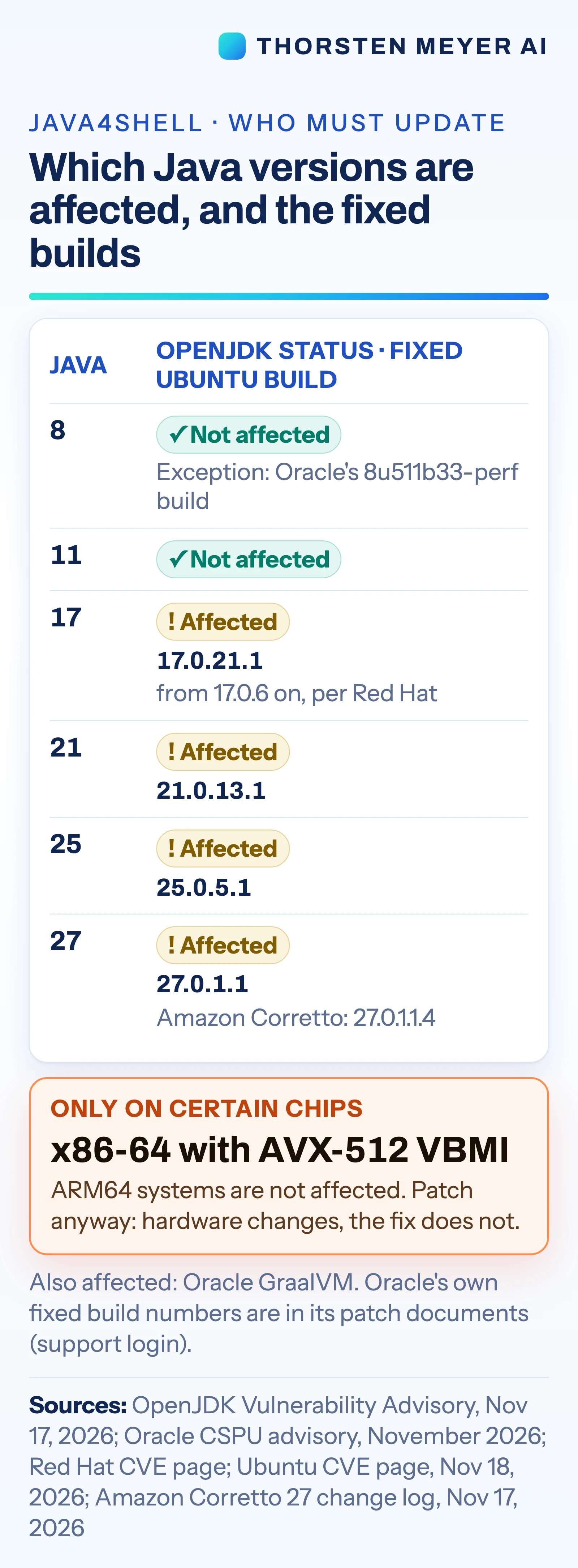
The vulnerability affects specified Java 17, 21, 25 and 27 runtimes, as well as Oracle GraalVM and one Oracle Java 8 build identified in the source material. Red Hat says the vulnerable code entered OpenJDK in version 17.0.6, while OpenJDK 8 and 11 do not contain it. The described processor requirement is an x86-64 chip with AVX-512 VBMI; Red Hat says ARM64 systems and x86-64 systems without that feature are not affected by this flaw.
Organizations should install their vendor’s November 2026 Java update, prioritizing internet-facing systems that process external input. The advisory material also calls for checking Java bundled with other products and included in container images, since those runtimes may not be managed as separate installations. Oracle’s November Critical Patch Update contains 11 Java SE patches among 655 patches across its products; the source identifies this CVE as the highest-scored of Oracle’s 11 Java fixes.
Severity scores differ by provider. Oracle assigns 8.1 out of 10 and describes exploitation as difficult; Red Hat rates it critical at 9.8, while the researchers’ CVSS 4.0 score is 9.2. The National Vulnerability Database had not assigned a score in the material provided. CISA’s CVE record listed exploitation as “none” on November 17, and the flaw was not in the agency’s known exploited vulnerabilities catalogue version dated November 18.
Patch Exposure Across Java Servers
The warning matters most to organizations running Java services that accept data from outside the organization. Base64 decoding is used in routine handling of data such as tokens, cookies and uploads, but the source material does not establish that every application using Base64 is exposed. The relevant question is whether an affected runtime on the specified processor receives outside input through the vulnerable decoder.
A compromised server could have serious consequences if the remote-code-execution condition described by CISA is met. CISA’s call to patch promptly reflects that potential impact, while the reported hardware and version limits narrow which systems are implicated. Asset inventories can miss runtimes tucked into vendor products or container images, so checking only standalone Java installations may leave affected copies undiscovered.
Products Worth Considering

Anker SOLIX C300 Portable Power Station, 288Wh

DJI Mini 4K Drone Combo with 4K Camera, 3-Axis Gimbal, and Two Batteries

Bose TV Speaker (2nd Gen) Compact Soundbar with Bluetooth and HDMI Connectivity
As an affiliate, we earn on qualifying purchases.
How the Java Fix Was Issued
CISA’s November 17 alert names Java4Shell and links to Oracle’s advisory. The Canadian Centre for Cyber Security contributed to the alert. CISA characterizes the issue as a critical memory-corruption vulnerability in the x86-64 HotSpot JVM, part of the Java Development Kit. The OpenJDK project published an advisory on the same date, with its risk matrix identifying Java 17, 21, 25 and 27 and not listing Java 8 or 11.
Oracle released its fix through its November 2026 Critical Patch Update, a monthly release that the company says complements its quarterly cumulative updates. Oracle’s advisory says exploitation requires supplying data to APIs in the affected component, such as through a web service, and excludes untrusted Java Web Start applications and applets from the stated attack path. The name Java4Shell echoes Log4Shell, but the source material describes a different flaw, in a Java virtual machine decoder rather than a logging library.
““strongly urges organizations to immediately patch””
— CISA, November 17, 2026 alert
Exploit Activity and Scope
No exploitation was listed in CISA’s record on November 17, and the CVE was absent from the known exploited vulnerabilities catalogue version dated November 18. That is a time-specific status, not proof that exploitation cannot occur or that the status will not change. The source material does not report independently confirmed attacks.
The exact number of exposed systems is also unknown. It depends on Java versions, processor capabilities and application behavior, including whether external data reaches the decoder. Severity ratings vary across Oracle, Red Hat and the researchers, and the National Vulnerability Database had not yet scored the CVE in the material provided. Researchers said they were withholding product-specific attack chains until users had time to upgrade.
Apply Vendor Updates and Recheck
Administrators should apply the relevant vendor’s November Java patches and check for affected runtimes embedded in applications, appliances and container images. Teams can use their software and hardware inventories to identify Java versions and processors matching the advisory’s stated conditions, then verify that updates reached internet-facing services.
Organizations should follow CISA, Oracle, OpenJDK and their Java distributor for changes to affected-version guidance or exploitation status. The supplied material gives no later remediation deadline or confirmed follow-up milestone; the immediate action described in CISA’s alert is patching.
Key Questions
What is Java4Shell?
It is the name used for CVE-2026-114938, a memory-corruption flaw in an optimized Base64 decoder in certain Java virtual machines. CISA says specially crafted input could cause a JVM crash and allow unauthenticated remote code execution under the described conditions.
Which Java systems are listed as affected?
The supplied advisories identify Java 17, 21, 25 and 27 runtimes, Oracle GraalVM and one Oracle Java 8 build. Red Hat says the vulnerable code appeared in OpenJDK 17.0.6 and that OpenJDK 8 and 11 are not affected.
Does every system with an affected Java version need to be considered exposed?
No. The source material says the flaw requires an x86-64 processor with AVX-512 VBMI and a path for outside data to reach the decoder. Red Hat says ARM64 systems and x86-64 processors lacking that feature are not affected by this flaw.
Has Java4Shell been exploited?
CISA’s record listed exploitation as “none” on November 17, 2026, and the CVE was not in its known exploited vulnerabilities catalogue version dated November 18. The information provided does not establish whether that status has changed since those dates.
What should organizations do now?
Install the Java update supplied by the relevant vendor for November 2026. Check internet-facing services and look for Java bundled inside other products and container images, as well as standalone runtimes.
Source: Thorsten Meyer AI