TL;DR
APEC leaders met in Shenzhen on November 19, 2026, with artificial intelligence, digital trade and regional cooperation on the agenda. Draft proposals had been sent to leaders, but their adoption was not confirmed as of 05:45 UTC; the leaders’ declaration had not yet been published.
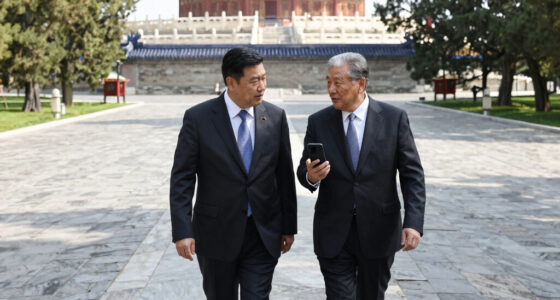
Leaders of APEC’s 21 member economies met in Shenzhen on November 19 with artificial intelligence, digital trade and regional economic cooperation on the agenda. Chinese President Xi Jinping described the digital economy and AI as “the engines of innovation-driven growth” in remarks published by China’s foreign ministry, while several draft proposals awaited a decision from leaders.

Get the latest gadgets delivered free with Prime
- Fast, free delivery on millions of items
- Prime Video, Amazon Music and more included
- Member-only deals all year
Senior officials had sent leaders a proposed statement on the digital economy and AI “for people’s well-being,” a proposed Trade Digitalization Cooperation Framework for 2027–2030 and a draft statement on a Free Trade Area of the Asia-Pacific. As of 05:45 UTC on November 19, it was not known whether leaders would adopt any of them. The leaders’ declaration had not yet been published.
Some commitments had already been made during the host year. At a May meeting, APEC trade ministers committed to “harnessing AI’s benefits for trade” and encouraged members to share AI policies with smaller firms. Labor ministers adopted a joint statement in September on jobs, vocational skills and social security. Xi also announced that China would provide US$20 million for APEC cooperation and establish cooperation institutions focused on digital technology, cross-border data flows, clean energy and small businesses.
These steps do not amount to binding regional rules. APEC’s decisions are made by consensus and its commitments are voluntary. A declaration can set a shared direction, but its text alone does not change tariffs, laws or rules governing advanced chips.
Trade and Technology Across the Pacific
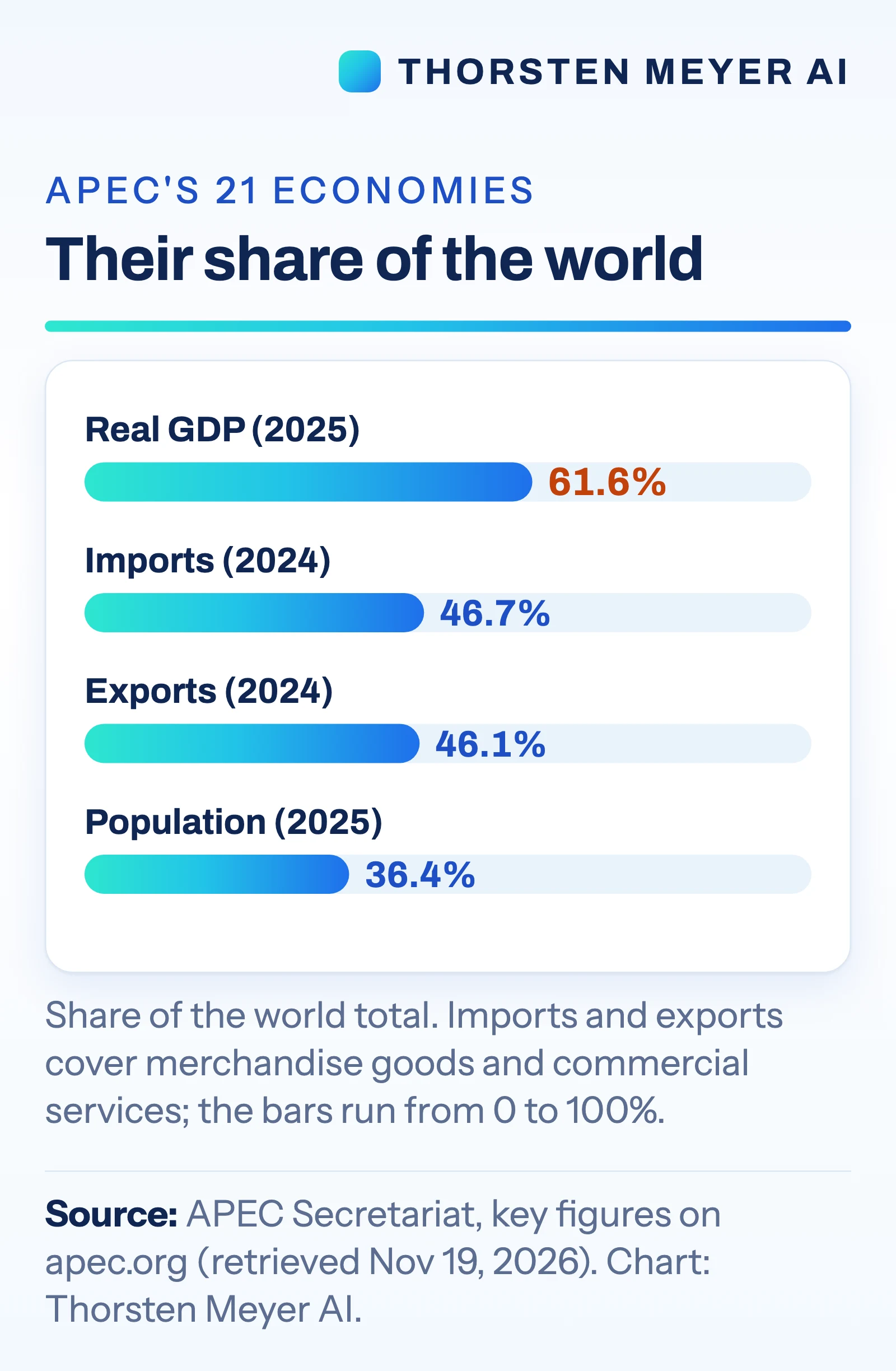
The agenda matters because APEC economies have substantial weight in global trade and output. APEC’s figures put the members at 61.6% of world GDP in 2025, about 46% of global trade in goods and commercial services in 2024, and 36.4% of the world’s population. Shared approaches to digital trade or AI could affect how businesses exchange data, sell across borders and adapt to new technology, although the proposals under discussion would not themselves impose common rules.
The economic outlook gives the trade discussions added urgency. On November 15, APEC’s Policy Support Unit raised its forecast for regional growth in 2026 to 3.4%, from 3.2%, and projected 3.1% growth in 2027. It cited technology-related investment and trade; regional export values rose 22.5% year on year in the first half of 2026, while export volumes rose 10.8%, supported by semiconductor demand. The unit also warned that the benefits of technology investment could be uneven.
For companies and workers, the practical effects remain uncertain. Cooperation on digital trade could help shape future policy discussions, and the labor ministers’ statement puts skills and social security alongside AI adoption. But APEC’s voluntary process means any concrete effect will depend on what members do at home and whether they follow through on shared proposals.
Products Worth Considering

Jackery HomePower 3600 Plus Portable Power Station, 3584Wh, 3600W

Apple AirPods Pro 3 Wireless Earbuds with Active Noise Cancellation

Amazon Kindle Scribe (16GB) with Premium Pen, Tungsten
As an affiliate, we earn on qualifying purchases.
A Year of APEC Preparations
China hosted APEC in 2026, with meetings throughout the year shaping the leaders’ agenda. Trade ministers met in Suzhou on May 22–23. Labor ministers met in Nanjing on September 21. Foreign and trade ministers held their 37th ministerial meeting by video on November 3, and senior officials met in Shenzhen on November 14–15 to prepare proposals for the leaders.
APEC was founded in 1989 and has 21 member economies. The forum uses the term “economies” for its members, which include countries and other separately participating economies. Its consensus-based approach allows members to discuss regional priorities while preserving their own authority over domestic rules.
The economic picture is mixed. Alongside its growth forecasts, the APEC Policy Support Unit projected inflation of 3.2% in 2026 and 2.8% in 2027. It forecast export volume growth for goods and services of 6.9% in 2026 and 3.8% in 2027. These are forecasts, not final outcomes, and the source material does not establish how the leaders’ proposals will affect them.
Regional diplomacy also formed part of the immediate setting. Xi welcomed U.S. President Donald J. Trump in Shenzhen on November 18, and a China-Russia-U.S. summit with Trump and Russian President Vladimir Putin was scheduled for November 19. The meetings came days after the United States tightened rules on remote access to advanced AI chips. The available material does not show that those chip rules were part of APEC’s proposed statements or that the Shenzhen meetings changed them.
““Harnessing AI’s benefits for trade.””
— APEC trade ministers, joint statement following their May 22–23 meeting
Drafts Await Leaders’ Decisions
As of 05:45 UTC on November 19, the leaders’ declaration was not yet available, and the source material did not confirm whether the proposed AI statement, digital trade framework or free trade area statement had been adopted. Their final wording, if issued, could differ from the drafts.
It is also unclear what practical steps members will take after the meeting, how any cooperation institutions funded by China will operate, or how the proposals may affect companies and workers. APEC’s voluntary commitments do not establish that members will change domestic law, trade rules or chip controls.
Declaration and Follow-Through
The next immediate milestone is publication of the leaders’ declaration, which will show what the economies agreed to say after the Shenzhen meeting. The source material said the declaration was still expected but did not give a publication time or confirm its eventual contents.
Afterward, attention will turn to whether members carry any shared priorities into their own policies and cooperation work. The proposed digital trade framework covers 2027–2030, but its adoption and implementation were not confirmed as of the stated reporting time. APEC’s decisions are voluntary, so the follow-through by individual economies will determine whether the proposals produce practical changes.
Key Questions
What was on the APEC leaders’ agenda in Shenzhen?
AI, digital trade and regional economic cooperation were among the topics. Draft proposals included an AI statement, a Trade Digitalization Cooperation Framework for 2027–2030 and a statement on a Free Trade Area of the Asia-Pacific.
Did APEC leaders adopt the draft proposals?
That was not confirmed as of 05:45 UTC on November 19, 2026. The leaders’ declaration had not yet been published at that time.
Can an APEC declaration change trade laws or tariffs?
No, not by itself. APEC decisions are reached by consensus and its commitments are voluntary. Members would have to take follow-up steps for domestic rules or trade arrangements to change.
What had APEC ministers already agreed on AI and jobs?
Trade ministers committed in May to “harnessing AI’s benefits for trade” and encouraged sharing AI policies with smaller firms. Labor ministers adopted a September statement on jobs, vocational skills and social security.
How large is APEC’s economic footprint?
APEC reports that its members accounted for 61.6% of world GDP in 2025 and about 46% of global trade in goods and commercial services in 2024. These figures describe different years and measures.
Source: Thorsten Meyer AI