

In the world of **wide-area motion imagery (WAMI)**, maintaining accurate object identities over time is crucial for effective surveillance and analysis. **Corvus ISR** has recently published a detailed **public tracker benchmark** that compares two different models, offering valuable insights into how advanced algorithms can improve multi-object tracking performance. This benchmark uses a synthetic scene with perfect ground truth to ensure transparent, measurable results, making it a significant step for developers and users alike.
The **baseline model (v1)** employs a simple, two-pass greedy association with constant velocity prediction and fixed 2-second coasting. In contrast, the **advanced model (v2)** introduces a **confirmed-track auction** system that features three-tier auction association, velocity-consistency gating, and noise-scaled reservation prices, significantly reducing identity errors. The core goal is to minimize **ID switches**, which occur when a tracker incorrectly reassigns an object’s identity, a critical issue in surveillance applications where tracking continuity matters.
Results from the benchmark show a **42% reduction in ID switches** per minute with the new model, dropping from 2,042 to 1,183 in a configuration tracking 150 movers at 2 frames per second. Under dense conditions with 400 movers, switches decreased from 14,032 to 8,040. This indicates a substantial improvement in **tracking reliability**, especially when handling crowded scenes, occlusions, or sensor limitations. The benchmark also measured performance under challenging conditions like frame starvation and degraded image quality, where reductions ranged from approximately 18% to 19%.
Understanding the importance of **honest metrics**, Corvus ISR emphasizes that the ID switch count is a strict measure counting every change of object identity, including fragmentations and re-acquisitions. These results are not marketing hype but raw measurements from a synthetic scene with perfect ground truth. The practice aims to promote transparency in the development of future tracking systems, where every new tracker must publicly demonstrate its capabilities against a common benchmark.
From an engineering standpoint, the **v2 tracker** runs efficiently, averaging around 1.2 milliseconds per sensor tick at a density of 400 objects. Even in worst-case scenarios, it stays within a 5-millisecond processing window, enabling **real-time operation** directly in a browser. This ease of deployment and testability is further enhanced by the ability to reproduce every benchmark row with a simple click on the **live demo** (reproduce it live) — no signup or NDA required. The system was built by an AI executor and independently reviewed, ensuring the results are both transparent and reproducible.
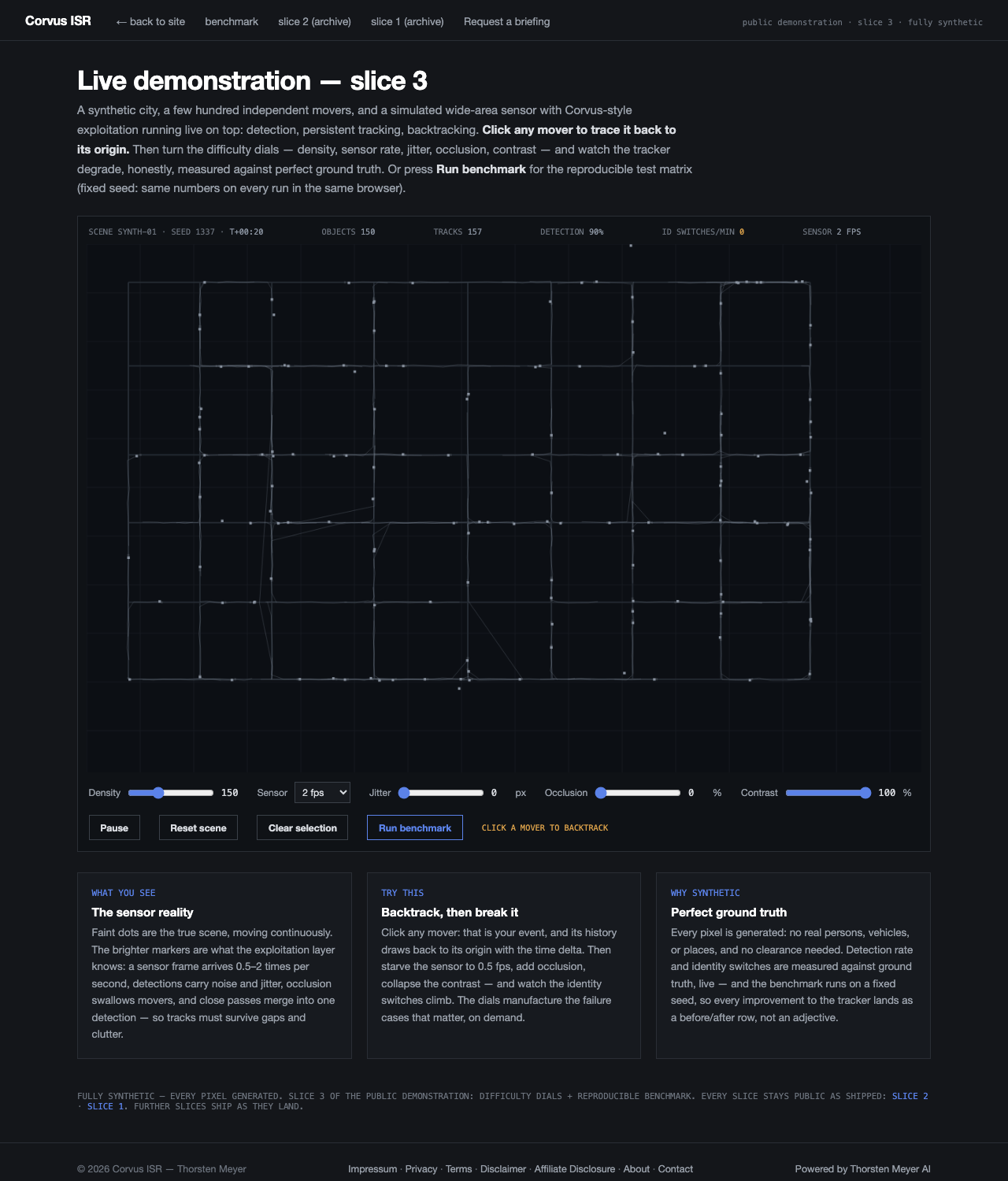
All of these results are based on a **fully synthetic environment**, meaning no real persons, vehicles, or locations are involved—every pixel is generated. This approach allows for controlled experimentation and benchmarking that is free from real-world variability, providing a solid foundation for ongoing development of more reliable multi-object tracking systems. The benchmark exemplifies how **innovative algorithms** can lead to significant reductions in identity errors, even in challenging scenarios.
If you’re a tech enthusiast or developer interested in the cutting edge of **multi-object tracking**, you can try the benchmark yourself. Visit the [public benchmark](https://corvusisr.com/benchmark/) and then head over to the [demo page](https://corvusisr.com/demo/) to see how the new model performs in real-time. Run the benchmark yourself and witness firsthand the impact of advanced association algorithms on tracking performance.

Data Association for Multi-Object Visual Tracking (Synthesis Lectures on Computer Vision)
As an affiliate, we earn on qualifying purchases.
As an affiliate, we earn on qualifying purchases.
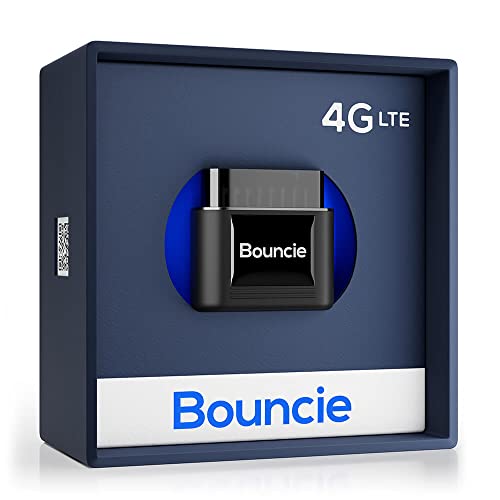
Bouncie GPS Tracker for Vehicles with Real-Time Location
- Real-Time Location Updates: Provides up-to-the-minute vehicle location
- Unlimited Trip History: Stores detailed route history for all trips
- Driving Behavior Monitoring: Tracks speed, acceleration, and braking
As an affiliate, we earn on qualifying purchases.
As an affiliate, we earn on qualifying purchases.
As an affiliate, we earn on qualifying purchases.
surveillance object tracking device
As an affiliate, we earn on qualifying purchases.
As an affiliate, we earn on qualifying purchases.