TL;DR
A federal jury in Brooklyn convicted Huawei of conspiracy to steal trade secrets and bank fraud, while acquitting the company of racketeering conspiracy. Huawei rejects the remaining charges and plans to appeal; a sentencing date and potential penalty have not been identified in the cited reports.
A federal jury in Brooklyn, New York, convicted Huawei of conspiracy to steal trade secrets and bank fraud on November 24, while acquitting the Chinese technology company of racketeering conspiracy, according to the Associated Press. The split verdict leaves Huawei facing criminal convictions it says it will challenge, but a sentencing date and penalty have not been identified in the cited reports.

Get the latest gadgets delivered free with Prime
- Fast, free delivery on millions of items
- Prime Video, Amazon Music and more included
- Member-only deals all year
The jury’s decision followed an 11-week trial in federal court in Brooklyn, Arab News reported. Prosecutors accused Huawei of a series of efforts to obtain competitors’ confidential technology and of misleading banks and U.S. officials about business dealings. The jury convicted the company on the trade-secret conspiracy and bank-fraud counts, according to the AP, but rejected the racketeering conspiracy charge.
Prosecutors’ account, as summarized by the AP, included allegations involving copied router source code, secret photographs of equipment at a competitor’s trade-show booth, and a robotic arm removed from a rival’s laboratory so it could be measured. The companies named as alleged victims in court records cited by the AP included Cisco Systems, Motorola Solutions, T-Mobile, Quintel USA and Fujitsu. These examples describe the government’s case; the verdict does not mean every allegation was separately upheld by the jury.
Prosecutors also alleged that Huawei did business in countries subject to U.S. sanctions, including Iran and North Korea, and made false statements to banks and officials. The company denied wrongdoing. Huawei said it welcomed the racketeering acquittal and described the remaining charges as “without legal or factual merit,” according to the source material. A Huawei lawyer told the AP that the company plans to appeal.
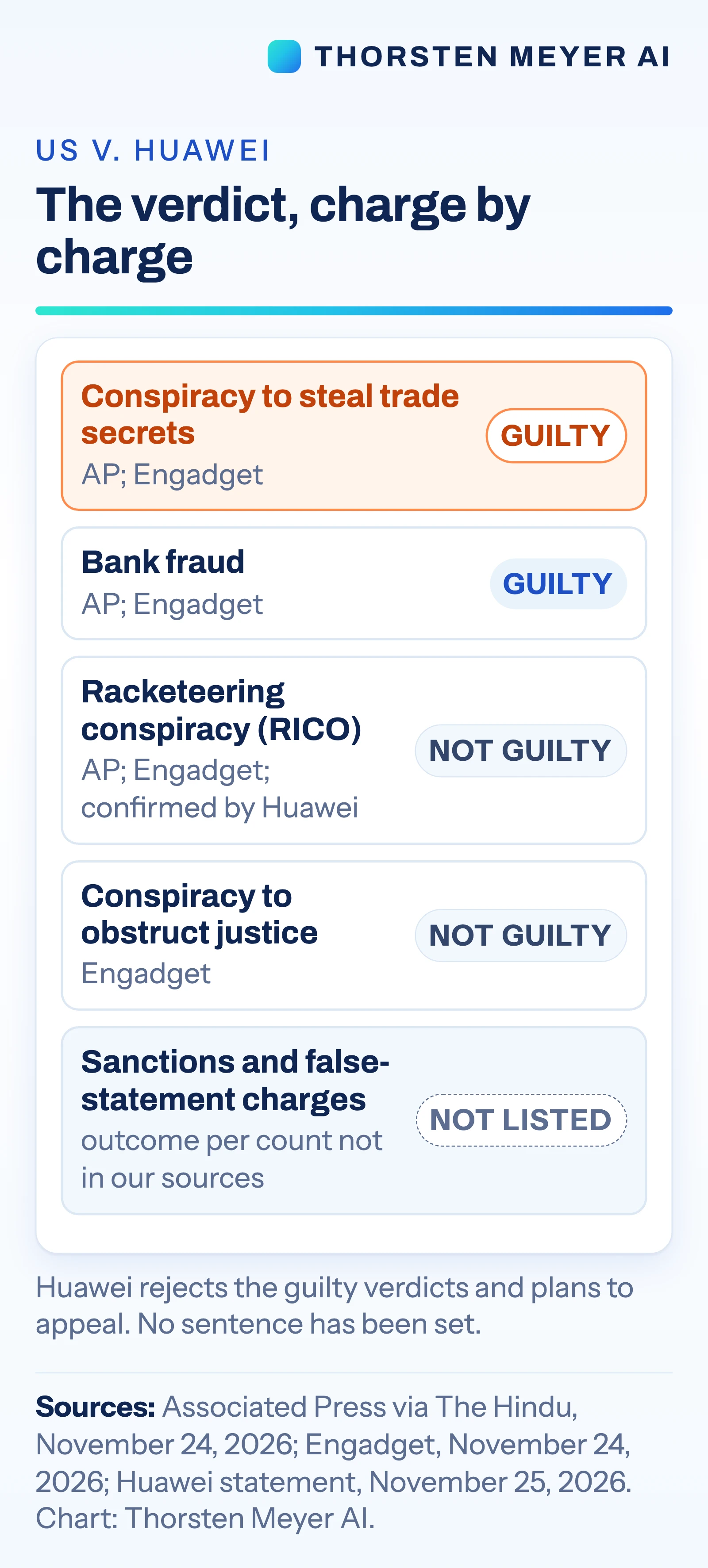
The Verdict’s Reach for Huawei
The verdict draws a line between the convictions the jury returned and the racketeering theory it rejected. For companies that rely on confidential designs, code and manufacturing methods, the trade-secret conviction shows that prosecutors can pursue criminal charges when they say corporate employees or representatives agreed to obtain protected information. It does not, by itself, settle how the law applies to every competitive research practice or establish that each alleged act occurred as prosecutors described.
The outcome also matters to technology businesses watching Huawei’s position in global markets. The AP described Huawei as a major alternative to Nvidia chips within China. However, the cited reports do not say the jury’s verdict changes Huawei’s chip business or creates a new trade restriction. Huawei was already barred from selling its equipment in the United States, according to the source material. Customers outside the U.S. should not infer an immediate product change from this criminal verdict alone.
For banks and companies that handle sensitive technology, the case also highlights how access and corporate controls can become part of a criminal investigation. The alleged conduct ranged from handling source code to photographing and measuring equipment. The trial’s outcome makes the legal distinction between obtaining public information and acquiring protected material through improper means especially relevant, while leaving the details of any eventual sentence unresolved.
Products Worth Considering

LG UltraGear 32-inch QHD Curved Gaming Monitor, 180Hz, 1ms, AMD FreeSync

Jackery Explorer 1000 v2 Portable Power Station

Sony WH-1000XM6 Wireless Noise-Canceling Headphones, Black
As an affiliate, we earn on qualifying purchases.
How the Federal Case Developed
The U.S. case began in early 2019, when the government announced criminal charges against Huawei and later expanded them, the AP reported. The case combined accusations concerning trade secrets, sanctioned-country business and statements to financial institutions and U.S. officials. The prosecution presented the allegations as a broader pattern; Huawei denied wrongdoing and contested the charges.
The trade-secret count concerned an alleged agreement to obtain information that competitors kept confidential because it had commercial value. In general terms, a trade secret can include source code, circuit designs or technical methods, rather than only a single document. A conspiracy charge concerns an alleged agreement to commit an offense, along with steps taken toward it. The jury’s conviction was on conspiracy to steal trade secrets, as reported by the AP.
Racketeering conspiracy was the more expansive charge in the case. Engadget described racketeering as a charge often associated with organized criminal activity. Prosecutors argued that it applied to what they portrayed as repeated conduct by Huawei. The jury acquitted the company on that count while returning guilty verdicts on the trade-secret conspiracy and bank-fraud charges. The verdict therefore resolved the charges differently rather than accepting or rejecting the prosecution’s case as a whole.
““Without legal or factual merit.””
— Huawei
Sentencing and Appeal Remain Open
The available reports do not identify a sentencing date or say what penalty prosecutors will seek or the court may impose. The jury’s verdict establishes the counts on which Huawei was convicted and acquitted; it does not establish the eventual sentence.
Huawei says it plans to appeal, but the cited material does not specify when an appeal will be filed, which issues it will raise or how long the process may take. The source material also does not provide a complete account of the jury’s reasoning on each allegation. Details beyond the reported verdict and the parties’ stated positions remain unclear.
Court Sets the Next Milestones
The next identified step is sentencing in federal court, though no date was listed in the sources available as of November 27. The court will determine the penalty after the convictions; the amount or form of any penalty has not been reported here. Huawei’s stated plan to appeal may lead to further proceedings, but the timing and grounds are not yet clear.
For now, the immediate legal position is defined by the split verdict: convictions for trade-secret conspiracy and bank fraud, and an acquittal on racketeering conspiracy. Any further account of the case should distinguish those jury findings from allegations that were part of the prosecution’s presentation.
Key Questions
What did the jury convict Huawei of?
The jury convicted Huawei of conspiracy to steal trade secrets and bank fraud, according to the Associated Press.
What charge did Huawei beat?
The jury acquitted Huawei of racketeering conspiracy, the most serious charge described in the source material.
What did prosecutors say Huawei took?
Prosecutors alleged conduct involving competitor source code, photographs of equipment at a trade show and a robotic arm taken from a rival’s lab to be measured. Those are allegations described in reports on the government’s case.
Will Huawei appeal?
A Huawei lawyer told the AP that the company plans to appeal. The available reports do not state when it will file or what arguments it will make.
Has the company been sentenced?
The source material available as of November 27, 2026, does not list a sentencing date or penalty.
Source: Thorsten Meyer AI