
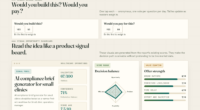
📊 Full opportunity report: Europe Regulated the Interface and Forgot to Build the Engine on ThorstenMeyerAI.com — validation score, market gap, and execution plan.

Get the latest gadgets delivered free with Prime
- Fast, free delivery on millions of items
- Prime Video, Amazon Music and more included
- Member-only deals all year
TL;DR
Europe has focused heavily on regulating digital interfaces like cookie banners but has neglected building the underlying AI engines. This has led to a significant lag in AI capability compared to the US and China, risking its technological sovereignty.
Europe’s efforts to regulate digital interfaces, exemplified by cookie banners, have come at the expense of developing its own AI engines. While the continent has focused on setting rules for user privacy and consent, it has largely failed to build or fund the advanced AI models necessary to compete globally. This shift highlights a strategic misstep in the continent’s approach to technological sovereignty.
European regulators have prioritized creating rules for digital interfaces, such as the GDPR and the ePrivacy Directive, leading to widespread cookie banners that often violate legal standards. These regulations have become symbolic of Europe’s regulatory approach but have not addressed the core technological capabilities needed for AI leadership. Meanwhile, Europe’s AI landscape remains limited, with only one notable lab, Mistral, which trails behind major US and Chinese models in capability and funding.
Despite efforts like the Digital Omnibus proposal to simplify consent mechanisms and reduce compliance costs, Europe has not invested significantly in building or funding advanced AI models. The continent’s flagship AI company, Mistral, has raised only a few billion dollars and remains mid-tier compared to US giants like OpenAI and Chinese models like Zhipu’s GLM 5.2, which are freely available and far more capable.
Furthermore, Europe’s regulatory and capital environment discourages innovation and talent retention, with many researchers and entrepreneurs leaving for more favorable markets in the US and China. This has resulted in a technological lag that could undermine Europe’s strategic independence in critical areas like cybersecurity, defense, and AI research.
Europe regulated the interface and forgot the engine
The cookie banner is the most-used European software of the decade. While Brussels perfected the consent pop-up, the frontier was built elsewhere — and now, in H2 2026, Europe wants to buy back in without changing what put it on the outside.
This isn’t about whether privacy or safety matter — they do. It’s that Europe mistook regulating the interface for having a seat at the table. You can’t grant your way out of a structural problem while keeping the structure — the laws, the capital gaps, the energy costs, the talent drain all left untouched. The fix isn’t another framework: it’s open weights as a product, sovereign compute on affordable power, real capital plumbing — and to stop mistaking a check for a strategy.
Implications of Europe’s Regulatory and Innovation Gap
This situation poses a significant risk to Europe’s technological sovereignty and economic competitiveness. By regulating only the surface of technology without fostering the underlying infrastructure, Europe risks falling behind in the AI race, which is increasingly tied to geopolitics and national security. The lack of investment and innovation could leave Europe dependent on foreign AI models and technology, diminishing its influence in global digital governance and security.
As an affiliate, we earn on qualifying purchases.
Europe’s Regulatory Approach and Global AI Competition
Europe pioneered comprehensive AI regulation with the AI Act, enacted before the industry was fully developed. While this aimed to ensure safety and privacy, it has inadvertently hampered the growth of local AI companies and talent. In contrast, the US and China have prioritized funding and building cutting-edge AI models, with China shipping near-frontier models for free download, and US companies raising tens of billions of dollars for advanced models.
European labs, like Mistral, are underfunded and lag behind global leaders in capability. The continent’s regulatory focus has created a fragmented market and a capital environment that discourages large-scale investment, further widening the gap in AI development. This divergence is not merely technical but strategic, affecting global influence and security.
“Our regulatory framework is choking innovation, while competitors are shipping models that outperform ours at a fraction of the cost.”
— European AI industry insider
As an affiliate, we earn on qualifying purchases.
Unclear Impact of Future European AI Funding
It remains uncertain whether Europe will significantly increase its investment in AI infrastructure and talent in the near future. While some policymakers acknowledge the gap, concrete plans and funding levels have yet to be announced or implemented, leaving the future of European AI competitiveness uncertain.
privacy compliant cookie management tools
As an affiliate, we earn on qualifying purchases.
As an affiliate, we earn on qualifying purchases.
Next Steps for Europe’s AI Strategy
Europe is likely to continue focusing on regulatory reforms, such as the Digital Omnibus, to improve user experience and compliance. However, without substantial investment in AI research, development, and talent retention, the continent risks further falling behind. Future policy discussions may need to balance regulation with proactive funding and support for local AI innovation to regain competitiveness.
As an affiliate, we earn on qualifying purchases.
Key Questions
Why has Europe focused more on regulating interfaces than building AI engines?
European policymakers prioritized privacy and user consent regulations, believing that control over interfaces would ensure safety and compliance. However, this approach overlooked the importance of developing the underlying AI infrastructure needed for technological leadership.
How does Europe’s AI capability compare to the US and China?
Europe’s AI landscape is limited, with only one notable lab, Mistral, which is mid-tier globally. In contrast, China and the US have developed and released advanced, often free, models that outperform European efforts in capability and funding.
What are the risks of Europe’s current approach?
Europe risks losing strategic independence in AI, falling behind in critical areas like cybersecurity and defense, and becoming dependent on foreign AI models and technology.
Will Europe change its strategy to focus more on AI development?
It is uncertain. While some policymakers recognize the gap, concrete plans for increased funding or building infrastructure have not yet materialized, making future shifts unclear.
Source: ThorstenMeyerAI.com
Fall Picks
fall essentials
As an affiliate, we earn on qualifying purchases.