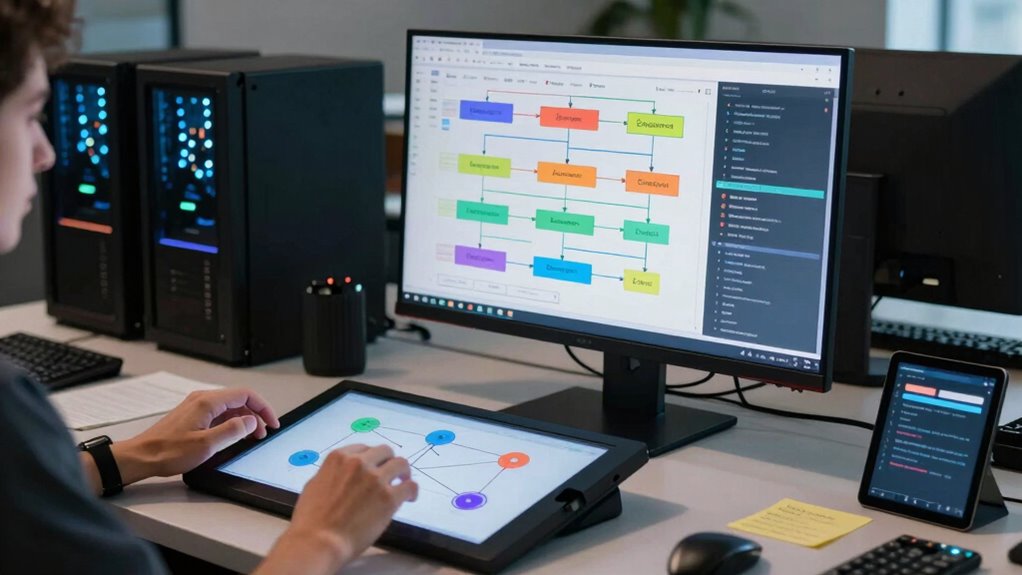

Event-driven architecture changes your application design by making it more reactive and responsive to real-time data and events. It shifts away from traditional request-response models, allowing components to communicate asynchronously through event streams. This approach improves scalability, fault tolerance, and flexibility, especially when integrating microservices. As systems adapt immediately to new information, your applications become faster and more resilient. Keep exploring to discover how this transformation can drive smarter, more efficient solutions for your projects.

Get the latest gadgets delivered free with Prime
- Fast, free delivery on millions of items
- Prime Video, Amazon Music and more included
- Member-only deals all year
Key Takeaways
- Shifts from monolithic, request-response models to distributed, event-centric systems for better scalability and flexibility.
- Enables real-time processing, allowing applications to respond instantly to user interactions and system events.
- Promotes loosely coupled microservices communication through asynchronous event streams.
- Enhances system resilience by reducing dependencies and improving fault tolerance.
- Fosters development of modular, adaptable applications capable of handling dynamic, fast-paced environments.
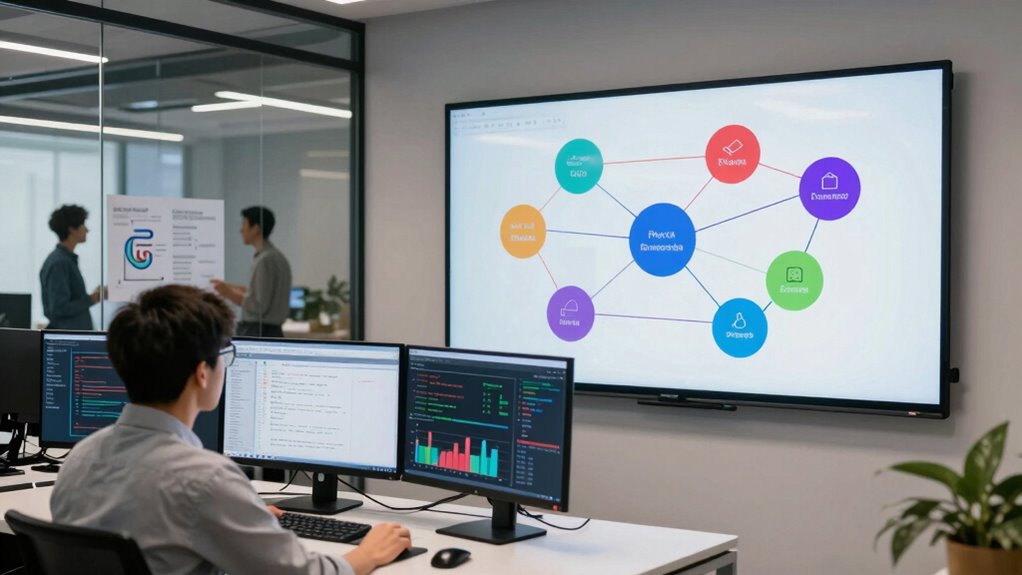
Have you ever wondered how modern applications respond instantly to real-time events? It’s a question many developers ask as they endeavor to create more responsive and scalable systems. The answer lies in event-driven architecture, which fundamentally changes how applications are designed and operated. Instead of relying on traditional request-response models, event-driven systems focus on reacting to events as they occur, enabling real-time processing that’s faster and more efficient. This shift is especially evident in how applications handle data streams, user interactions, and system notifications, allowing them to adapt immediately to new information.
At the core of this transformation is the concept of real-time processing. Instead of batch updates or delayed responses, event-driven architecture guarantees that applications process events instantly or with minimal latency. When an event happens—say, a user clicks a button or a sensor detects a change—the system responds right away, updating data, triggering workflows, or notifying users. This immediacy creates a more engaging and dynamic user experience, as applications no longer feel sluggish or disconnected from real-world activities. Moreover, real-time processing supports high throughput and low latency, which are critical for modern applications handling large volumes of data, such as financial platforms or IoT systems. Additionally, advancements in high-performance hardware and networking technologies further support the widespread adoption of event-driven systems, making real-time responsiveness more achievable than ever before. As a result, real-time processing is increasingly becoming a standard feature in contemporary application development.
Real-time processing ensures instant responses, creating dynamic user experiences and supporting high-volume, low-latency applications like finance and IoT.
Another key aspect is microservices integration. Event-driven architecture naturally complements microservices by enabling loosely coupled, independent components that communicate through events rather than direct calls. This approach makes it easier to develop, deploy, and scale individual services without disrupting the entire system. When a specific event occurs—like a new user registration or a payment confirmation—relevant microservices can listen for and react to that event asynchronously. This design reduces dependencies, improves fault tolerance, and enhances overall system resilience. It also simplifies updates and deployments, since changes to one microservice don’t necessarily impact others, fostering a more flexible and maintainable architecture. This model also leverages asynchronous messaging, which is fundamental for ensuring decoupled communication between services. Furthermore, scalability benefits significantly from this modular approach, enabling systems to grow efficiently as demand increases.
In essence, adopting event-driven architecture reshapes application design by making systems more reactive, scalable, and resilient. It promotes a shift from monolithic, request-driven models to distributed, event-centric ones, where components work together through streams of events. This paradigm enables applications to handle real-time processing seamlessly, providing users with instant feedback and adaptive experiences. It also aligns perfectly with microservices integration, allowing organizations to build modular, flexible systems that can evolve swiftly in response to changing demands. As a result, event-driven architecture is no longer just a trend but a fundamental approach to creating smarter, more responsive applications in today’s fast-paced digital world.
As an affiliate, we earn on qualifying purchases.
Frequently Asked Questions
How Does Event-Driven Architecture Impact System Scalability?
Event-driven architecture boosts your system’s scalability by enabling better event scalability, allowing your application to handle increased loads efficiently. As events are processed asynchronously, your system can scale components independently, improving load balancing across services. This architecture supports dynamic scaling, so when demand spikes, you can quickly add more event handlers or resources without disrupting existing operations, ensuring your system remains responsive and resilient under heavy loads.
What Are Common Challenges in Implementing Event-Driven Architecture?
You might face challenges with implementing event-driven architecture, especially around designing a consistent event schema and choosing reliable message brokers. Ensuring schema evolution doesn’t break your system requires careful planning. Additionally, managing message delivery guarantees and handling message failures can be tricky. You need to monitor and troubleshoot message flow effectively. Balancing these aspects helps create a robust system that leverages event-driven benefits without compromising reliability or performance.
How Is Data Consistency Maintained Across Services?
Think of your system as a busy orchestra, where data consistency is the harmony. You maintain data synchronization across services through event sourcing and message queues, ensuring each part updates correctly. Implementing consistency guarantees like eventual consistency or strong consistency helps prevent mismatched data. This approach keeps your services in tune, so they respond cohesively, even amid the asynchronous nature of event-driven architecture.
What Tools or Frameworks Support Event-Driven Design?
You can use tools like Kafka, RabbitMQ, or AWS SNS/SQS to support event-driven design with message brokers. These frameworks help manage message delivery and decouple services effectively. Incorporating event sourcing allows you to track state changes as a sequence of events, enhancing system reliability. Together, message brokers and event sourcing enable scalable, flexible, and resilient applications that respond swiftly to events, improving overall system responsiveness.
How Does Event-Driven Architecture Affect System Monitoring?
You might worry that event-driven architecture complicates monitoring, but it actually enhances your ability to respond quickly. With real-time alerts and anomaly detection, you catch issues instantly, preventing outages. You gain granular visibility into system behavior, making troubleshooting faster and more precise. This proactive approach boosts reliability, giving you peace of mind and confidence that your system remains robust and responsive under any load or unexpected event.
real-time data processing software
As an affiliate, we earn on qualifying purchases.
As an affiliate, we earn on qualifying purchases.
Conclusion
Embrace the exciting evolution of event-driven architecture, where your applications become agile, alert, and adaptable. By harnessing this dynamic design, you’ll build bold, boundary-breaking systems that respond rapidly and reliably. Let the lively, lightning-fast flow of events energize your enterprise, empowering you to excel in a competitive, constantly changing landscape. With this powerful paradigm, your applications transform into vibrant, vivid venues of value, energy, and vision—ready to revolutionize your digital domain.
As an affiliate, we earn on qualifying purchases.
As an affiliate, we earn on qualifying purchases.
Halloween Picks
halloween
As an affiliate, we earn on qualifying purchases.