TL;DR

Get the latest gadgets delivered free with Prime
- Fast, free delivery on millions of items
- Prime Video, Amazon Music and more included
- Member-only deals all year
Nvidia CEO Jensen Huang publicly dismissed a comparison equating GPUs to nuclear weapons, calling it ‘stupid.’ The statement highlights ongoing debates over AI hardware’s dual-use nature and export controls.
Nvidia CEO Jensen Huang publicly dismissed a comparison that likened GPUs to nuclear weapons, calling it ‘stupid’ during a speech at Stanford University. The statement underscores his stance against restricting access to Nvidia’s technology, which is central to AI development worldwide.
During a guest appearance at Stanford’s CS 153 Frontier Systems course, Jensen Huang addressed the controversial analogy made by industry peers, notably Dario Amodei of Anthropic, who compared selling advanced AI chips to China with selling nuclear weapons to North Korea. Huang emphasized that such a comparison is fundamentally flawed, stating, “What I’m fundamentally against, and it makes no sense, is to compare Nvidia GPUs to atomic bombs.” He clarified that Nvidia GPUs are used by billions globally for civilian purposes, including personal and commercial applications, and are not military weapons.
Huang further explained that while AI hardware has dual-use potential, it is not inherently a military system like nuclear missiles. He highlighted that AI chips are used in various sectors such as science, research, and industry, but acknowledged their potential military applications, including intelligence and autonomous systems. He also addressed concerns about export controls, arguing that restricting access could harm U.S. technological dominance and that Nvidia’s hardware remains accessible worldwide, including to some Chinese entities with ties to military research, though the company denies direct assistance for military use.
Why It Matters
This development is significant because it clarifies Nvidia’s CEO stance amid ongoing geopolitical debates about AI technology export restrictions. Huang’s rejection of the nuclear analogy aims to defend the civilian and commercial use of Nvidia’s chips, which are vital to global AI progress. However, the acknowledgment of dual-use concerns underscores the delicate balance between maintaining technological leadership and preventing military proliferation. The statement may influence policy discussions on export controls and international AI development strategies.
As an affiliate, we earn on qualifying purchases.
Background
Recent years have seen increasing scrutiny of AI hardware exports, especially to China, amid fears of military applications. Industry leaders like Huang have argued against restrictive policies, emphasizing the importance of open access for innovation. The comparison of GPUs to nuclear weapons, made by others in the industry, has heightened tensions, prompting Huang’s public rebuke. Historically, AI hardware’s dual-use nature has been a point of concern for U.S. policymakers seeking to prevent adversaries from gaining military advantages while supporting domestic innovation.
“What I’m fundamentally against, and it makes no sense, is to compare Nvidia GPUs to atomic bombs. There are a billion people with Nvidia GPUs; I advocate Nvidia GPUs to all of you, I advocate Nvidia GPUs to my family, my kids, to people I love — but I don’t advocate atomic bombs to anybody.”
— Jensen Huang
“The idea that I regard as completely ridiculous is why should American companies go compete in foreign countries if you are going to lose it anyway. If you guys all apply that same philosophy, why wake…”
— Jensen Huang
As an affiliate, we earn on qualifying purchases.
What Remains Unclear
It remains unclear how this statement will influence future policy decisions regarding export controls and AI hardware restrictions, especially in the context of ongoing geopolitical tensions and military concerns. The extent of Nvidia’s involvement or compliance with potential restrictions also remains uncertain.
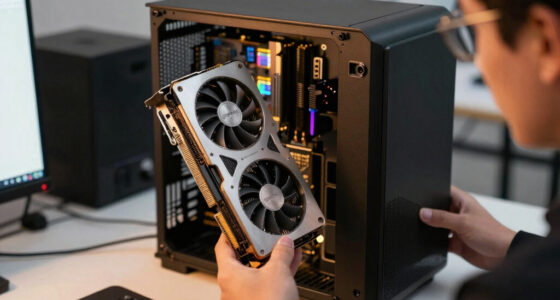
professional Nvidia graphics card
As an affiliate, we earn on qualifying purchases.
As an affiliate, we earn on qualifying purchases.
What’s Next
Next steps include continued policy debates in the U.S. and abroad regarding AI export restrictions, with industry leaders like Huang likely to advocate for open access. Nvidia may also face increased scrutiny or regulatory adjustments based on evolving geopolitical and security concerns.
As an affiliate, we earn on qualifying purchases.
Key Questions
Why did Jensen Huang compare GPUs to nuclear weapons?
He was responding to industry claims equating AI chips with nuclear weapons, which he strongly opposed, emphasizing that GPUs are civilian tools used worldwide for many purposes.
Does Nvidia support exporting chips to China?
Huang has publicly supported the idea that restricting access harms U.S. technological leadership, though Nvidia complies with existing export controls. The company denies providing military assistance to Chinese entities.
How does this affect global AI development?
The statement highlights the importance of open access to AI hardware for innovation, but also underscores concerns over dual-use technology and military applications, influencing international policy debates.
Halloween Picks
halloween
As an affiliate, we earn on qualifying purchases.