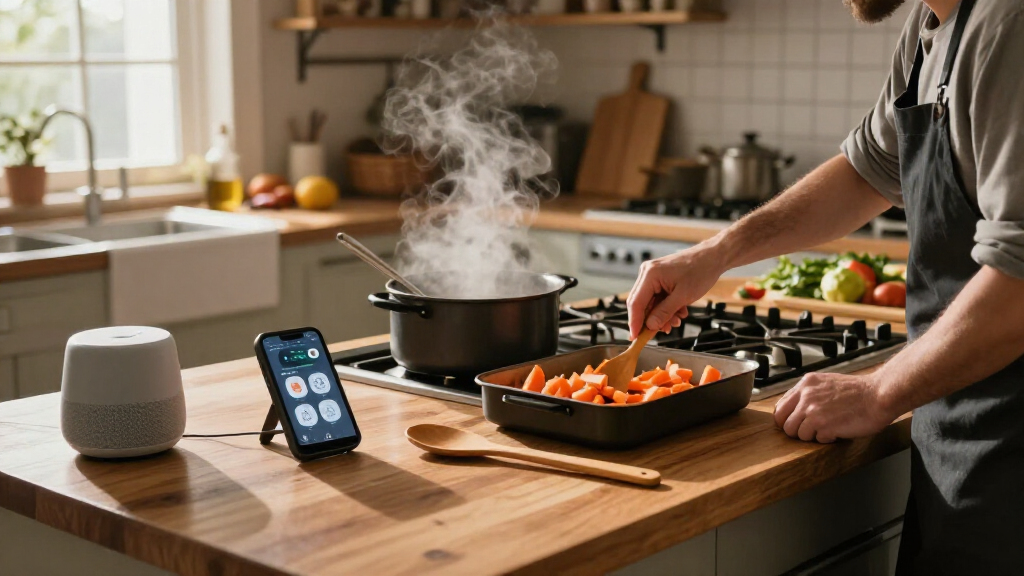

🔍 Read the full analysis: Make Thanksgiving Meal Prep Easier With AI-Powered Kitchen Timers on ThorstenMeyerAI.com

Get the latest gadgets delivered free with Prime
- Fast, free delivery on millions of items
- Prime Video, Amazon Music and more included
- Member-only deals all year
TL;DR
AI-powered kitchen timers can interpret spoken requests, label multiple countdowns and suggest alerts from recipes, which may help cooks manage several Thanksgiving dishes. Features vary, and speech errors, connection problems and imperfect recipe readings remain possible; timers cannot determine whether food is safely cooked.
The original guide to AI-powered kitchen timers describes how AI-powered kitchen timers can interpret spoken cooking requests, manage multiple labeled countdowns and suggest alerts from recipes—features that may help cooks coordinate a busy Thanksgiving meal. The guide also cautions that these tools can mishear instructions or depend on an internet connection, and that a timer cannot verify food safety.
The term “AI-powered” covers a range of tools, according to the guide. Some assistants interpret a spoken request and set a countdown; others connect timers to recipe services or suggest a schedule from recipe instructions. A device being connected to Wi-Fi does not, by itself, establish that it uses AI. Buyers should check the product’s feature description for what it can actually do, such as name timers, accept voice changes or present recipe-based suggestions.
Multiple labeled timers could help when a cook is managing dishes with different cooking times. A request to time pasta for nine minutes and check sauce in five, for example, requires the system to keep the two tasks distinct. Clear labels can help identify an alert, while controls to pause, adjust or dismiss one timer without clearing the others can make it easier to respond when a recipe changes.
Voice recognition can be affected by kitchen noise, ambiguous wording or other speech differences. The guide recommends checking a timer’s display or spoken confirmation when an error could affect cooking, and keeping a basic phone or manual timer available as a backup. Recipe-derived alerts should also be reviewed before they are started, rather than treated as a complete cooking plan.
Check what a product actually does: voice control and Wi-Fi alone do not prove it uses AI.
Use clear timer names, review spoken commands, and confirm recipe-generated alerts before cooking.
Compare alert options, timer adjustments, offline use, privacy controls, and total cost.
Treat recipe timers as reminders to check; use a food thermometer when safe temperature matters.
Keeping Thanksgiving Dishes on Track
Thanksgiving cooking often involves several dishes that need attention at overlapping times. A timer that lets someone start or adjust countdowns without touching a phone could reduce the number of steps involved, especially when hands are wet or covered in ingredients. Task labels and reliable alerts matter as much as voice control: an alert is less useful if the cook cannot tell which dish it refers to.
The technology does not remove the need for judgment. A countdown can remind someone to check a dish, but it cannot account for every oven, portion size or recipe variation, and it cannot confirm that meat has reached a safe temperature. Cooks still need to follow appropriate food-safety guidance and check food directly. The practical value is in organizing reminders, not certifying that dinner is done.
That distinction also matters when shopping. A flexible conversational feature may be convenient, but a straightforward timer with dependable alerts and easy corrections may be a better fit for some kitchens. Features can depend on a device, software version, region, subscription or cloud service, so advertised capabilities should be checked against current product documentation.
Products Worth Considering

Bose TV Speaker Compact Soundbar with Bluetooth and HDMI-ARC, Black

Samsung Odyssey G7 G75F 40-Inch WUHD Curved Gaming Monitor

DJI Osmo 360 Motorcycle Handlebar POV Combo
As an affiliate, we earn on qualifying purchases.
From Voice Commands to Recipe Alerts
The source guide describes AI timers as part of a broader addition of conversational and generative AI features to existing assistants, recipe services and smart displays. Its account of that trend is based on information available through mid-2024; it does not establish the current capabilities of any particular product. Manufacturers may alter software and service features after a device is sold.
There is a practical difference between a fixed command and flexible language interpretation. A fixed command may require users to learn specific phrasing but can be more predictable. More flexible interpretation may accept natural requests, while increasing the chance that a phrase is misunderstood. In either case, cooks benefit from being able to see or hear what the device understood before relying on a countdown.
Recipe tools add another layer: software may identify cooking durations in written instructions and turn them into suggested reminders. The guide advises treating those alerts as a draft to review. Recipe wording does not always translate cleanly into a timer, and a suggested schedule cannot account for every change in ingredients, equipment or cooking conditions.
““AI-powered” covers everything from a voice assistant that recognizes timer commands to a recipe service that suggests a schedule.”
— ThorstenMeyerAI.com guide
What Timer Features Can Promise
The source material does not identify a particular product, independent testing results or measured improvements in cooking outcomes. It also does not establish how accurately any device handles speech in a noisy kitchen, how often alerts are missed, or which features are available on current models. Those details vary by product and may change with software or service updates.
Other points to check include whether basic countdowns work without internet access, what happens during a service outage, whether voice recordings or cooking data are collected, and whether recipe functions require a subscription. The guide does not provide product-specific answers on privacy, pricing or offline operation. It also does not claim that AI-generated schedules are consistently accurate.
Check Settings Before Cooking
Before relying on a timer for a holiday meal, cooks can check the manufacturer’s current documentation for supported commands, recipe features, offline behavior, alert settings, privacy terms and any subscription costs. Testing the device with a few simple timers ahead of time can show whether it labels tasks clearly and lets users correct one countdown without disturbing the others.
For the meal itself, name each timer by dish or action, confirm its duration on screen or through a spoken repeat, and keep a separate basic timer available if the connection or device fails. Recipe suggestions should be checked against the recipe being prepared, and food should be assessed directly using appropriate food-safety practices. The guide names no upcoming product launch or policy milestone; current features will need to be verified with individual manufacturers.
Key Questions
What does an AI-powered kitchen timer do?
It may interpret spoken requests to create or label countdowns, and some products can suggest alerts from recipe instructions. Capabilities differ by device; the label alone does not show which functions are included.Can it manage several Thanksgiving dishes at once?
Some systems can keep multiple named countdowns, such as one for potatoes and another for rolls. Check that the device displays or announces which task an alert belongs to and allows timers to be changed separately.Can a timer tell me when food is safe to eat?
No. A countdown can prompt you to check food, but it cannot confirm that a dish has been cooked safely. Follow food-safety guidance and check the food itself.Will an AI kitchen timer work without internet?
That depends on the product and feature. Check the manufacturer’s current documentation to see whether basic countdowns and alerts continue during an internet outage.What should I check before buying one?
Compare timer labels and controls, alert reliability, offline behavior, privacy terms, recipe features and costs, including any subscription. Verify advertised capabilities with current product documentation.Source: ThorstenMeyerAI.com