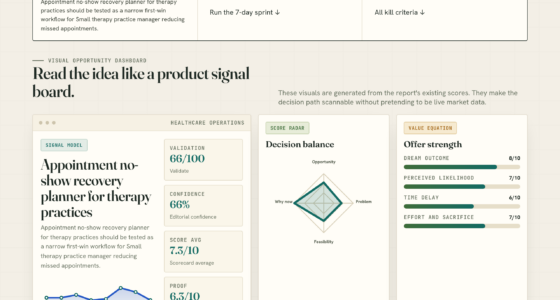
📊 Full opportunity report: The Door: Why the Interface Is Worth More Than the Model on ThorstenMeyerAI.com — validation score, market gap, and execution plan.
TL;DR
SpaceX acquired a major coding interface for $60 billion, emphasizing that the interface—where users interact—is now more valuable than the underlying AI models. Control of this surface determines access, routing, and data flow, shaping AI dominance.
SpaceX’s acquisition of a $60 billion coding interface platform marks a significant shift in AI industry dynamics, emphasizing the importance of the user interface over the underlying models. This move underscores how control of the interface—the point where developers and users interact—has become the most strategic asset in AI distribution, surpassing the value of the models themselves.
In June 2024, SpaceX purchased a prominent coding interface platform built on top of various AI models, with an estimated valuation of $60 billion. This platform, known as Cursor, generates roughly $4 billion in annual revenue and has successfully resisted attempts by competitors like OpenAI and Microsoft to acquire it. The core value lies not in the models but in the interface—where developers type commands, and demand flows through.
This transaction exemplifies a broader industry trend: as AI models become more commoditized, the interface—where users engage with AI—emerges as the primary chokepoint. The interface captures the default model, user habits, data feedback, and routing choices, effectively controlling access and influence over AI usage.
Industry experts, including Thorsten Meyer, highlight that owning the surface means owning the habit, data, and the decision-making process around which models are called. This shift has been reinforced by recent moves in browser-based AI interfaces, such as OpenAI’s Atlas and Perplexity’s Comet, which are rapidly gaining user adoption and are embedded in operating systems and popular platforms.
The Door: Worth More Than the Model
SpaceX paid $60B for a coding tool — not a model. As the model commoditizes, the surface the human touches captures the value: the default, the habit, the data, and the choice of which model gets called.
Perplexity
The most valuable chokepoint — and, strangely, the most winnable. You can’t bootstrap a gigawatt or a 555K-GPU cluster, but a small team can still build the door (Cursor was a few founders on rented models). Own the interface and the user relationship even if you rent everything underneath — and never let a platform’s default be your only door to your users.
Implications of Interface Control in AI Dominance
The acquisition underscores a fundamental shift: control of the user interface, or the ‘door’ to AI, is now more valuable than the models themselves. This control determines the default AI, influences user habits, and captures valuable data streams, creating a formidable moat for the interface owner. As AI becomes more integrated into daily tools and browsers, the ability to route demand and influence model selection will define industry leadership and market power.
This trend signals that future AI dominance may hinge less on developing the most advanced models and more on owning the surfaces where users interact. Companies that control these interfaces can steer user behavior, shape data feedback loops, and establish proprietary demand pipelines, making the interface a strategic asset with high valuation potential.

AI ESP32-P4-WIFI6-DEV-KIT Development Board, Based On ESP32-P4 and ESP32-C6, Supports Wi-Fi 6 and Bluetooth 5 / BLE 5, Rich Human-Machine Interfaces, Supports AI Speech Interaction, with Speaker
ESP32-P4-WIFI6-DEV-KIT Development Board, Based On ESP32-P4 and ESP32-C6. It features rich Human-Machine interfaces, including MIPI-CSI (with integrated Image…
As an affiliate, we earn on qualifying purchases.
As an affiliate, we earn on qualifying purchases.
Industry Shift Toward Interface Ownership
Over the past three years, AI industry focus has largely centered on developing increasingly capable models, with billions invested in frontier models and data centers. However, as the cost of training and maintaining models decreases and open weights become more accessible, the value of models is diminishing, approaching commodity status.
Meanwhile, the importance of the interface—such as browsers, APIs, and developer tools—has grown. Recent launches like OpenAI’s Atlas and Perplexity’s Comet demonstrate that the battleground for user engagement is shifting toward the surface layer. Major tech companies, including Google and Microsoft, are integrating AI directly into their OS and browser defaults, reinforcing the critical role of the interface in controlling access and routing demand.
“The surface on top of AI models is worth more than the models themselves because it captures the habit, data, and demand routing, making it the strategic chokepoint.”
— Thorsten Meyer

CepuXozi 6.6ft/2M ENET Diagnostic Cable, RJ45 Interface Compatible with BMW F/G Series Vehicle, OBD2 Cable for BMW ICOM & ISTA Coding
[Unlock Hidden Features] Easily program or hide modules using this enet cable bmw compatible tool. It works perfectly…
As an affiliate, we earn on qualifying purchases.
As an affiliate, we earn on qualifying purchases.
What Aspects of Interface Control Are Still Unclear
It remains unclear how quickly and widely companies will adopt interface ownership as a strategic priority. The long-term impact of this shift on model development, competition, and regulation is still developing. Additionally, the extent to which control over routing and data feedback will translate into market dominance or legal challenges is yet to be determined.

The Art and Science of UX Design: A step-by-step guide to designing amazing user experiences
As an affiliate, we earn on qualifying purchases.
As an affiliate, we earn on qualifying purchases.
Future Developments in Interface-Driven AI Competition
Expect increased investment in interface platforms and default integrations within operating systems and browsers. Legal and regulatory scrutiny around data control and antitrust issues may intensify. Companies will likely focus on consolidating ownership of user habits and routing capabilities, shaping the next phase of AI industry leadership.

Spend Less on AI with OpenRouter: A Beginner’s Guide to Using GPT, Claude, Gemini, DeepSeek, and Open Models More Wisely
As an affiliate, we earn on qualifying purchases.
As an affiliate, we earn on qualifying purchases.
Key Questions
Why is the interface more valuable than the AI model?
The interface controls user access, habits, data flow, and demand routing. Owning it allows companies to influence which models are used and capture valuable user data, making it a strategic chokepoint.
How did SpaceX’s purchase of the interface platform change industry dynamics?
The $60 billion acquisition highlights that controlling the surface where users interact with AI is now more valuable than the models themselves, shifting industry focus toward interface ownership as a competitive advantage.
What are the risks of focusing on interface control?
Legal challenges, regulatory scrutiny, and potential anti-trust actions could arise as companies seek to monopolize user interfaces. Additionally, reliance on a single interface could create vulnerabilities if user habits shift or competitors innovate.
Will the model layer become obsolete?
Not necessarily. Models will still be essential, but their value may decrease relative to the interface, which determines how and when models are used, making the interface the new strategic asset.
Source: ThorstenMeyerAI.com