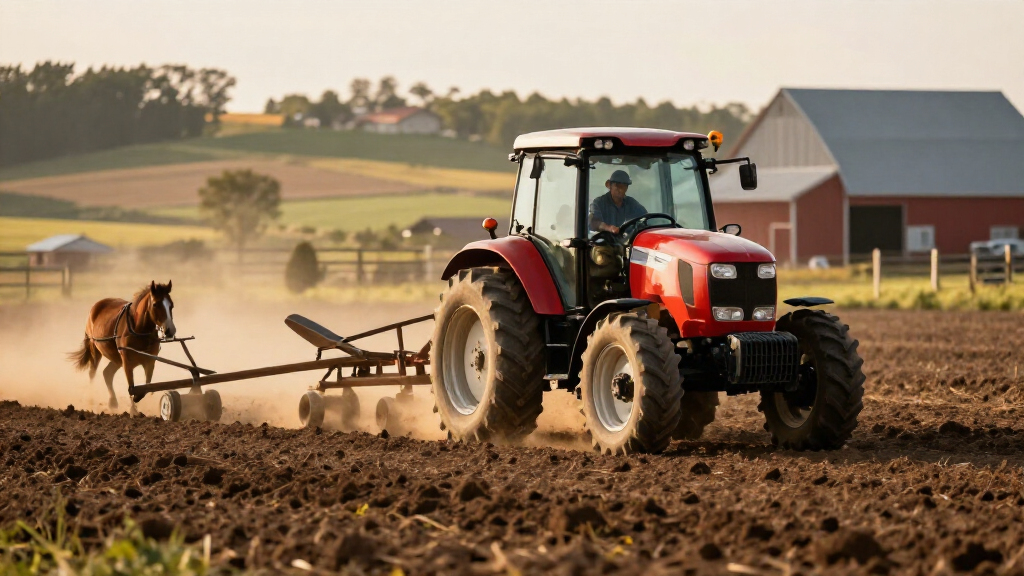

🔍 Read the full analysis: Tractor Vs. Horse: How Farms Moved Beyond Animal Power on ThorstenMeyerAI.com

Get the latest gadgets delivered free with Prime
- Fast, free delivery on millions of items
- Prime Video, Amazon Music and more included
- Member-only deals all year
TL;DR
American farms had an estimated 26.7 million horses and mules in 1918, but tractors overtook them around 1955. By 1960, farm horses and mules had fallen to 3.1 million as machinery changed agricultural production and reduced the land needed to grow animal feed. The shift also cut farm employment, while many new jobs were located in cities.
Tractors overtook horses and mules on American farms around 1955, marking a major change in how the country produced food and powered farm work. A historical account published by ThorstenMeyerAI.com on November 4, 2026, draws on U.S. government statistics to chart the decline from a peak of 26.7 million farm horses and mules in 1918 to 3.1 million in 1960—and considers what that history can and cannot tell us about automation today.
The figures cited in the account come from the U.S. Census Bureau’s *Historical Statistics of the United States, Colonial Times to 1970*, which reproduces Department of Agriculture estimates. The combined number of horses and mules on farms reached 26.7 million on January 1, 1918. Horses alone had peaked at 21.4 million in 1915; the mule count continued rising for several years.
Tractor numbers rose as animal numbers fell. The source reports about 1,000 tractors on U.S. farms in 1910, 246,000 in 1920, 920,000 in 1930 and 4.69 million in 1960. In 1955, its figures show 4.35 million tractors compared with 4.31 million horses and mules. By 1960, the animal count was down to 3.1 million, almost 90% below the 1918 peak.
Replacing animal power also freed land previously used to feed working animals. The account estimates that about 93 million acres of harvested cropland grew horse and mule feed in 1915, more than a quarter of the total harvested area that year. It puts the comparable figure at about 5 million acres in 1960. The source notes that tractor and animal counts were collected on somewhat different schedules and that the government’s combined horse-and-mule series changed in 1951.
How Mechanization Reshaped Farm Work
The change was not simply a swap of one source of power for another. Horses required land and feed throughout the year, while tractors used fuel when operating. When fewer animals needed feeding, acreage could be put to other uses. The source describes this as a shift in the resources tied up in farm power, alongside wider gains in agricultural output.
Farm labor also contracted. The account cites a peak of 13.6 million U.S. farm workers in 1916 and 4.5 million in 1970, even as the overall U.S. labor force doubled. It says new employment grew in cities, making migration part of the adjustment. The figures describe a long period of economic change; they do not, by themselves, show what happened to each worker or establish that machinery alone caused the employment decline.
The history matters to current debates because it shows both the scale of productivity changes and the disruption they can bring. It also cautions against treating past animal displacement as a direct forecast for people: workers have social, political and economic capacities that animals did not.
Products Worth Considering

LG UltraGear 34GX90SA-W 34-inch WQHD Curved OLED Gaming Monitor

Bose QuietComfort Ultra Earbuds (2nd Gen), Wireless Noise-Cancelling Earbuds, Black

Samsung Galaxy Tab A7 Lite 8.7 32GB Wi‑Fi Android Tablet – Long‑Lasting Battery, Compact Slim Design, Sturdy Metal Frame (US Version)
As an affiliate, we earn on qualifying purchases.
From Fordson to Modern Farm Robots
Tractors existed before World War I, but the source says early models were heavy, costly and better suited to large farms. Henry Ford introduced the Fordson in 1917. The Henry Ford museum describes it as a mass-produced, inexpensive lightweight tractor aimed at smaller farmers; the 100,000th Fordson left the assembly line on February 21, 1920.
Mechanization extended beyond tractors. The source reports that U.S. farms had about 4,000 combine harvesters in 1920, 190,000 in 1940 and 1.042 million in 1960. It also cites Department of Agriculture estimates that one farm worker supplied 7.1 people in 1910, 10.7 in 1940 and 47.1 in 1970. The 1970 measure includes people abroad supplied through exports.
The account connects the history to present-day automation but describes current farm robots as limited in scope. It says John Deere’s 16-camera autonomy kit, reported in February 2025, performs tillage on selected large tractors. It also reports that China said about 74% of ploughing, sowing and harvesting was mechanized in 2023. Those modern examples are source-reported claims, not evidence that all farm tasks are autonomous.
Limits of the Horse Analogy
The historical counts document a steep decline in farm horses and mules, but the figures do not provide a complete account of individual animals or the varied effects on farm families and workers. The source says farmers stopped breeding replacements and the working population aged out; it does not offer detailed, nationwide records of each animal’s fate.
It is also unclear how closely the horse-to-tractor transition can predict the effects of present-day automation on human employment. The historical account notes that farm workers moved into other parts of the economy, often in cities, but does not quantify how much of that movement resulted from mechanization rather than other economic changes. Modern autonomy examples remain task-specific in the material cited, and their broader adoption or employment effects are not established.
What the Historical Record Can Show
The account is a retrospective rather than an announcement of a new policy or technology milestone. Its next step is to compare the U.S. experience with developments in China, Germany and Japan, and to examine what today’s driverless tractors can do. Any assessment of the modern shift will depend on clearer evidence about the range of tasks automated, adoption across different farm sizes and the resulting effects on workers.
For the historical comparison, the key measures remain the dates and definitions behind the government series. Tractor counts were recorded on slightly different dates in some census years, and the horse-and-mule estimate changed its treatment of the animals after 1951. Those qualifications matter when reading the crossover around 1955 as a broad turning point rather than a precise, uniform change on every farm.
Key Questions
When did tractors outnumber horses and mules on U.S. farms?
The source’s figures place the crossover around 1955: 4.35 million tractors compared with 4.31 million horses and mules. The counts use somewhat different reporting dates, so the year is best read as an approximate national milestone.
How many horses and mules worked on farms at the peak?
The combined farm population peaked at an estimated 26.7 million on January 1, 1918, according to figures reproduced in the U.S. Census Bureau’s historical statistics. Horses alone peaked earlier, in 1915.
What happened to the farm horses?
The account says farmers generally stopped breeding replacements, and the working population declined as animals aged. It does not provide a detailed record of what happened to every animal.
Does the history prove automation will eliminate human jobs?
No. The horse comparison is an analogy, not a law or a direct forecast. The account reports that U.S. farm employment fell over the period while the wider labor force grew, but it does not establish that tractors alone caused those changes or show exactly how future automation will affect workers.
Source: ThorstenMeyerAI.com