
TL;DR

Get the latest gadgets delivered free with Prime
- Fast, free delivery on millions of items
- Prime Video, Amazon Music and more included
- Member-only deals all year
Amazon’s Ring announced two mobile security cameras on November 10, 2026: a flying camera for homes and a patrol robot for businesses. Ring says both include privacy controls, but the devices’ reliance on cloud processing and the limits of its TAKE encryption remain relevant questions. The drone also lacks required FCC authorization and cannot be sold until it receives it.
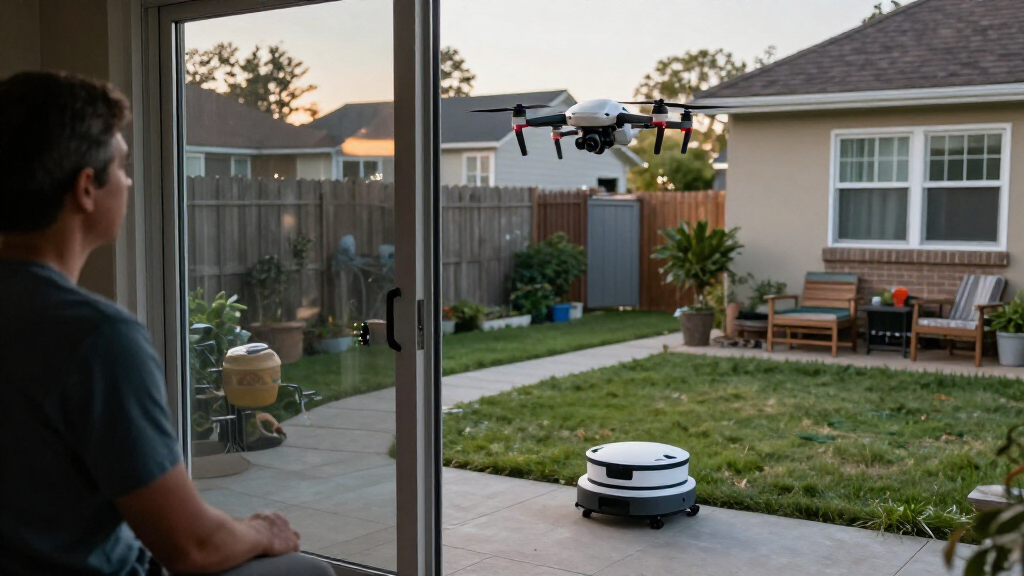
Amazon’s Ring announced two mobile security cameras on November 10, 2026: a drone designed to fly inside homes and a wheeled robot intended to patrol businesses. The products extend Ring’s camera system beyond fixed devices, bringing new questions about when recording starts, how footage is processed and what control people have over cameras that move through indoor spaces.
Ring calls the product line Ring Robotics. Its Drone Cam is listed at $249.99, with US shipping scheduled to start January 27, 2027. Ring says it can fly scheduled or on-demand routes and respond when a Ring camera, sensor or alarm is triggered. The announcement lists 2K video, a 148-degree field of view, 360-degree rotation and LED lights. Ring says its camera is off while the drone is docked. The drone has not received the authorization required under Federal Communications Commission rules, and Ring says it may not be sold until it does.
The Rover Cam, listed at $999.99, is aimed at businesses, with US shipping scheduled to start December 16, 2026. Ring says it can patrol on a schedule, investigate alerts from other Ring devices and scan 360 degrees when it reaches a patrol point. Its features include a periscope camera on an adjustable mast, two-way audio, a siren and a light tower. Ring says Rover records up to 4K while moving or patrolling and can begin recording after detecting motion, including while docked. Scheduled patrols require a compatible Ring Protect plan.
Both devices use a system Ring calls AI Pilot, which Ring says maps spaces, suggests patrol points and steers around obstacles using cameras, sensors, vision models and cloud processing. The Verge reported that Drone Cam depends on an internet connection and can only land if Wi-Fi is unavailable. It also reported Ring’s estimate that the drone flies for five to eight minutes per charge. Those details come from reporting on the product demonstration rather than the launch release.

When Cameras Leave Their Mounts
Mobile cameras change the relationship between a security device and the space it watches. A fixed camera’s view is limited by where it is installed; Ring says its new devices can move toward an alarm or patrol locations on a schedule. That may help users see areas a fixed camera cannot cover, but it also means recording can happen in more places and at times that depend on alerts, schedules or motion detection.
The distinction matters particularly indoors, where workers, household members and visitors may not control the devices. Ring says Rover can record while moving and can start recording after detecting motion even when docked. For Drone Cam, Ring says the camera is off in its dock and recording occurs after a flight is triggered. Those controls are relevant, but the announcement does not fully describe how users can review or limit every recording trigger, or how people in the spaces will be informed beyond the devices’ lights, screens and audible presence.
Cloud processing is another part of the privacy picture. Ring says AI Pilot uses cloud processing, and The Verge reported that the drone depends on an internet connection. Ring’s encryption announcement says its servers temporarily access keys to run cloud features and then delete them. The design may support those features, but it differs from end-to-end encryption in which only a customer’s devices hold the keys.
Products Worth Considering

LG UltraGear 25G590B-B 25-Inch Full HD 1000Hz Gaming Monitor

Apple Watch SE 3 GPS 40mm Smartwatch

Bose TV Speaker Compact Soundbar with Bluetooth and HDMI-ARC, Black
As an affiliate, we earn on qualifying purchases.
Ring’s Earlier Drone Plans
The announcement revives a product idea Ring has discussed for years. CNBC reported that the company previewed an indoor drone called Always Home Cam in 2020. The Verge reported that founder Jamie Siminoff said development began in 2016. Ring describes the new products as a category of autonomous, mobile security devices that can patrol and respond to alerts.
Ring’s privacy statements also sit alongside a record that has drawn regulatory and civil-liberties scrutiny. In 2023, the Federal Trade Commission charged Ring with allowing employees and contractors to access customers’ private videos. That was an FTC allegation in an enforcement action; it is not a finding about the operation of these newly announced products. Ring announced its Throw Away the Key encryption, or TAKE, on August 26, 2026, describing it as inspired by end-to-end encryption principles. The Electronic Frontier Foundation later argued that TAKE remains short of end-to-end protection.
Rover also follows Amazon’s earlier attempt to sell a business security robot. The Verge reported that Amazon launched Astro for Business in 2023 and discontinued it a year later. Ring says Rover was developed after feedback from Astro customers who valued its roving security features. Whether this product can sustain a business market remains unknown.
““For years, customers told us they wanted eyes in the places a fixed camera couldn’t reach, and peace of mind in the spots they’d never want one.””
— Jamie Siminoff, Ring founder and chief inventor
Open Questions on Recording and Access
Ring’s announcement does not specify how long recordings from either device are retained, which account settings govern each recording trigger or whether people recorded by a business can access footage. It also does not explain in detail how AI Pilot’s cloud processing handles video during navigation. Ring says devices indicate when they are recording, but the exact user controls for pausing, reviewing and deleting footage are not laid out in the source material.
The encryption trade-off remains a point of disagreement. Ring says TAKE temporarily gives its servers access to keys for cloud features and then deletes them; the EFF says this does not provide protections comparable to end-to-end encryption. The supplied information does not establish how the system will be independently assessed or what specific access Ring personnel may have under the new arrangement. Drone Cam’s launch timing is also conditional: its listed January 2027 shipping date does not resolve the outstanding FCC authorization.
Ring lists Rover Cam for US shipment beginning December 16, 2026, followed by Drone Cam beginning January 27, 2027. The drone cannot be sold until it receives the FCC authorization required under the rules, so its listed date depends on that approval. Further product details, including final user controls and how cloud features operate in practice, may emerge as the devices approach release.
For buyers evaluating the products, the next concrete information to watch for is Ring’s final setup documentation, plan requirements and privacy settings. The announcement says scheduled patrols require a compatible Ring Protect plan, but the supplied material does not give plan pricing or specify which features are available without a subscription.
Key Questions
What did Ring announce?
Ring announced Ring Robotics, a line starting with Drone Cam, an indoor flying camera for homes, and Rover Cam, a wheeled patrol robot for businesses.
When will the devices ship?
Ring lists US shipments for Rover Cam beginning December 16, 2026, and Drone Cam beginning January 27, 2027. The drone’s sale is contingent on required FCC authorization.
What privacy controls does Ring describe?
Ring says Drone Cam’s camera is off while docked and that Rover has a Sleep Mode that retracts its periscope and turns off its microphone. The company also says both devices use recording indicators and that videos are protected by TAKE encryption.
Is Ring’s TAKE encryption end-to-end encryption?
Ring describes TAKE as inspired by end-to-end encryption principles. It says its servers temporarily access keys for cloud features and then delete them. The EFF says TAKE falls short of end-to-end encryption, where only the customer’s devices hold the keys.
Can Ring Drone Cam be sold now?
Ring says the drone has not received authorization required by FCC rules and may not be sold until that authorization is granted.
Source: Thorsten Meyer AI