

🔍 Read the full analysis: 10 Best Mesh WiFi Systems For A Stronger Home Network In 2027 on ThorstenMeyerAI.com

Get the latest gadgets delivered free with Prime
- Fast, free delivery on millions of items
- Prime Video, Amazon Music and more included
- Member-only deals all year
TL;DR
ThorstenMeyerAI.com’s buyer’s guide compares 10 mesh Wi-Fi systems for different home sizes, internet plans and smart-home setups. It favors the TP-Link Deco XE75 as its overall pick, but the supplied source does not provide a complete, verifiable model-by-model list or independent test results for all 10 picks.
ThorstenMeyerAI.com’s 2027 buyer’s guide, the original analysis, ranks 10 mesh Wi-Fi systems for home networks, naming the TP-Link Deco XE75 its best overall choice for balancing Wi-Fi 6E performance and cost. The guide also highlights Wi-Fi 7 systems from NETGEAR and Amazon, while arguing that the right choice depends on home layout, device load, internet speed and smart-home needs.
The guide’s stated selection criteria are coverage consistency, backhaul efficiency and setup simplicity. It says it considered manufacturers’ coverage claims and node counts, wireless communication between mesh units, and the clarity of mobile-app setup. Its ranking approach favors value in the Wi-Fi 6E and Wi-Fi 7 categories, with premium options included for features such as multi-gigabit ports or smart-home functions.
The source names the NETGEAR Orbi 770 Series as a Wi-Fi 7 option and the Amazon eero Pro 7 as a choice for households using Amazon’s smart-home ecosystem. It also identifies the TP-Link Deco X55 and Amazon eero 6+ as dual-band options that may suit smaller homes with moderate device counts, and the compact Deco S4 as easier to place out of sight. These are descriptions and recommendations from the guide, not independently verified performance findings.
The supplied source material does not include the full set of 10 ranked models, detailed prices, test data, or a complete results table. It therefore supports a summary of the guide’s named picks and selection criteria, but not a confirmed comparison of all 10 systems or their measured speeds.
The 10 picks
- 1
 Amazon eero Pro 7 tri-band mesh Wi-Fi 7 router (newest model) – Supports inte…View on Amazon →
- 2
 NETGEAR Orbi 770 Series WiFi 7 Tri-Band Mesh System, 3-Pack, Covers Up to 8,0…View on Amazon →
- 3
 Amazon eero 7 dual-band mesh Wi-Fi 7 router (newest model) – Supports interne…View on Amazon →
- 4
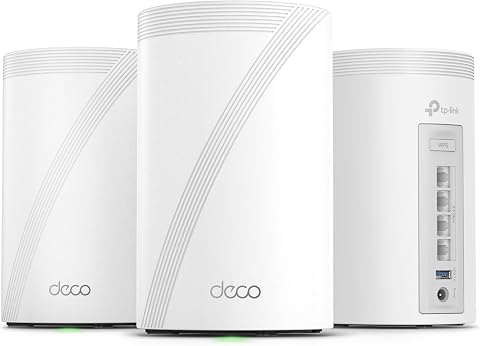 TP-Link Deco 7 Pro Tri-Band WiFi 7 BE10000 Whole Home Mesh System (3-Pack)View on Amazon →
- 5
 Amazon eero 6+ Dual-Band Wi-Fi 6 Mesh System, 3-PackView on Amazon →
- 6
 NETGEAR Orbi 370 Series WiFi 7 Mesh System for Home (RBE373) – Wireless Route…View on Amazon →
- 7
 TP-Link Deco 7 BE5000 Dual-Band Wi-Fi 7 Mesh SystemView on Amazon →
- 8
 TP-Link Deco XE75 AXE5400 Tri-Band Wi-Fi 6E Mesh System, 3-PackView on Amazon →
- 9
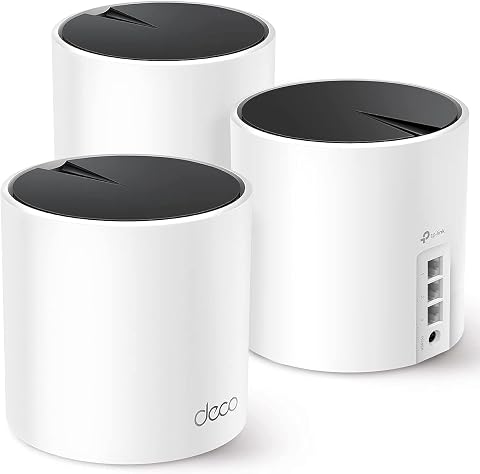 TP-Link Deco X55 AX3000 Wi-Fi 6 Mesh System (3-Pack)View on Amazon →
- 10
 TP-Link Deco S4 AC1900 Mesh Wi-Fi System (3-Pack)View on Amazon →
Choosing Between Speed and Value
The choice affects more than a router’s headline speed. Backhaul capacity determines how mesh nodes communicate with one another, while the home’s construction and layout can limit the signal reaching rooms where people work, stream or play games. A system with advanced wireless features may not deliver its full benefit if client devices or the internet plan cannot use them.
The guide’s central tradeoff is between tri-band or newer Wi-Fi systems that reserve more wireless capacity for node-to-node traffic and less expensive dual-band systems that share radio capacity. That distinction matters most in larger homes or networks with heavy simultaneous use. For a smaller home and moderate usage, paying for top-tier equipment may not be necessary; a buyer should also check wired-port speeds if their internet plan exceeds 1 gigabit per second.
Products Worth Considering

Apple Watch Series 12 GPS Smartwatch, 46 mm

DJI Mic 3 Wireless Microphone System (2 Transmitters, 1 Receiver, Charging Case)

Apple AirPods Pro 3 Wireless Earbuds with Active Noise Cancellation
As an affiliate, we earn on qualifying purchases.
What the Guide Compares
The guide describes Wi-Fi 6 as its baseline, Wi-Fi 6E as adding access to the 6GHz band, and Wi-Fi 7 as supporting wider channels and lower-latency capabilities. These standards describe technical capabilities, not guaranteed real-world speeds. A compatible client device and suitable broadband connection are needed to benefit from many of them.
It also distinguishes dedicated backhaul, where a band is reserved for communication among mesh units, from dual-band designs that share wireless capacity. The source cautions that stated coverage areas can be optimistic, particularly in homes with multiple floors, thick walls or other sources of interference. It recommends judging coverage against the actual floor plan rather than relying on a manufacturer’s square-footage claim alone.
“The TP-Link Deco XE75 stands out as the best overall pick for balancing Wi-Fi 6E performance with reasonable cost.”
— ThorstenMeyerAI.com guide
Limits of the Published Rankings
The available source does not identify all 10 systems in the title, provide their full rankings, or state when testing took place. It gives no measured throughput, latency, coverage results, sample home layouts, or pricing snapshots. The guide’s recommendations should therefore be treated as editorial assessments rather than a documented head-to-head lab comparison.
It is also unclear how the guide verified its stated evaluation criteria, whether all models were tested under the same conditions, and which regional versions or firmware releases were considered. Wi-Fi features and product prices can change, so the 2027 framing alone does not establish that every specification or recommendation remains current.
What Buyers Should Verify
Before purchasing, readers should check the complete model list and current prices in the original guide, then compare each system’s supported Wi-Fi standard, Ethernet port speeds and add-on node compatibility with their own broadband plan and devices. They should also review current manufacturer specifications, since the source does not supply a dated test record.
The guide does not announce a forthcoming test update or publication milestone. Its next useful development would be a full 10-model comparison with dated pricing, clearly described testing conditions and measured results; until then, the precise basis for the rankings remains limited.
Key Questions
Which mesh system does the guide recommend overall?
ThorstenMeyerAI.com names the TP-Link Deco XE75 as its best overall pick, citing its balance of Wi-Fi 6E performance and cost. The supplied source does not include independent test results supporting that ranking.
Do all homes need Wi-Fi 7?
No. The guide presents Wi-Fi 7 as a higher-capability option but says its benefits depend on compatible devices and a suitable internet connection. For many households, Wi-Fi 6E or dual-band equipment may be sufficient, depending on home size and use.
When is a tri-band mesh system useful?
The guide says a dedicated band for communication between mesh nodes can help maintain capacity, particularly in larger homes or networks with many high-bandwidth users. Actual results depend on layout, interference and device support.
Does the source provide a verified comparison of all 10 picks?
Not in the supplied material. It names several systems and describes selection criteria, but does not provide the complete 10-model list, measured performance results or a dated testing methodology.
Source: ThorstenMeyerAI.com