
Portable power banks range from slim 10,000mAh pocket chargers to 50,000mAh monsters that can keep a whole family’s devices alive for days, and picking the wrong size is the most common mistake buyers make. For most people, the INIU Portable Charger 20000mAh 22.5W hits the sweet spot of capacity, speed, and price, which is why it earns my best overall pick. If you want a premium workhorse, the Anker Prime 26,250mAh with 300W output can even charge laptops, while the Charmast 10,000mAh with built-in cables is the fuss-free budget choice for casual users. The main tradeoffs you’ll face are weight versus capacity, wattage versus price, and whether you need USB-only charging or AC outlets for camping gear. Read on for the full breakdown of all 15 models and which one fits your situation.
Play games included with Prime
Start a Prime free trial and play with Amazon Luna on your devices.
Start playingAs an affiliate, we earn on qualifying purchases.
Complete the kit



Key Takeaways
- Mid-size 20,000mAh banks offered the best capacity-to-price ratio; the giant 50,000–60,000mAh models from OHOVIV, IAPOS, and ZZI trade portability for multi-day endurance and are best reserved for group travel or emergencies.
- Built-in cables were the biggest convenience differentiator — the OHOVIV 50000mAh, Charmast 10000mAh, and the 50000mAh model with a wall plug eliminate forgotten-cable frustration entirely, while Anker‘s built-in USB-C cable on its 20,000mAh bank is the tidiest execution of the bunch.
- Wattage determines what you can charge, not just how fast: 22.5W banks handle phones comfortably, but only the Anker Prime (300W) and the Daran and Jackery power stations can reliably run laptops, cameras, or small appliances.
- The Jackery Explorer 300 and Daran 89.6Wh station blur the line between power bank and power station — both include AC outlets, and the Daran’s LiFePO4 chemistry gives it a much longer lifespan than any lithium-ion bank in this lineup.
- Value shoppers get two strong plays: the Miady 2-pack effectively delivers chargers for under $15 each, while the INIU 10000mAh 45W squeezes laptop-grade charging into a pocket-sized frame.
- Anker‘s three entries dominated on build quality and warranty support, but INIU undercut them meaningfully on price at nearly every capacity tier.
| OHOVIV Portable Charger Power Bank 50000mAh with 4 Built-in Cables | 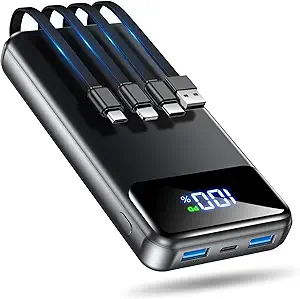 | Best for Group Travel | Battery Capacity: 50000mAh | Output Power: 22.5W fast charging | Number of Ports: 3 | VIEW LATEST PRICE | See Our Full Breakdown |
| INIU Portable Charger 20000mAh 22.5W Fast Charging Power Bank |  | Best Overall | Battery Capacity: 20000mAh | Output Power: 22.5W fast charging | Number of Ports: 3 | VIEW LATEST PRICE | See Our Full Breakdown |
| INIU 10000mAh 45W Fast Charging Portable Charger |  | Best for Fast Charging on the Go | Battery Capacity: 10000mAh | Output Power: 45W | Cable: Detachable braided USB-C | VIEW LATEST PRICE | See Our Full Breakdown |
| Anker Power Bank, 10,000mAh Portable Charger, PowerIQ USB-C Battery Pack |  | Best Slim Everyday Carry | Capacity: 10,000mAh | Dimensions: 5.99 × 2.81 × 0.61 inches | Weight: 8.6 oz | VIEW LATEST PRICE | See Our Full Breakdown |
| Jackery Explorer 300 Portable Power Station, 292Wh |  | Best for Camping and Off-Grid Use | Capacity: 292Wh | Weight: 7.5 lbs | Outlets: 2 AC, 1 USB-C PD, 2 USB-A, 1 car port | VIEW LATEST PRICE | See Our Full Breakdown |
| OHOVIV Portable Charger Power Bank 50000mAh, PD 22.5W Battery Pack |  | Best for Multi-Day Trips Off the Grid | Capacity: 50000mAh | Output Power: 22.5W PD | Ports: USB-C (18W in/22W out), 2x USB-A, 1 USB-C input | VIEW LATEST PRICE | See Our Full Breakdown |
| Anker Prime Power Bank, 26,250mAh, 300W Fast Charging |  | Best Premium Pick for Laptop Users | Battery Capacity: 26,250mAh | Total Output Power: 300W | Max Single-Port Output: 140W | VIEW LATEST PRICE | See Our Full Breakdown |
| IAPOS 60000mAh 22.5W Fast Charge Portable Power Bank for Multiple Devices |  | Best for Group and Family Charging | Battery Capacity: 60000mAh | Output Power: 22.5W | Ports: 2x USB-A, 1x USB-C, 3-in-1 cable | VIEW LATEST PRICE | See Our Full Breakdown |
| Daran Portable Power Station 89.6Wh LiFePO4 Battery 100W Solar Power Bank |  | Best for Camping and Emergency Backup | Battery Capacity: 89.6Wh | Battery Type: LiFePO4 (3,500+ cycles) | Maximum Output: 100W | VIEW LATEST PRICE | See Our Full Breakdown |
| Charmast Portable Charger Power Bank with Built-in 4 Cables, 10000mAh |  | Best Cable-Free Travel Pick | Battery Capacity: 10000mAh | Battery Type: Lithium Polymer | Built-in Cables: USB-C, USB-A, Micro-USB | VIEW LATEST PRICE | See Our Full Breakdown |
| Portable Charger 50000mAh Power Bank with Built-in Cables and Wall Plug |  | Best All-in-One Design | Capacity: 50,000mAh | Fast Charging Power: 22.5W | Charging Time (Wall): 6 hours | VIEW LATEST PRICE | See Our Full Breakdown |
| Anker Power Bank 20,000mAh with Built-in USB-C Cable |  | Best for Laptop Charging | Capacity: 20,000mAh | Power Output: 87W | Built-in Cable: USB-C | VIEW LATEST PRICE | See Our Full Breakdown |
| Miady 2-Pack Portable Charger 10000mAh Power Bank |  | Best Two-Pack Value | Capacity: 10,000mAh per unit | Number of Units: 2 | Dimensions: 5.5 × 2.6 × 0.6 inches | VIEW LATEST PRICE | See Our Full Breakdown |
| ZZI Portable Charger Power Bank 60000mAh, 22.5W PD Fast-Charge Battery Pack |  | Best for Emergencies and Off-Grid Trips | Battery Capacity: 60,000mAh | Output Power: 22.5W PD | Number of Ports: 3 | VIEW LATEST PRICE | See Our Full Breakdown |
| Anker Power Bank 10,000mAh 30W with USB-C Portable Charger |  | Best Pocket Pick | Battery Capacity: 10,000mAh | Power Output: 30W | Input: 20W | VIEW LATEST PRICE | See Our Full Breakdown |
| portable power bank | Dimensions | Weight | Battery Capacity |
|---|---|---|---|
| OHOVIV Portable Charger Power | 5.82 x 1.18 x 2.83 inches | 390 g | 50000mAh |
| INIU Portable Charger 20000mAh | 4.1 x 2.8 x 1.2 inches | 320 g | 20000mAh |
| INIU 10000mAh 45W Fast Chargin | — | — | 10000mAh |
| Anker Power Bank | 5.99 × 2.81 × 0.61 inches | 8.6 oz | — |
| Jackery Explorer 300 Portable | — | 7.5 lbs | — |
| OHOVIV Portable Charger Power | 13.4 x 7 x 3.4 cm | 613g | — |
| Anker Prime Power Bank | — | — | 26,250mAh |
| IAPOS 60000mAh 22.5W Fast Char | 15 x 7.5 x 2.8 cm | 15.5 oz | 60000mAh |
| Daran Portable Power Station 8 | 6.5 x 3.3 x 4 inches | 2.54 lbs | 89.6Wh |
| Charmast Portable Charger Powe | 5.67 x 2.64 x 0.71 inches | 170g | 10000mAh |
| Portable Charger 50000mAh Powe | — | — | — |
| Anker Power Bank 20,000mAh wit | 6.2 × 2.9 × 1.0 inches | 15.5 oz | — |
| Miady 2-Pack Portable Charger | 5.5 × 2.6 × 0.6 inches | 7.68 oz | — |
| ZZI Portable Charger Power Ban | 5.8 × 2.9 × 1.1 inches | — | 60,000mAh |
| Anker Power Bank 10,000mAh 30W | 4.32 × 2.58 × 0.98 inches | — | 10,000mAh |
More Details on Our Top Picks
OHOVIV Portable Charger Power Bank 50000mAh with 4 Built-in Cables
When one power bank has to keep a whole family or group of friends running, capacity matters more than portability. The OHOVIV’s 50000mAh cell delivers over ten full phone charges, and its four built-in cables mean nobody needs to remember their own — a genuine advantage over the INIU 20000mAh, which relies on a single integrated cable and would run dry long before a weekend trip ended. Charging up to six devices at once makes it the obvious hub for campsites and airport gates. The tradeoff is weight: at 390 grams it lives in a backpack, not a pocket. Compared with similar mega-capacity rivals like the IAPOS 60000mAh, its integrated cables give it a packing advantage, though a wall charger isn’t included, so budget for a high-wattage brick to refill it in reasonable time.
Pros:- 50000mAh capacity provides over ten smartphone charges
- Four built-in cables eliminate the need to pack extras
- Charges up to six devices simultaneously
- Digital display shows remaining battery precisely
Cons:- Heavy at 390 grams — backpack-only portability
- No wall charger included, so refilling it takes extra planning
- Only three output ports despite six-device claims
Best for: Families and group travelers who need to charge multiple devices from one shared battery
Not ideal for: Everyday pocket carry — at 390 grams it’s too heavy to carry loosely on a commute
- Battery Capacity:50000mAh
- Output Power:22.5W fast charging
- Number of Ports:3
- Built-in Cables:4
- Weight:390 g
- Dimensions:5.82 x 1.18 x 2.83 inches
- Cell Type:Lithium Polymer
- Extra Features:Digital display, overcharge protection
Our verdict“Buy this if you’re powering a group for days; skip it if you only need to top up one phone.”
INIU Portable Charger 20000mAh 22.5W Fast Charging Power Bank
This INIU hits the sweet spot most buyers actually need: enough capacity for two days away from an outlet, fast enough charging to matter, and a size that still fits a jacket pocket. Compared with the Anker 10,000mAh PowerIQ, it doubles the runtime for roughly double the thickness — a worthwhile exchange for anyone who charges a phone plus earbuds daily. The built-in USB-C cable is the standout convenience; unlike the OHOVIV 50000mAh, you won’t be digging for cords, and the detachable lanyard doubles as a carry loop or clip. TSA approval makes it a safe bet for carry-ons. Its 320 grams is heavier than it looks, and there’s no wireless pad for AirPods or Qi phones — the 22.5W ceiling also won’t fast-charge larger laptops. For phones and tablets, though, this is the most balanced pick here.
Pros:- 20000mAh provides roughly four to five phone charges
- Built-in USB-C cable means one less thing to pack
- Pocket-friendly dimensions for its capacity
- Flashlight and TSA approval add travel value
Cons:- 320 grams is heavier than slimmer 10,000mAh rivals
- No wireless charging for Qi devices
- Full recharge takes about 5.4 hours
Best for: Commuters and weekend travelers who want multi-day phone power without a bulky battery
Not ideal for: Laptop users — 22.5W output falls well short of USB-C laptop charging needs
- Battery Capacity:20000mAh
- Output Power:22.5W fast charging
- Number of Ports:3
- Charge Time:5.4 hours
- Weight:320 g
- Dimensions:4.1 x 2.8 x 1.2 inches
- Extras:Built-in USB-C cable, lanyard, flashlight
- Travel:TSA-approved
Our verdict“The most sensible all-around choice for anyone who wants serious capacity in a still-portable package.”
INIU 10000mAh 45W Fast Charging Portable Charger
Speed is this charger’s whole argument. At 45W output, it doubles the wattage of the 22.5W INIU 20000mAh, which means a compatible phone hits 50% in roughly half the time — and some smaller laptops and the Nintendo Switch will actually charge properly, something the Anker 10,000mAh PowerIQ simply can’t manage. Being 40% smaller and 36% lighter than conventional chargers, it disappears into a bag pocket, and the detachable braided USB-C cable is replaceable if it frays, unlike fixed-cable designs. The obvious cost is runtime: 10000mAh means about two phone charges before you’re hunting for an outlet. The included 0.4ft cable is also comically short for anything but close-range top-ups, so Lightning or USB-A users need their own cords. As a grab-and-go speed companion, it earns its slot; as your only battery, it’s limiting.
Pros:- 45W output charges phones at double the speed of 22.5W rivals
- Remarkably compact and lightweight footprint
- Detachable braided cable is durable and replaceable
- TSA-compliant for air travel
Cons:- 10000mAh capacity limits it to about two phone charges
- Included 0.4ft cable is too short for practical use
- Additional cables needed for non-USB-C devices
Best for: Travelers who prioritize quick top-ups and occasionally charge small laptops or gaming devices
Not ideal for: Multi-day off-grid trips — 10000mAh runs out after roughly two phone charges
- Battery Capacity:10000mAh
- Output Power:45W
- Cable:Detachable braided USB-C
- Size:40% smaller and 36% lighter than conventional chargers
- Compatibility:Smartphones, tablets, gaming devices
- Travel:TSA-compliant, airline-safe
Our verdict“The pick for buyers who value charge speed over endurance — ideal as a daily-carry speedster, not a trip battery.”
Anker Power Bank, 10,000mAh Portable Charger, PowerIQ USB-C Battery Pack
Some buyers just want a battery that slides into a pocket next to a phone without a bulge, and this Anker is the thinnest mainstream option in this lineup at 0.61 inches. Against the INIU 45W, it gives up nearly half the charging speed but gains a slimmer, drop-resistant chassis that shrugs off daily abuse — a fair trade for commuters rather than power users. PowerIQ intelligently matches output to each device, so phones charge at their natural rate without fuss. Where it trails competitors is the fine print: no cable is included, unlike the INIU models with built-in or bundled cords, and 10,000mAh means roughly two charges before it needs refilling itself. Its single USB-C port also forces sequential charging if you carry two devices. For a slim, dependable daily top-up from a trusted brand, though, it’s hard to beat the simplicity.
Pros:- Slim 0.61-inch profile slips into pockets easily
- Drop-resistance certification adds durability confidence
- USB-C port handles both input and output
- Anker’s reputation for reliability and support
Cons:- No charging cable included in the box
- Charging speed trails the 45W INIU considerably
- Single port limits simultaneous device charging
Best for: Commuters and students who want a slim, pocketable top-up battery from a reliable brand
Not ideal for: Multi-device users — one port and 10,000mAh won’t keep a phone and tablet alive through a long day
- Capacity:10,000mAh
- Dimensions:5.99 × 2.81 × 0.61 inches
- Weight:8.6 oz
- Ports:USB-C (input/output)
- Charging Tech:PowerIQ
- Durability:Drop resistance certified
Our verdict“Choose this for effortless everyday pocket carry; look elsewhere if speed or multi-device charging matters.”
Jackery Explorer 300 Portable Power Station, 292Wh
This isn’t really competing with the power banks above — it’s the step up when you need AC outlets. The Explorer 300’s 292Wh capacity is roughly eight times a 20000mAh bank, and its two AC outlets run laptops, cameras, drones, and small appliances that USB-only options like the INIU 20000mAh can’t touch. The LiFePO4 chemistry rated for 4,000+ cycles means it should outlast several conventional power banks combined, which matters if you camp regularly. At 7.5 pounds with a built-in handle, it’s portable in the car-to-campsite sense, never the backpack-pocket sense. Two caveats shape the buying decision: the solar panel costs extra, and the 300W output ceiling rules out power-hungry gear like kettles or hair dryers. For buyers weighing this against the Daran 89.6Wh solar bank, the Jackery offers far more capacity and cycle life at a weight penalty.
Pros:- Two AC outlets plus USB-C, USB-A, and car port cover nearly every device
- LiFePO4 battery rated for over 4,000 charge cycles
- Lightweight for its class with integrated carry handle
- Fast solar recharging in roughly 2.8 hours with 100W panel
Cons:- Solar panel sold separately, adding to the real cost
- 300W output ceiling excludes high-draw appliances
- Too heavy for everyday carry at 7.5 pounds
Best for: Campers, van lifers, and remote workers who need AC power for laptops and gear off the grid
Not ideal for: Everyday commuters — at 7.5 pounds it’s far too heavy for bag carry and overkill for phone charging
- Capacity:292Wh
- Weight:7.5 lbs
- Outlets:2 AC, 1 USB-C PD, 2 USB-A, 1 car port
- Rated Output:300W
- Battery Chemistry:LiFePO4
- Charge Cycles:Over 4,000
- Solar Recharge:Approximately 2.8 hours with 100W panel
Our verdict“The right choice when you need real AC power away from the grid, not just phone charges.”
OHOVIV Portable Charger Power Bank 50000mAh, PD 22.5W Battery Pack
Massive capacity is the whole story here, and the OHOVIV 50000mAh delivers roughly ten smartphone charges before it needs a wall outlet itself. That puts it in a different category than the Anker 10,000mAh, which is built for a single day out rather than a week away. The smart LED display removes the guesswork of wondering how much juice is left, and three simultaneous outputs make it a natural hub for a group campsite. The tradeoff is real: at 613g and 13.4cm long, this is a bag-dweller, not a pocket companion. It also cannot fly with you — airline limits cap batteries well below this capacity. Compared with the IAPOS 60000mAh, it gives up a little capacity but is cheaper and more pocketable, which makes it the smarter pick for most long-trip scenarios.
Pros:- 50000mAh capacity delivers roughly ten full smartphone charges
- PD 22.5W fast charging with QC support across ports
- Charges three devices at once, ideal for groups
- Smart LED display shows exact remaining power
Cons:- Not permitted on airplanes due to capacity limits
- At 613g and 13.4cm, it’s too bulky for pockets or everyday carry
Best for: Campers, festival-goers, and travelers on multi-day trips who won’t have wall power and need to keep several devices alive
Not ideal for: Air travelers and daily commuters — it’s banned on planes and far too heavy to carry in a pocket every day
- Capacity:50000mAh
- Output Power:22.5W PD
- Ports:USB-C (18W in/22W out), 2x USB-A, 1 USB-C input
- Dimensions:13.4 x 7 x 3.4 cm
- Weight:613g
- Display:Digital battery percentage
- Charging Protocols:PD, QC
Our verdict“Buy this if your trips last days, not hours — but leave it home before heading to the airport.”
Anker Prime Power Bank, 26,250mAh, 300W Fast Charging
This is the option that treats a power bank as a serious workstation accessory rather than an emergency top-up. With up to 140W output on a single port, the Anker Prime can genuinely charge a power-hungry laptop at near-wall speeds — something the 22.5W OHOVIV and IAPOS models simply cannot do, no matter how big their batteries are. The 250W dual-input recharging flips the usual annoyance of giant banks: instead of waiting overnight, it refills to 80% in about 39 minutes. App control adds fine-grained monitoring most competitors skip. The catch is price and weight discipline — Anker doesn’t publish a weight figure, which is telling, and you’re paying a premium for the brand and speed. If your devices are phones and earbuds only, the Anker 20,000mAh with built-in cable covers the same basics for far less money.
Pros:- Up to 140W single-port output charges laptops at near-wall speed
- 250W dual-input recharge reaches 80% in about 39 minutes
- App control for monitoring and customization
- 26,250mAh covers multiple devices plus a laptop session
Cons:- Premium price far above standard high-capacity banks
- No published weight, and 300W-class banks are rarely light
Best for: Digital nomads and remote workers who need to run or fast-charge a laptop away from outlets
Not ideal for: Budget buyers and phone-only users — the laptop-grade output goes unused, and the price reflects features they’ll never touch
- Battery Capacity:26,250mAh
- Total Output Power:300W
- Max Single-Port Output:140W
- Ports:3 (USB-A, USB-C)
- Voltage / Amperage:28V / 5A
- Rapid Recharge:80% in 39 minutes (250W dual input)
- Battery Cell Type:Lithium Polymer
- Extras:Companion app for management
Our verdict“If a laptop depends on your power bank, this justifies its price; if it’s just phones, spend less elsewhere.”
IAPOS 60000mAh 22.5W Fast Charge Portable Power Bank for Multiple Devices
Where the OHOVIV 50000mAh balances capacity against size, the IAPOS goes all-in on volume: 60,000mAh is enough to keep an entire family’s phones, tablets, and earbuds running through a long weekend. The standout is breadth of charging — up to five devices simultaneously, helped by an included 3-in-1 cable, versus three on the OHOVIV. It also speaks more charging dialects (PD, QC, SCP, FCP, AFC), so Android flagships and older devices negotiate faster speeds instead of falling back to trickle rates. The scratch-resistant shell suggests it can survive being tossed in a gear bag. The costs are predictable: at 15.5 oz it’s a dedicated-bag item, and like the OHOVIV it cannot board a plane. Compared with the ZZI 60000mAh, the IAPOS wins on port count and cable convenience for group scenarios.
Pros:- 60,000mAh capacity handles several days of multi-device use
- Charges up to 5 devices at once with included 3-in-1 cable
- Broad protocol support (PD, QC, SCP, FCP, AFC) for faster Android charging
- Durable, scratch-resistant exterior built for gear bags
Cons:- 15.5 oz weight makes it impractical for pockets or daily carry
- Higher price driven by raw capacity that solo users won’t need
- Not allowed on airplanes
Best for: Families or groups on camping trips and long road trips who need one bank to feed many devices
Not ideal for: Solo travelers and anyone flying — it’s overkill for one person and prohibited in carry-ons
- Battery Capacity:60000mAh
- Output Power:22.5W
- Ports:2x USB-A, 1x USB-C, 3-in-1 cable
- Dimensions:15 x 7.5 x 2.8 cm
- Weight:15.5 oz
- Charging Protocols:PD, QC, SCP, FCP, AFC
- Safety Features:Overcharge, short-circuit, temperature regulation
- Display:Digital battery indicator
Our verdict“The group-trip workhorse — buy it when one bank needs to serve many people, skip it if you’re packing light alone.”
Daran Portable Power Station 89.6Wh LiFePO4 Battery 100W Solar Power Bank
The Daran sits in a different category from every bank in this lineup: it has AC wall outlets, not just USB ports. That means a mini-fridge, camera charger, or drone battery can plug straight in — something the Anker Prime, for all its speed, cannot do. Its LiFePO4 chemistry is the other differentiator: rated for over 3,500 cycles versus the few hundred typical of standard lithium-polymer banks like the OHOVIV or IAPOS, it’s built to sit in an emergency kit for years. Solar input capability (panel sold separately) means it can theoretically recharge indefinitely off-grid. The limits are equally clear — 89.6Wh caps output at 100W, so power tools and kettles are out, and it’s over the 100Wh line for easy air travel. Compared with the Jackery Explorer 300, it trades capacity for a much lighter 2.54 lb footprint.
Pros:- AC outlets let you run small appliances, not just USB devices
- LiFePO4 battery rated for 3,500+ cycles for long-term reliability
- Four charging sources including solar (with panel) and car
- Silent operation with built-in 4-level LED flashlight and SOS mode
Cons:- Solar panel not included despite solar branding
- 100W output ceiling excludes power tools and larger appliances
- 89.6Wh is modest for extended off-grid power needs
Best for: Campers, van-lifers, and households wanting a quiet emergency backup for phones, laptops, and small appliances
Not ideal for: Air travelers and anyone powering devices above 100W — it exceeds carry-on limits and can’t run high-draw appliances
- Battery Capacity:89.6Wh
- Battery Type:LiFePO4 (3,500+ cycles)
- Maximum Output:100W
- Ports:7 (including AC outlets)
- Charging Methods:AC wall, USB-C PD, car, solar panel
- Weight:2.54 lbs
- Dimensions:6.5 x 3.3 x 4 inches
- Extras:LED display, 4-level flashlight with SOS, 12-protection BMS
Our verdict“The right choice when you need AC power and long battery life in the field, not just another USB bank.”
Charmast Portable Charger Power Bank with Built-in 4 Cables, 10000mAh
The Charmast solves the most common power-bank frustration: forgetting the cable. With USB-C, Micro-USB, and Lightning-compatible cables built right into the chassis, it works out of the pocket for nearly any device — a convenience the Anker 20,000mAh with built-in USB-C offers in only one connector. At 170g and under 15cm long, it slips into a jacket pocket or seatback without a thought, making it the natural companion to a phone on a long travel day. The honest tradeoff is capacity: 10,000mAh means roughly two phone charges, so it can’t carry a weekend the way the OHOVIV or IAPOS can. Charging speed is also modest, and built-in cables are a long-term wear point — if one breaks, it’s part of the unit. For a single day away from an outlet, though, the no-cables-needed design beats carrying a separate wall of accessories.
Pros:- Four built-in cables cover USB-C, Micro-USB, and iPhone devices
- Featherweight at 170g with a slim 0.71-inch profile
- Charges up to 6 devices simultaneously with outputs
- Three input options for recharging the bank itself
Cons:- 10,000mAh capacity limits it to roughly two phone charges
- Built-in cables can wear out and aren’t replaceable
- Fast charging not supported across all ports
Best for: Travelers and students who want a grab-and-go backup that works with any phone without carrying cables
Not ideal for: Power users and multi-day travelers — 10,000mAh runs dry after about two phone charges
- Battery Capacity:10000mAh
- Battery Type:Lithium Polymer
- Built-in Cables:USB-C, USB-A, Micro-USB
- Output Ports:3
- Input Ports:3
- Weight:170g
- Dimensions:5.67 x 2.64 x 0.71 inches
Our verdict“The effortless everyday carry for people who hate carrying cables — just don’t expect it to last a weekend.”
Portable Charger 50000mAh Power Bank with Built-in Cables and Wall Plug
Most power banks in this roundup force you to carry a separate cable and wall charger — this one folds everything into a single block. The built-in USB-C and iOS cables plus an integrated wall plug mean a phone, a tablet, and a laptop brick all collapse into one accessory, which is a genuine advantage over the Anker 20,000mAh, which has only a single built-in cable and no plug. At 50,000mAh it stays under airline limits, unlike the ZZI 60,000mAh. The tradeoff is bulk: this is a bag power bank, not a pocket one, and recharging it takes six hours from a wall outlet. Compared with the OHOVIV 50,000mAh models, its edge is the wall plug — fewer items to forget on a trip.
Pros:- All-in-one design eliminates cables and wall adapters
- 50,000mAh capacity stays within airline limits
- Charges up to four devices simultaneously
- 22.5W fast charging for phones and tablets
Cons:- Large and heavy compared with slim options like the Miady packs
- Full recharge takes about 6 hours via wall outlet
Best for: Travelers who want one brick to handle cables, wall charging, and multiple devices without packing extras
Not ideal for: Minimalist everyday-carry users — the size and weight make it impractical for pockets or small bags
- Capacity:50,000mAh
- Fast Charging Power:22.5W
- Charging Time (Wall):6 hours
- Charging Time (USB-C):4 hours
- Devices Supported:4
- Built-in Cables:USB-C and iOS
Our verdict“If you want a single grab-and-go brick for a family trip or emergencies, this is the most complete package in the lineup.”
Anker Power Bank 20,000mAh with Built-in USB-C Cable
At 87W output, this Anker outpaces nearly every other bank here — the ZZI and OHOVIV models top out at 22.5W, which is fine for phones but painfully slow for a MacBook. This is the pick where capacity meets wattage: enough juice for roughly two laptop top-ups, and it recharges itself through its own attached USB-C cable. It is also airline approved, so unlike the ZZI 60,000mAh it boards with you. The compromises are real, though: 87W won’t drive larger 100W-plus laptops at full speed, and the single-cable design means you can’t easily charge three devices at once the way the Miady two-pack or the 50,000mAh all-in-one can.
Pros:- 87W output charges laptops, not just phones
- Built-in durable USB-C cable stays attached
- Airline approved for carry-on travel
- Balanced 20,000mAh capacity in a compact frame
Cons:- 87W ceiling falls short for high-power laptops
- Limited port selection for charging several devices at once
Best for: Digital nomads and students who need to top up a USB-C laptop away from an outlet
Not ideal for: Multi-device households — one built-in cable limits simultaneous charging compared with multi-port rivals
- Capacity:20,000mAh
- Power Output:87W
- Built-in Cable:USB-C
- Dimensions:6.2 × 2.9 × 1.0 inches
- Weight:15.5 oz
- Airline Approved:Yes
Our verdict“The strongest choice here if a laptop — not just a phone — is what needs rescuing mid-day.”
Miady 2-Pack Portable Charger 10000mAh Power Bank
Buying one big bank is the conventional answer, but two slim 10,000mAh units solve a different problem: keeping one in a bag and one in a glovebox, or lending one to a travel companion. Each unit is under eight ounces and half an inch thick, far easier to pocket than the 50,000–60,000mAh bricks in this guide, and each still offers three ports (two USB-A, one USB-C) — more simultaneous charging than the Anker 87W with its single cable. The catch is raw capability: there’s no advertised fast-charging speed, so top-ups are slower than Anker’s 30W compact, and 10,000mAh won’t fully revive a tablet or laptop. iPhone users also need to supply their own cable.
Pros:- Two complete power banks for the price of one
- Slim 0.6-inch profile slips into pockets easily
- Three ports per unit for simultaneous charging
- Broad compatibility with phones, tablets, and more
Cons:- No advertised fast-charging output
- 10,000mAh per unit is modest for high-demand devices
Best for: Couples, families, or anyone who wants backup power stashed in two places at a budget price
Not ideal for: Power users with tablets or laptops — capacity and charging speed won’t keep up with demanding devices
- Capacity:10,000mAh per unit
- Number of Units:2
- Dimensions:5.5 × 2.6 × 0.6 inches
- Weight:7.68 oz
- Ports:2 USB-A, 1 USB-C
- USB-C:Bidirectional input/output
Our verdict“Redundancy beats raw capacity here — a smart buy when two people or two locations need coverage.”
ZZI Portable Charger Power Bank 60000mAh, 22.5W PD Fast-Charge Battery Pack
When the priority is raw endurance over portability, this is the tank of the lineup. At 60,000mAh it outlasts the all-in-one 50,000mAh charger by roughly 20 percent and can feed five devices at once — more than anything else here — with a digital display showing exactly what’s left. The bundled 3-in-1 braided cable covers phones and tablets without extra packing. But the tradeoff is decisive: it cannot fly with you, because it exceeds airline battery limits — unlike the Anker 87W or the 50,000mAh all-in-one. Recharging also takes around seven hours, so this belongs in a car kit or camp bin, not a briefcase. The IAPOS 60,000mAh is its closest rival; the display and included cable tip the balance here.
Pros:- Massive 60,000mAh capacity for multi-day use
- Charges up to five devices simultaneously
- Digital display shows real-time battery status
- Includes durable 3-in-1 braided cable
Cons:- Banned from airline carry-on and checked bags
- Roughly 7-hour recharge time
- Bulky despite its portable framing
Best for: Campers, road-trippers, and households preparing emergency kits where outlet access may vanish for days
Not ideal for: Frequent flyers — the capacity exceeds airline limits and must be left behind when traveling by air
- Battery Capacity:60,000mAh
- Output Power:22.5W PD
- Number of Ports:3
- Connector Types:USB-A, USB-C
- Voltage:5V, 9V
- Amperage:3A
- Dimensions:5.8 × 2.9 × 1.1 inches
Our verdict“A ground-based power reserve for outages and campsites — buy it for endurance, never for air travel.”
Anker Power Bank 10,000mAh 30W with USB-C Portable Charger
This is the bank that lives in a jacket pocket every day rather than a bag. At 4.32 inches tall and 10,000mAh, it vanishes next to the ZZI’s bulk, yet its 30W output actually beats the ZZI and both 50,000mAh models on charging speed for a single phone — a reminder that wattage, not capacity, determines how fast your device fills up. The built-in USB-C cable doubles as the recharge input, so nothing extra is needed. Compared with the Miady two-pack, you give up a spare unit and a USB-A port in exchange for speed and Anker’s tighter build. The honest limit is capacity: expect roughly two phone charges and nothing meaningful for a tablet or laptop, so heavy users should step up to the 20,000mAh Anker instead.
Pros:- 30W fast charging outpaces larger 22.5W banks
- Built-in USB-C cable eliminates loose accessories
- Genuinely pocketable at 4.32 inches tall
- Bi-directional fast charging refills the bank itself quickly
Cons:- Only about two full phone charges per outing
- No wireless charging or USB-A flexibility for older gear
Best for: Commuters and travelers who want daily-carry insurance for their phone without noticing the weight
Not ideal for: Tablet or laptop owners — 10,000mAh and 30W won’t sustain larger devices through a workday
- Battery Capacity:10,000mAh
- Power Output:30W
- Input:20W
- Number of Ports:3
- Built-in Cable:USB-C
- Dimensions:4.32 × 2.58 × 0.98 inches
- Battery Type:Lithium Polymer
Our verdict“The one to grab when size and speed matter more than total capacity — ideal phone-only daily carry.”
How We Picked
My ranking logic starts with a simple question: what is this power bank actually for? A 10,000mAh pocket charger and a 292Wh power station solve different problems, so each product was evaluated against its intended buyer rather than a single scoreboard. I weighted capacity-to-price ratio, charging speed (wattage), portability (weight and dimensions), port selection and built-in cables, and build quality or battery chemistry — with extra credit for thoughtful features like wall plugs, pass-through charging, and LiFePO4 cells.
Products rose or fell based on how cleanly they served a specific use case. The INIU 20000mAh earned the top spot because it balances every factor without a weak point, while the Anker Prime ranked high on raw capability despite its premium price. The massive 50,000–60,000mAh banks were judged as group and emergency chargers, not everyday carry, and the two power stations were held to station-grade standards. Durability, brand warranty support, and real-world recharging time (how long the bank itself takes to refill) separated otherwise similar spec sheets.
Factors to Consider When Choosing Portable Power Banks
Before settling on a specific model, it helps to understand the landscape of portable power banks and where buyers commonly go wrong. The right choice depends less on which product is ‘best’ and more on matching capacity, speed, and weight to your actual routine.Capacity: Bigger Isn’t Always Better
Capacity, measured in milliamp-hours (mAh), is the spec buyers fixate on, but real-world output is always lower than the label because of voltage conversion losses — expect roughly 60–70% of the rated capacity to reach your devices. A 10,000mAh bank delivers about two full phone charges, 20,000mAh gets you four to five, and 50,000mAh can run a phone for a week or charge a small group’s devices across a weekend. The mistake I see most often is buying giant capacity for daily commuting, then leaving the heavy brick at home because it’s unpleasant to carry. A power bank that lives in a drawer helps no one. Match capacity to the longest stretch you’ll realistically spend away from an outlet, not the worst-case scenario you imagine once a year. Also note that airlines cap carry-on batteries at 100Wh (about 27,000mAh), so oversized banks can be confiscated at security — a genuine reason to keep your travel bank modest.
Charging Speed and Wattage
Wattage is where cheap power banks quietly cut corners, and it matters more than most shoppers realize. A basic 10–15W bank may take three hours to charge a modern phone, while a 22.5W or 30W bank cuts that to roughly an hour. If you want to charge a USB-C laptop, you generally need 45W minimum — which rules out most budget banks regardless of their capacity. Check both the output rating and whether the ports support PD (Power Delivery) or QC (Quick Charge), since your device and cable must support the same protocol to hit top speed. One overlooked spec: how fast the bank itself recharges. Large 50,000mAh banks with only micro-USB input or low-watt recharging can take a full day to refill, which is a real problem if you rotate between trips. Models with high-watt USB-C input/output on the same port solve this elegantly.
Weight, Size, and Portability
Weight is the honest tax on capacity, and manufacturers don’t always make it visible on the listing’s main page. As a rough guide, 10,000mAh banks weigh 6–8 ounces, 20,000mAh lands around 12–14 ounces, and 50,000–60,000mAh monsters approach or exceed two pounds — pocket vs. backpack vs. luggage territory. The common mistake is treating a giant bank as a ‘do everything’ purchase, then discovering it’s too heavy for a jacket pocket and too slow for laptop charging anyway. Frequent flyers should also remember the 100Wh airline limit mentioned above. Consider whether you actually carry a bag daily; if the answer is no, a slim 10,000mAh model will get used a hundred times more than a beast that stays home. Two smaller banks often beat one huge one for couples or families, which is exactly the logic behind the Miady 2-pack in this lineup.
Ports, Cables, and Built-In Convenience
Port selection determines whether your bank is a solo charger or a group hub. At minimum, look for USB-C in both directions (input for recharging the bank, output for devices), since USB-C is now the standard across phones, tablets, earbuds, and laptops. Banks with four or five outputs let you charge a phone, earbuds, and a tablet simultaneously — useful for families sharing one bank on a road trip. Built-in cables are the most underrated convenience feature: they eliminate the single most common failure point, the forgotten cable. Some models even add a built-in wall plug, so the bank recharges itself directly from an outlet without carrying a separate charger and cable. That combination effectively turns a power bank into a self-contained charging kit. The tradeoff is slight bulk and one more thing that can physically break, so check that the retracted cables feel sturdy rather than flimsy.
Battery Chemistry and Lifespan
Nearly all consumer power banks use lithium-ion cells, which degrade after 300–500 full charge cycles and hold less capacity each year whether you use them or not. LiFePO4 (LFP) chemistry, found in the Daran power station in this lineup, lasts 2,000+ cycles and is more thermally stable — the reason it’s worth paying attention to if you buy for emergency preparedness rather than casual use. Cycle count matters for heavy users: if you drain and refill a bank weekly, a standard lithium-ion unit may lose a third of its capacity within two years. Storage habits also affect lifespan; banks kept at full charge in a hot car degrade fastest. For occasional travelers, standard lithium-ion is perfectly fine and much lighter per watt-hour. For a go-bag or camping kit you want to rely on for a decade, chemistry becomes a deciding factor rather than a footnote.
When to Buy a Power Station Instead
There’s a crossover point where a power bank stops being the right tool. If you need AC outlets for a CPAP machine, camera charger, fan, laptop brick, or small appliance, you need a power station like the Jackery Explorer 300 or Daran 89.6Wh — no USB power bank, however large, will do the job. Stations also typically support solar panel input, which makes them viable for multi-day off-grid trips where wall outlets disappear entirely. The costs are real: they’re heavier, three to five times the price per watt-hour, and far too bulky for daily carry. A sensible setup for many households is a two-tier approach — a compact bank for daily life plus a small station for outages and camping. Buyers who buy only the giant 50,000mAh bank hoping to ‘cover everything’ often end up with neither convenience nor AC power, the worst of both worlds.
Frequently Asked Questions
Is a 50,000mAh power bank allowed on airplanes?
Almost never in carry-on, and definitely not in checked luggage. Airlines and the FAA cap lithium batteries at 100Wh (roughly 27,000mAh) for carry-on without airline approval, and 50,000mAh banks typically exceed 150Wh — above the hard limit even with approval. If you fly regularly, choose a bank at or under 20,000mAh, like the INIU 20000mAh or Anker 20,000mAh models in this lineup. The giant 50,000–60,000mAh banks from OHOVIV, IAPOS, and ZZI are better suited to road trips, camping, and home emergency kits where airport rules don’t apply. Some travelers carry two smaller banks instead of one large one specifically to stay compliant. Always check your specific airline’s policy before flying with any lithium battery over 100Wh.
What wattage do I need to charge a laptop from a power bank?
Most USB-C laptops need at least 45W to charge reliably, and larger machines like 16-inch models want 60–100W. The INIU 10000mAh 45W can trickle-charge a small ultrabook in a pinch, but its capacity only adds a partial laptop charge. For real laptop work, the Anker Prime 26,250mAh at 300W is the proper choice in this lineup — it can fast-charge a MacBook while also running other ports. Below 45W, a laptop will typically only maintain its charge or charge very slowly while asleep. Check your laptop’s charger wattage to know your floor, and remember the bank needs PD (Power Delivery) support over USB-C, not just high amperage. If your laptop charges via a barrel connector or AC brick only, you’ll need a power station with an AC outlet like the Jackery or Daran instead.
Are power banks with built-in cables worth it?
For most casual users, yes — the convenience of never hunting for a cable outweighs the minor downsides. Built-in cables eliminate the most common reason a power bank sits useless at the bottom of a bag, and models like the Charmast 10000mAh and OHOVIV 50000mAh include multiple cable types (usually USB-C, Lightning, and micro-USB) so one bank serves mixed-device households. The tradeoffs are worth knowing: a damaged built-in cable can’t be swapped out, thicker housings add a little bulk, and cheap implementations can feel flimsy. The sweet spot is a bank with both built-in cables and standard USB ports, so you’re covered either way. Anker’s approach on its 20,000mAh model — a single built-in USB-C cable that doubles as the recharging input — is the cleanest design I found in this category. If you already carry a good braided cable everywhere, built-ins matter less and you can prioritize other features.
Why does my 10,000mAh power bank only charge my phone twice?
This is normal, not a defect, and understanding why will make you a smarter buyer. The rated capacity is measured at the cell’s 3.7V voltage, but your phone charges at 5V or higher, and voltage conversion wastes 30–40% of the energy as heat. A 10,000mAh bank therefore delivers roughly 6,000–7,000mAh of usable charge at phone voltage, and modern phones with 4,500–5,000mAh batteries consume most of that in one full charge. Add losses from the phone’s own charging circuit and heat during fast charging, and two full charges is exactly what physics allows. This is why I recommend buying 20,000mAh if you want a full weekend of phone use — the real-world math is less generous than the box suggests. Any bank claiming dramatically more charges than this math allows is being creative with its marketing.
Should I buy one large power bank or two smaller ones?
Two smaller banks win for most households, and this pattern showed up repeatedly in my comparison. Two 10,000mAh banks like the Miady 2-pack let two people charge independently, split weight between bags, and keep one working if the other is left behind or fails. A single 50,000mAh bank centralizes everything, which sounds efficient until one person has to babysit the shared brick all day. Large banks also take far longer to recharge themselves and can’t fly in carry-on luggage. The one-large-bank case is legitimate for camping, group trips, and emergency kits where one person manages charging for everyone and outlets are scarce. If you’re strictly solo and never share, a single mid-size 20,000mAh bank is simpler than juggling two. But for couples and families, the 2-pack approach costs less and fails more gracefully.
Conclusion
The right pick depends entirely on how you charge, so here’s my breakdown by buyer type. For best overall, the INIU Portable Charger 20000mAh 22.5W balances capacity, speed, and price better than anything else in this lineup. The best value goes to the Miady 2-pack for households and the Charmast 10000mAh for solo casual users who want built-in cables on a budget. Best premium is clearly the Anker Prime 26,250mAh 300W — it’s the only true bank-style pick that fast-charges laptops. Beginners should start with the Anker 10,000mAh PowerIQ: simple, reliable, and backed by the strongest warranty support in the group. For specific needs, the OHOVIV or ZZI 50,000–60,000mAh banks suit group travel and emergency kits, the INIU 10000mAh 45W fits laptop-toting minimalists, and campers needing AC power should step up to the Jackery Explorer 300 or the longer-lived Daran LiFePO4 station. Whatever you choose, match the bank to your real routine rather than the biggest number on the box — that single habit separates satisfied buyers from disappointed ones.
Fall yard work Picks
leaf blowers
As an affiliate, we earn on qualifying purchases.