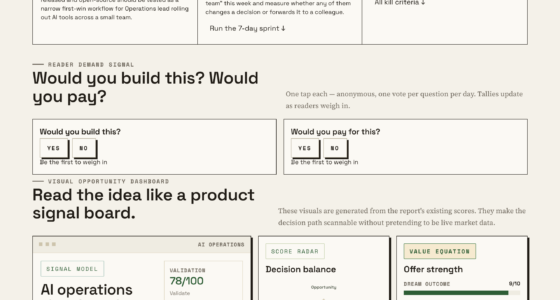

📊 Full opportunity report: NTT DATA Group Achieves 30-Minute Incident Analysis Using Cutting-Edge AI on ThorstenMeyerAI.com — validation score, market gap, and execution plan.
TL;DR
NTT DATA Group has reportedly cut incident analysis to 30 minutes by integrating OpenAI’s Codex AI. The development could improve response times, but specific measurement details are not disclosed.
NTT DATA Group has reduced incident analysis time to 30 minutes using OpenAI’s Codex, according to a report published by OpenAI. This development aims to enable faster identification of issues in technical systems, potentially improving response speed for service disruptions as detailed in the original analysis. The announcement highlights the use of advanced AI to streamline operational workflows, but specifics about the baseline, scope, and impact are not yet available.
The reported reduction to a 30-minute incident analysis was achieved by NTT DATA Group through the use of OpenAI’s Codex, an AI coding agent. OpenAI’s statement indicates that Codex was integrated into the incident investigation process, but it does not specify whether this time applies to initial hypothesis generation, root cause identification, or full analysis completion. Learn more from the original report.
OpenAI has not disclosed the previous average analysis duration, the number or types of incidents measured, or whether the results are based on specific case studies. The scope of deployment—whether limited to certain teams or systems—is also unclear. See the detailed coverage here. The claim is based on a single customer account, and no independent verification or detailed technical data has been provided.
Potential Impact on Incident Response Efficiency
This development suggests that AI tools like Codex could significantly accelerate incident investigations, enabling teams to identify issues more rapidly. Faster analysis could lead to shorter service disruptions and quicker recovery times, especially if the AI’s suggestions are accurate and reliable. However, without data on accuracy, false positives, or overall resolution times, the actual operational benefits remain uncertain.
For large-scale technology providers, integrating AI into incident workflows may reduce manual effort and allow engineers to focus on validation and mitigation. Still, the broader impact depends on the consistency, safety, and correctness of AI-assisted analysis, which have not yet been evaluated in this context.
AI incident analysis software
As an affiliate, we earn on qualifying purchases.
As an affiliate, we earn on qualifying purchases.
Background on AI in Incident Management
OpenAI’s Codex is primarily known as an AI model designed to assist with coding and software development tasks. Its application in operational incident analysis marks a shift toward using AI for real-time troubleshooting and system diagnostics. Prior to this, incident response generally involved manual log review, source code inspection, and human-led investigation, which could take hours or days depending on complexity.
The use of AI to reduce analysis time is a recent area of exploration, with early reports indicating potential for efficiency gains. However, detailed case studies or independent benchmarks have yet to be published, making it difficult to assess the true scale of improvement or the reliability of AI in this domain.
“We are exploring AI-driven solutions to enhance our incident response capabilities, with initial results showing promising speed improvements.”
— NTT DATA Group representative

Kaisi Professional Electronics Opening Pry Tool Repair Kit with Metal Spudger Non-Abrasive Nylon Spudgers and Anti-Static Tweezers for Cellphone iPhone Laptops Tablets and More, 20 Piece
Kaisi 20 pcs opening pry tools kit for smart phone,laptop,computer tablet,electronics, apple watch, iPad, iPod, Macbook, computer, LCD…
As an affiliate, we earn on qualifying purchases.
As an affiliate, we earn on qualifying purchases.
Unverified Aspects of the 30-Minute Claim
It is not yet clear how the 30-minute figure was measured—whether it reflects initial hypothesis generation, root cause identification, or full incident resolution. The baseline analysis time prior to AI implementation has not been disclosed, making it impossible to quantify the actual improvement.
Details about the number of incidents measured, the types of systems involved, or whether the result applies across multiple use cases are also unknown. Additionally, the accuracy and reliability of Codex’s suggestions in operational contexts have not been evaluated or reported.
incident management AI tools
As an affiliate, we earn on qualifying purchases.
As an affiliate, we earn on qualifying purchases.
Next Steps for Validation and Expansion
Further details from NTT DATA Group and OpenAI are expected, including measurement methodology, incident scope, and performance metrics like resolution times and customer impact. Independent studies or third-party assessments could clarify the effectiveness of AI-assisted incident analysis.
Future developments may include broader deployment, integration with other incident management tools, and validation of AI accuracy. Monitoring these updates will be essential to understand whether this approach can be reliably scaled across industries and systems.
automated system diagnostics software
As an affiliate, we earn on qualifying purchases.
As an affiliate, we earn on qualifying purchases.
Key Questions
Does the 30-minute analysis time mean faster overall incident resolution?
No, the 30-minute figure specifically refers to incident analysis. The total resolution time, including fixing the issue and restoring service, may still be longer and has not been disclosed.
How exactly did Codex assist in the incident investigation?
The available information does not specify the workflow. Codex may have supported tasks such as log review, source code analysis, or hypothesis generation, but details are not provided.
Has this AI approach been tested in real-world scenarios outside NTT DATA Group?
As of now, this development is based on a single customer account, and there are no publicly available independent tests or broader case studies confirming its effectiveness.
Will this AI tool replace human engineers in incident response?
Currently, there is no indication that AI will replace humans. It is more likely to serve as an assistive tool to speed up analysis, with human oversight remaining essential.
When can we expect more detailed technical information or independent verification?
No specific timeline has been announced. Future disclosures from NTT DATA Group or third-party researchers will be necessary to validate and understand the full impact of this AI integration.
Source: ThorstenMeyerAI.com