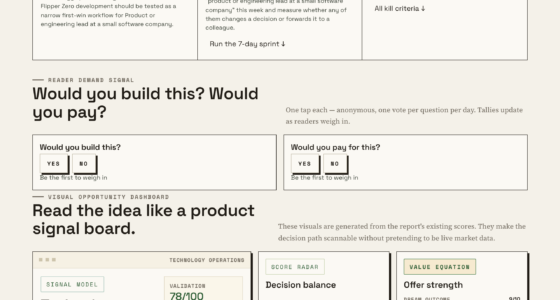

📊 Full opportunity report: A Deep Dive Into AI Tools & Automation Technologies on ThorstenMeyerAI.com — validation score, market gap, and execution plan.
TL;DR
This article examines the current landscape of AI tools and automation technologies, highlighting their capabilities, use cases, and strategic considerations. It discusses how these tools are transforming workflows and what challenges remain.
AI tools and automation technologies are increasingly integrated into workflows across industries, enabling users to organize information, generate content, analyze data, and automate repetitive tasks. This report offers a detailed examination of current tools, their functions, and strategic considerations for adoption, based on recent industry insights. For a comprehensive overview, see the original analysis.
Recent analyses, including insights from Thorsten Meyer AI, highlight that the core challenge now is not finding AI tools but determining how to effectively integrate them into existing workflows. AI tools are software systems that use models or decision algorithms to generate, classify, or transform information, often working alongside traditional automation systems. Unlike conventional automation, which follows fixed rules, AI-assisted automation interprets less structured inputs, making it suitable for tasks involving language, variation, and complex decision-making.
Experts suggest that successful AI deployment begins with clearly defining the task, identifying repetitive, time-consuming, and verifiable processes. You can explore related strategies in The 2026 Guide To The Best AI Workflow Automation Tools. Mapping current workflows helps in selecting appropriate AI levels—suggestion, preparation, execution with approval, or full automation—each with varying degrees of human oversight. For example, AI can assist students and knowledge workers with organizing notes, scheduling, research, or content creation, often improving efficiency without complicating existing systems.
In content production, generative AI supports brainstorming, outlining, summarization, and editing, but human oversight remains essential to verify accuracy and relevance. The choice of tools should consider integration ease, exportability, notification controls, and whether AI suggestions can be ignored without disrupting workflow. Hardware considerations also matter for demanding tasks, such as media editing or local model experimentation, which require high-performance setups.
Strategic Impact of AI and Automation Adoption
The integration of AI tools and automation technologies influences organizational and individual workflows, potentially increasing efficiency and reducing manual effort. It also presents challenges related to task selection, oversight, and technology integration. Careful planning and understanding of these factors are necessary for effective implementation.
Building AI Agents for Network Operations: Design LLM-powered NetOps workflows with Python, Ollama, MCP, and tool calling
As an affiliate, we earn on qualifying purchases.
As an affiliate, we earn on qualifying purchases.
Evolution and Current State of AI Tools in Workflows
Over recent years, AI and automation have transitioned from experimental phases to broader adoption across various sectors. Early applications focused on rule-based automation, but recent advances in generative AI and machine learning have expanded capabilities. Industry reports, including those from Thorsten Meyer AI, emphasize that the current focus is on strategic integration—aligning AI tools with specific tasks to maximize benefits while managing associated risks.
Recent developments include AI systems that assist with content creation, data analysis, and project management, often combining rule-based automation with AI-driven interpretation. The ongoing challenge is to select appropriate tools, design effective workflows, and ensure responsible use, especially as AI systems become more autonomous and capable.
“The key to successful AI adoption is starting with a clear understanding of the task, not just the latest tool.”
— Thorsten Meyer, AI Expert

Generative AI Essentials For Beginners: Boost Your Artificial Intelligence Skills With Innovative Tools To Write, Create, And Edit Content With Ease
As an affiliate, we earn on qualifying purchases.
As an affiliate, we earn on qualifying purchases.
Unresolved Challenges in AI Integration
Questions remain regarding how organizations will balance automation with human oversight as AI systems become more autonomous. Issues related to reliability, ethical use, and integration complexity are ongoing areas of discussion. The rapid pace of technological development also raises concerns about maintaining current knowledge and managing potential errors or misuse of AI systems.
high-performance laptops for AI tasks
As an affiliate, we earn on qualifying purchases.
As an affiliate, we earn on qualifying purchases.
Future Directions for AI and Automation Strategies
Future developments are expected to include more advanced AI tools that integrate seamlessly with existing systems, along with enhanced safety and oversight mechanisms. Clearer guidelines for responsible AI use are also anticipated. Organizations are likely to focus on designing workflows that leverage AI strengths while maintaining human oversight, with ongoing research into AI ethics and governance informing future practices.
AI data analysis software
As an affiliate, we earn on qualifying purchases.
As an affiliate, we earn on qualifying purchases.
Key Questions
What are the main benefits of AI tools in workflows?
AI tools can assist in organizing information, automating repetitive tasks, generating content, analyzing data, and improving overall efficiency, allowing human workers to focus on higher-value activities.
How should organizations start implementing AI automation?
Organizations should begin by mapping current processes, identifying tasks that are repetitive and verifiable, and selecting appropriate AI levels—such as suggestion, preparation, or execution—with clear oversight and control points.
What are the risks of integrating AI into workflows?
Risks include over-reliance on automation, potential errors or biases, ethical considerations, and challenges in maintaining adequate human oversight as AI systems become more autonomous.
Will AI replace human judgment entirely?
Most experts agree that AI is intended to augment human judgment rather than replace it, especially in complex or sensitive decision-making contexts where oversight and ethical considerations are critical.
What hardware considerations are important for AI-intensive tasks?
High-performance hardware, including powerful processors, sufficient memory, and suitable graphics capabilities, is important for demanding tasks such as media editing or local AI model experimentation.
Source: ThorstenMeyerAI.com