
TL;DR
SpaceX said on Nov. 12 that it is advancing two AI computing projects with more than $74 billion in planned investment: one near Starbase, Texas, and another in Cochise County, Arizona. Local proceedings are scheduled for Dec. 9, but key details—including Texas facility water use and Arizona power arrangements—remain unresolved.
SpaceX said Nov. 12 it is advancing two AI supercomputing projects in Starbase, Texas, and Cochise County, Arizona, describing their combined planned investment as more than $74 billion. Both projects face local proceedings scheduled for Dec. 9, and several details—including the Texas facility’s water use and the Arizona site’s power arrangements—remain unresolved.

Get the latest gadgets delivered free with Prime
- Fast, free delivery on millions of items
- Prime Video, Amazon Music and more included
- Member-only deals all year
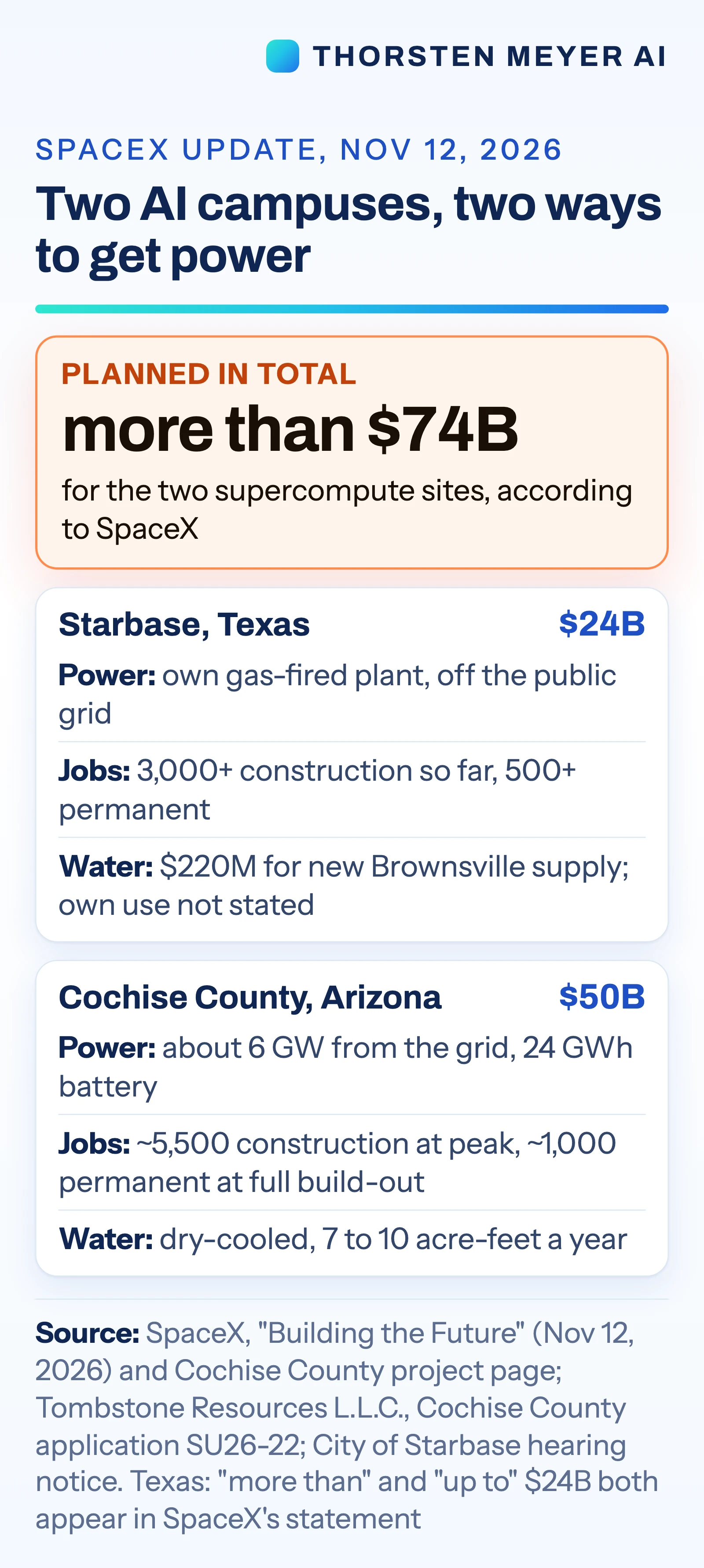
SpaceX puts the Texas investment at more than $24 billion. A Starbase City Commission notice estimates approximately $24 billion in capital investment for the initial phases, with possible later expansion. The proposed site covers about 444 acres between Boca Chica Boulevard and the Port of Brownsville. SpaceX says the facility would generate its own electricity; the city describes a gas-fired power plant alongside the computing facility but does not state its generating capacity.
For Arizona, SpaceX says it has committed $50 billion to a campus on about 747 acres along U.S. Highway 191 near Cochise. The county application was filed by Tombstone Resources L.L.C. and proposes up to nine computing buildings, each about 493,000 square feet, built in four phases. The application describes a potential full build-out of approximately 6 gigawatts of grid power and a 24-gigawatt-hour battery system. The county documents cited in the source material do not name SpaceX; the connection is supported by the company’s project page and Tombstone Resources’ town hall statement.
The two plans use different approaches to electricity and cooling. SpaceX says the Texas project would operate off its own generation. The Arizona application describes grid power delivered through Sulphur Springs Valley Electric Cooperative and Arizona Electric Power Cooperative to a utility-owned substation, with natural-gas generators for backup. SpaceX says the Arizona campus would use dry cooling and no industrial groundwater. It also says it will help reduce local cooperative members’ power bills, but the utility arrangements behind that promise remain subject to review.
Two States Face Major AI Power Demand
The proposals would commit large amounts of capital and electricity to AI computing infrastructure in two communities. The Arizona application’s full-build estimate of about 6 gigawatts signals a substantial planned demand on the regional grid. In Texas, a separate gas-fired power plant would supply the computing site, making local air emissions and the project’s power capacity relevant questions for public review.
For residents, the effects could include construction and permanent jobs, new utility infrastructure, and pressure on local services. SpaceX says the Texas project has supported more than 3,000 construction jobs so far and would create more than 500 permanent jobs once operational. It also says it has committed $220 million to water and wastewater infrastructure for Brownsville and Cameron County, including $40 million it says it has already provided. The company’s figures and projected benefits are claims by SpaceX; the supplied material does not independently verify them.
The plans also put a community question at the center of AI expansion: who supplies the electricity and water, and who bears the costs? Arizona’s campus is described as grid-connected, while Texas would generate power on site. The two local processes will give officials and residents a chance to examine details, though the information available so far does not settle every environmental or financial question.
Products Worth Considering

Bose QuietComfort Ultra Headphones (2nd Gen), Wireless Noise-Cancelling Over-Ear Headphones with Spatial Audio, Driftwood Sand

Kindle Paperwhite Signature Edition 32GB E-Reader, 7-Inch Display, Seaglass Green

Jackery Explorer 1000 v2 Portable Power Station
As an affiliate, we earn on qualifying purchases.
From Orbital Computing to Ground Sites
When SpaceX announced on Feb. 2 that it had acquired xAI, it argued that global electricity demand for AI could not be met with terrestrial solutions in the near term without hardship to communities and the environment. The company presented computing in orbit as part of its answer. The two projects announced in November are instead ground-based facilities, though SpaceX says the Texas site would also help develop and test technology for future space-based computing.
The announcement comes as AI has become a significant part of SpaceX’s business. Reuters reported that the company’s AI segment generated more than half of its revenue in the third quarter. That figure is Reuters’ reporting, and the source material does not provide further detail about how the revenue was calculated. The project plans show the scale of infrastructure SpaceX is proposing as it expands its AI operations.
The claims and project details come from different records. SpaceX provided investment figures and descriptions of intended benefits. Starbase issued a notice about the Texas site and a proposed property tax abatement. Cochise County’s application describes the Arizona campus but names Tombstone Resources as the applicant. Those distinctions matter as local officials review the plans.
““Together, they represent more than $74 billion in planned American investment.””
— SpaceX
Capacity, Water and Utility Terms
Several operational details are not established in the material available. The Starbase notice does not give the Texas computing facility’s capacity or the gas plant’s generating capacity, and SpaceX has not stated how much water the computing site itself would use. Its stated water infrastructure commitments concern regional supply and wastewater projects, not a disclosed facility-level consumption estimate.
For Arizona, the application describes the campus’s proposed power route and SpaceX promises lower bills for cooperative members. It is not clear whether the relevant utility or regulatory approvals will be granted, or how any savings would be calculated and distributed. The supplied material also does not establish the final construction schedule, total cost after any changes, or whether the projects will receive all requested local approvals.
The Texas source material cites a local report on an air registration filed with the Texas Commission on Environmental Quality. According to that report, an initial temporary setup would use 35 natural-gas turbines totaling about 748 megawatts, later replaced by eight larger turbines totaling about 708 megawatts. Those figures are attributed to the report and the registration it obtained; they are not specified in the Starbase notice summarized here.
Local Reviews Set for December 9
On Dec. 9, 2026, the Cochise County Planning and Zoning Commission is scheduled to hold a hearing on the Arizona proposal. The Starbase City Commission is also scheduled to consider a property tax abatement related to the Texas project. These proceedings are the next identified local milestones; the available source material does not state whether either meeting will produce a final approval.
Residents and officials will be able to consider the project proposals and their supporting documents during those processes. Further detail on the Texas site’s water demand, power plant capacity, and tax terms—and on Arizona’s utility approvals and promised bill cuts—will be needed to clarify how the campuses would operate and what their local costs and benefits would be.
Key Questions
Where does SpaceX plan to build the AI campuses?
The proposed sites are near Starbase in the Rio Grande Valley, Texas, and near Cochise in Cochise County, Arizona.
How much investment has SpaceX announced?
SpaceX says the two projects represent more than $74 billion in planned investment: more than $24 billion in Texas and about $50 billion in Arizona.
How would the sites get electricity?
SpaceX says the Texas facility would generate its own electricity at a gas-fired plant. The Arizona application describes a grid connection, with natural-gas generators for backup.
When will local officials consider the projects?
Local proceedings are scheduled for Dec. 9, 2026: a planning and zoning hearing in Cochise County and a Starbase City Commission consideration of a property tax abatement.
What remains unknown about the projects?
The available material does not state the Texas computing facility’s capacity or water use. Arizona’s utility approvals and the basis for SpaceX’s promised lower power bills also remain unclear.
Source: Thorsten Meyer AI