
TL;DR
Diffusion models are trained by adding noise to images and teaching a neural network to predict what was added. To generate an image, the model starts with noise and removes it step by step, guided by a text prompt. This explains both how the method works and why it can struggle with lettering, object placement and reproducing training images.
A November 23 explainer from Thorsten Meyer AI describes how image diffusion models create pictures by starting with random noise and progressively removing it, with a text prompt steering each step. The account draws on published research and documentation to explain a widely used image-generation method, as well as its limits in handling text, object counts and spatial relationships.

Get the latest gadgets delivered free with Prime
- Fast, free delivery on millions of items
- Prime Video, Amazon Music and more included
- Member-only deals all year
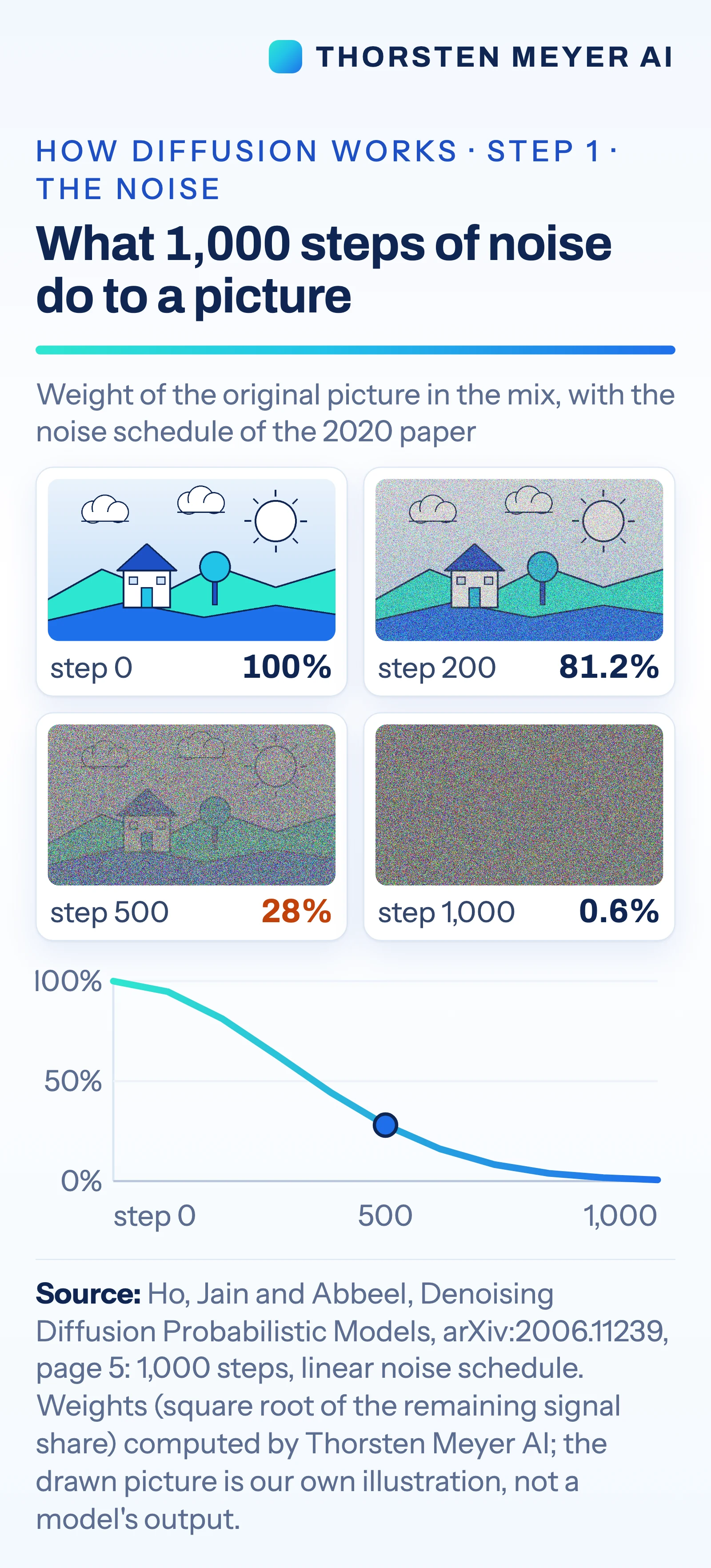
During training, a model receives real images altered with increasing amounts of noise. A neural network learns to estimate the noise added at each stage. The 2020 paper Denoising Diffusion Probabilistic Models, by Jonathan Ho, Ajay Jain and Pieter Abbeel, used 1,000 steps in its experiments. The explainer says that, under the paper’s schedule, the original image accounts for about 81.2% of the mixture after 200 steps, 28% after 500 and 0.6% after 1,000.
Image generation reverses the learned process: the system begins with noise and repeatedly estimates and removes some of it. Broad shapes emerge before finer detail. The article cites the Hugging Face diffusers documentation for a 50-step default in a commonly used open-source pipeline; that is a software setting, not a universal rule for all diffusion models.
Many systems do this work in a compressed representation called latent space rather than directly on every image pixel. The explainer states that Stable Diffusion v1 compresses a 512-by-512 image to 48 times fewer numbers. A text encoder converts the prompt into a representation that guides generation. The article says stronger guidance can bring results closer to the prompt, while potentially reducing image quality.
Why Noise Removal Shapes Image Results
The method helps explain why image generators can produce convincing scenes while mishandling specific details. A prompt is used to steer a sequence of estimates; the process does not amount to a system checking that every requested object, letter or relationship is present. The explainer identifies garbled lettering, inaccurate counting and misplaced objects as recurring weaknesses.
The training process also matters to ongoing discussions about image reuse. The source says researchers have extracted near-copies of some training images from models. Separately, it reports that a UK court found in 2025 that Stable Diffusion itself was not an “infringing copy,” while other legal questions remain open. These are distinct points: evidence of possible memorization does not by itself establish a legal finding about a particular image or model.
Products Worth Considering

Bose TV Speaker Compact Soundbar with Bluetooth and HDMI-ARC, Black

Amazon Kindle Paperwhite (12th Generation, 2024), 16 GB, 7-inch Display, Black

Bose QuietComfort Wireless Noise Cancelling Headphones – Cypress Green (Limited Edition)
As an affiliate, we earn on qualifying purchases.
From Early Theory to Practical Models
The basic proposal predates today’s popular image generators. In 2015, Jascha Sohl-Dickstein and colleagues described gradually destroying structure in data and learning a reverse process to restore it. Their work framed diffusion as an iterative method inspired by physical diffusion.
The 2020 work by Ho, Jain and Abbeel helped make the approach practical for image generation. It described a forward process that adds noise until the original signal is largely lost, then trains a model to estimate that noise. Modern text-to-image systems add components such as compressed latent representations and text encoders to make generation more efficient and responsive to prompts.
“A diffusion model learns to remove noise.”
— Thorsten Meyer AI explainer
Where Image Generation Still Falls Short
The explainer does not quantify how often models produce errors such as misspelled text or incorrect object placement, and performance may differ across models and prompts. Its figures also describe particular examples: the 1,000-step training schedule comes from the 2020 paper, while 50 steps is a cited pipeline default, not a universal generation count.
The source notes that researchers have extracted near-copies of training images, but it does not specify the studies or the frequency of such outputs in the material provided. The legal status is also not settled across all disputes: the reported 2025 UK ruling addressed whether Stable Diffusion itself was an “infringing copy,” while other questions remain open.
Further Research and Legal Questions
The explainer points readers to the underlying 2015 and 2020 papers and to the Hugging Face diffusers documentation for the process and implementation details. Those sources provide ways to examine how particular training schedules and generation settings work.
Further developments to watch include research into how models reproduce training images and the progress of unresolved legal questions. The source does not identify a specific upcoming study, court date or product milestone, so no immediate next event is confirmed.
Key Questions
Does a diffusion model search for an existing picture?
The process described in the explainer starts from random noise and refines it step by step under the prompt’s influence. Research cited by the source indicates that models can sometimes reproduce near-copies of training images, but that is different from saying each generated image is retrieved from a search.
Why can generated images contain misspelled words?
The model estimates and removes noise while responding to prompt guidance; the source identifies lettering as a known weakness. It does not report an error rate or a single cause that applies to every model.
How many steps does image generation take?
It depends on the model and its settings. The explainer cites a 50-step default for a commonly used open-source pipeline, while the 2020 training paper used 1,000 steps for its noise schedule.
What did the UK court decide about Stable Diffusion?
The source reports that a UK court found in 2025 that Stable Diffusion itself was not an “infringing copy.” It also says other questions remain open, so the reported finding should not be read as resolving every dispute about training data or generated images.
Source: Thorsten Meyer AI