
📊 Full opportunity report: Retirement Care Planner on IdeaNavigator AI — validation score, market gap, and execution plan.

Get the latest gadgets delivered free — and shop member deals
- Fast, free delivery on millions of items
- Access to Prime Big Deal Days deals on October 6–7
- Prime Video, Amazon Music and more included
TL;DR
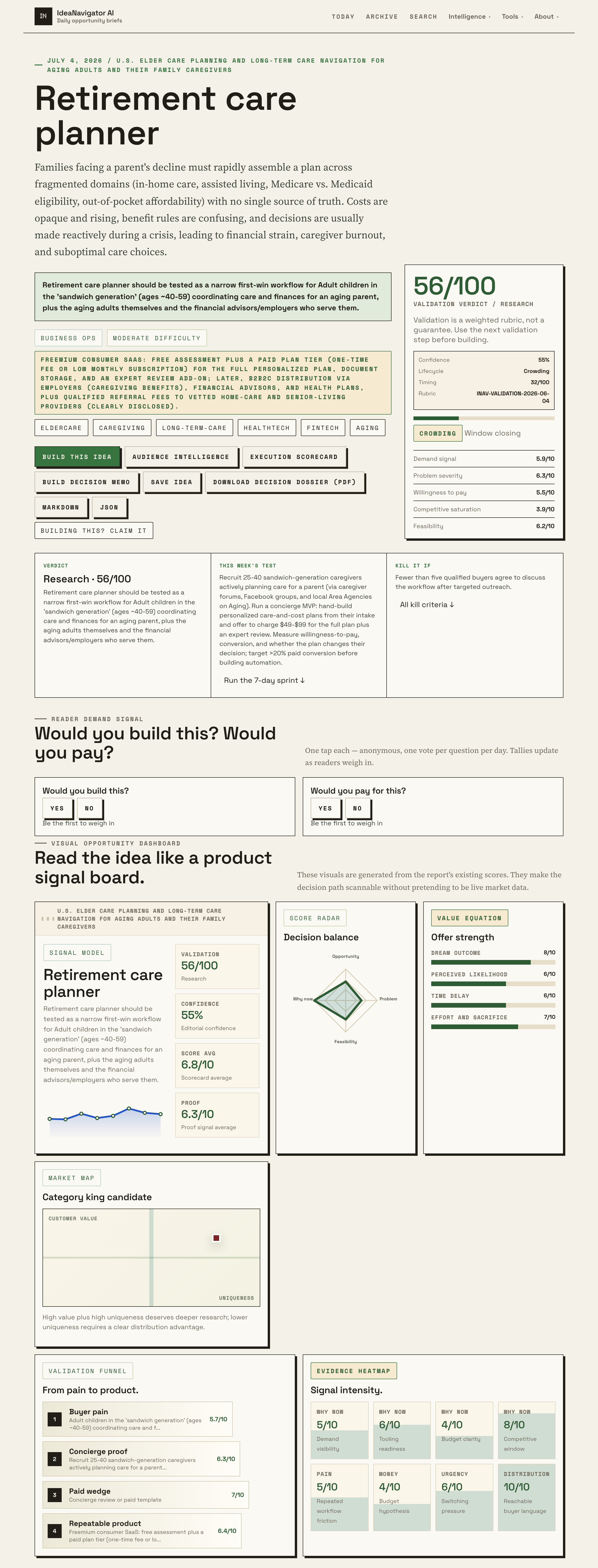
A prototype retirement care planning tool is being tested to assist adult children in the ‘sandwich generation’ with coordinating care and finances for aging parents. The initiative aims to provide personalized, localized plans amid rising costs and complex benefit rules.
IdeaNavigator AI is currently testing a prototype web app aimed at helping adult children in the ‘sandwich generation’ coordinate care and finances for their aging parents. This development addresses a critical gap in elder care planning, offering structured guidance amid rising costs and complex benefit rules.
The proposed retirement care planner targets families facing the challenge of managing multiple care options, including in-home care, assisted living, and nursing homes. It aims to generate personalized care and cost plans based on a brief intake about the parent’s health, location, and finances. The app will provide localized cost comparisons, eligibility explanations for Medicare and Medicaid, affordability projections, and a prioritized action checklist with vetted local providers.
This initiative is in the testing phase, with an initial target group of 25-40 caregivers actively planning for a parent’s care. The plan is to offer a concierge MVP, charging between $49 and $99 for a comprehensive plan and expert review, and to measure willingness-to-pay, plan impact, and decision changes. The project is focusing on a high-cost state initially to manage data complexity, with plans to expand based on user feedback and validation metrics.
Impact of Structured Planning for Aging Families
This development could significantly improve how families manage elder care, reducing reactive decision-making, financial strain, and caregiver burnout. By providing clear, personalized guidance, the tool aims to make complex, fragmented care decisions more manageable and transparent, which is increasingly urgent as the U.S. approaches a demographic peak of over 73 million seniors by 2030. The project’s success could also pave the way for broader adoption of tech-enabled elder care planning, influencing employer benefits, financial advising, and care provider networks.
Medicare Medicaid eligibility guidebook
As an affiliate, we earn on qualifying purchases.
As an affiliate, we earn on qualifying purchases.
Growing Need for Elder Care Planning Solutions
The U.S. is experiencing a surge in demand for elder care planning due to demographic shifts and rising costs. The median monthly cost for assisted living has risen to approximately $6,200, and nursing home expenses average around $115,000 annually. Meanwhile, nearly 70% of Americans turning 65 today will require long-term care. Families in the ‘sandwich generation’ face mounting financial and emotional pressures, often making reactive decisions during crises without comprehensive guidance.
Existing solutions are fragmented, with no centralized tool to compare local costs, benefits, and options effectively. This gap has led to suboptimal care choices, financial strain, and caregiver burnout, highlighting the need for structured, accessible planning tools tailored to local contexts and individual circumstances.
“The current elder care landscape is highly fragmented, and families need better tools to make informed, proactive decisions.”
— an anonymous researcher
assisted living cost comparison tool
As an affiliate, we earn on qualifying purchases.
As an affiliate, we earn on qualifying purchases.
Unconfirmed Aspects of the Care Planner Prototype
It remains unclear how accurately the prototype will perform in diverse geographic and socioeconomic contexts, or how well users will adopt and value the tool at scale. The effectiveness of the personalized plans in influencing actual care decisions and cost savings is still being evaluated. Additionally, the long-term sustainability of the business model and integration with existing elder care services are yet to be confirmed.
long-term care financial planning book
As an affiliate, we earn on qualifying purchases.
As an affiliate, we earn on qualifying purchases.
Next Steps for Validation and Expansion
The project will continue with user testing, collecting feedback on plan accuracy, usability, and willingness-to-pay. Success metrics include over 20% paid conversion and evidence that the plans influence decision-making. Based on initial results, the team plans to refine the app, expand geographic coverage, and explore partnerships with employers, financial advisors, and care providers to scale deployment.
local elder care provider directory
As an affiliate, we earn on qualifying purchases.
As an affiliate, we earn on qualifying purchases.
Key Questions
How will the retirement care planner determine the best care options?
The app will use local cost data, benefit eligibility rules, and user input about the parent’s health and finances to generate personalized recommendations and cost comparisons.
Is this tool available for free?
The initial assessment will be free, but a full personalized plan with expert review will cost between $49 and $99 during the testing phase.
Will this tool be accessible to families in all states?
Initially, the prototype will focus on a high-cost state to manage data complexity, with plans to expand based on success and feasibility.
How does the app plan to generate revenue?
Revenue will come from paid plans, subscription options, referral fees from vetted providers, and later, B2B partnerships with employers and financial advisors.
What challenges might the project face?
Key challenges include ensuring data accuracy across regions, user adoption, and demonstrating cost-effectiveness to justify paid plans.
Source: IdeaNavigator AI
Halloween Picks
halloween
As an affiliate, we earn on qualifying purchases.