📊 Full opportunity report: An SMB Guide To Auditing Workflows For Automation on IdeaNavigator AI — validation score, market gap, and execution plan.

Get the latest gadgets delivered free with Prime
- Fast, free delivery on millions of items
- Prime Video, Amazon Music and more included
- Member-only deals all year
TL;DR
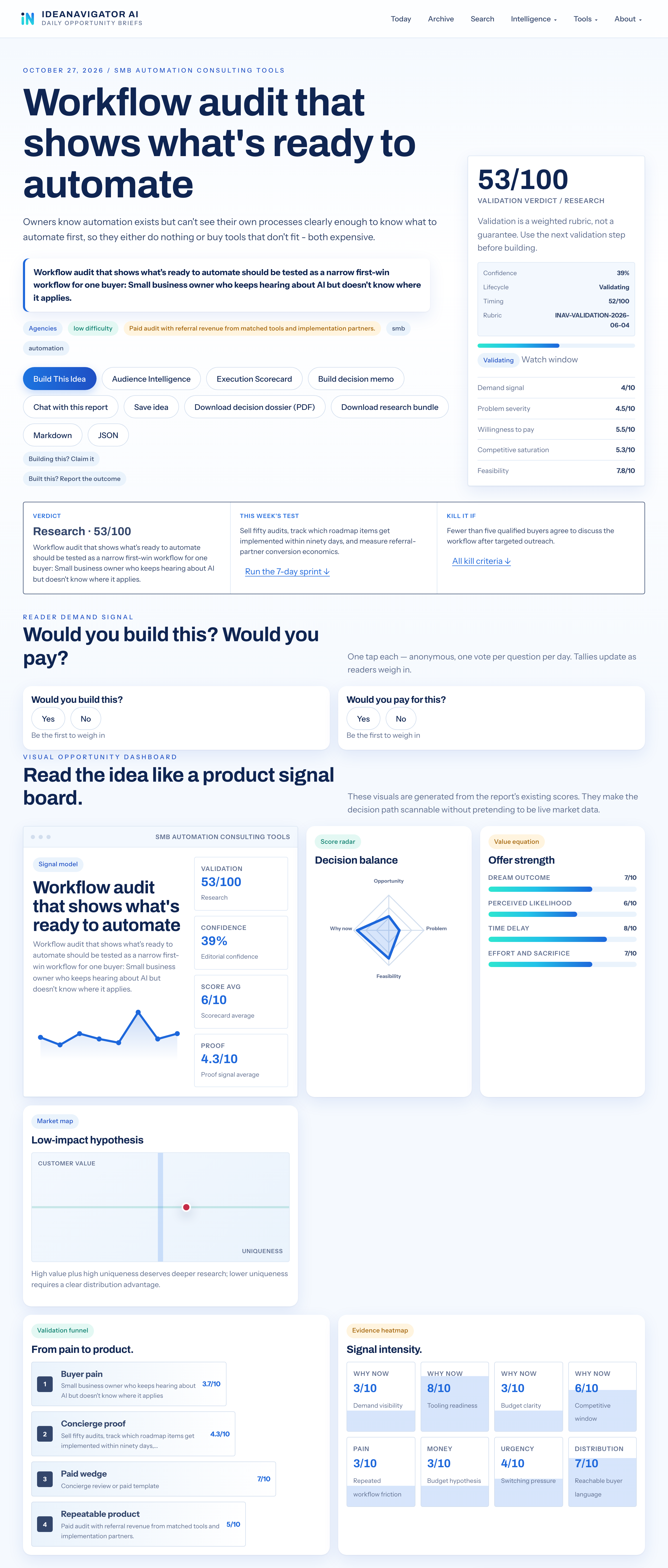
IdeaNavigator AI outlines a proposed paid workflow audit to help small-business owners identify which processes may be suitable for automation. The concept would rank opportunities by readiness, return on investment and difficulty, then test demand by selling 50 audits and tracking implementation over 90 days.
IdeaNavigator AI has outlined a proposed workflow audit for small-business owners who are unsure where automation fits, pairing an interview about daily operations with a ranked process map and a 90-day implementation roadmap. The proposal describes a product concept and a validation plan, not a launched service or demonstrated result.
According to IdeaNavigator AI’s proposal, the suggested minimum viable product would guide an owner through questions about how the business operates, then identify processes that might be suitable for automation. Each candidate would be scored for automation readiness, potential return on investment and implementation difficulty. The audit would also recommend tools matched to individual steps in the roadmap.
IdeaNavigator AI proposes combining a paid audit with referral revenue from recommended software providers and implementation partners. The proposal does not specify the audit price, the referral terms, which tools would be recommended or how scoring would be calculated. Those details would affect both the product’s usefulness and the independence of its recommendations.
For validation, the proposal calls for selling 50 audits, then tracking which recommended roadmap items customers implement within 90 days. It also proposes measuring conversion economics for referral partners. IdeaNavigator AI reports no customer sales, implementation rates or revenue results, so the plan remains a test to be run rather than evidence of demand.
SMALL BUSINESS • AUTOMATION FIELD GUIDE
An SMB Guide To Auditing Workflows For Automation
IdeaNavigator AI proposes a paid workflow audit to help small-business owners find processes that may suit automation—and a 90-day trial to learn whether owners will pay and act.
A product proposal, not a launched service
01 / THE OPPORTUNITY
From AI interest to process mapping
More tools do not automatically make it easier to know which business tasks are worth changing. The proposed audit starts with the work itself.
Document daily operations
A structured interview would ask how the business runs and surface recurring tasks and workflows.
Start with the processRank candidate workflows
Each process would be considered for automation readiness, potential return, and implementation difficulty.
Compare opportunitiesRecommend next steps
A process map and 90-day roadmap would pair actions with tools matched to individual steps.
Move toward action02 / HOW IT COULD WORK
A proposed audit journey
The concept uses guided process mapping to turn a broad question—“Where could automation help?”—into a set of testable actions.
Interview
Ask the owner about operations, tasks, and existing tools.
Map
Document workflows and identify possible automation candidates.
Rank
Score readiness, potential ROI, and implementation difficulty.
Roadmap
Suggest tools and track selected actions over 90 days.
03 / THE DECISION FRAMEWORK
Three lenses for each workflow
These are proposed scoring dimensions. The proposal does not explain how scores would be calculated.
04 / OPEN QUESTIONS
Details that will shape trust
The business model and scoring approach remain underspecified. Those choices affect usefulness, economics, and confidence in recommendations.
Price and terms: No audit price or referral terms are provided.
Scoring evidence: The interview questions and calculation method are not described.
Fit and safeguards: Effects of business size, software, data quality, and compliance are unclear.
Independence: Referral incentives may influence tool suggestions; safeguards and disclosures are unspecified.
Technical evidence: No accuracy study or comparison with human-led consulting is reported.
Market evidence: No market-size estimate or competitor analysis is included.
05 / VALIDATION PLAN
Test payment and follow-through
Interest alone would not establish that the assessment is useful. The proposed trial measures purchases, implementation, and referral economics.
Sell the assessment. Learn whether owners will pay for process mapping and a tailored roadmap.
Follow up at 90 days. Track which recommended roadmap actions customers implement.
Measure referrals. Examine conversion economics for software and implementation partners.
No sales, implementation rates, or revenue results have been reported. No trial schedule or launch commitment is specified.
06 / KEY QUESTIONS
What we know—and what we don’t
IdeaNavigator AI describes a product concept and a proposed test, with outcomes still unknown.
What is the proposed workflow audit?
An assessment that would interview a small-business owner, map processes, and rank automation candidates by readiness, potential ROI, and difficulty.
Is it already available?
The available details describe a concept and validation plan. They do not confirm a launch or provide a launch date.
How would the idea be tested?
Sell 50 audits, track roadmap implementation over 90 days, and measure conversion economics from referrals.
What remains unknown?
Price, referral terms, scoring method, recommended tools, and safeguards around referral incentives are not specified.
THE TAKEAWAY
A testable idea, not proven demand
Until the proposed trial runs and results are shared, the workflow audit should be treated as an unvalidated product concept.
A Practical Test for Automation Advice
Small-business owners can face a gap between hearing that automation tools are available and knowing which, if any, of their own processes are worth changing. A structured audit could make that decision more concrete by setting out tasks, possible tools, effort and expected value in one plan. That may help owners avoid choosing software before they understand the work it is meant to improve.
The proposed 90-day follow-up also focuses the test on implementation, not just interest. A business might pay for an assessment but never act on its recommendations; tracking completed steps could show whether the roadmap is practical. Referral measures could indicate whether tool recommendations generate revenue, but commercial incentives may shape what gets suggested. IdeaNavigator AI’s proposal does not describe safeguards or disclose how that potential conflict would be handled.
Products Worth Considering

Logitech MX Mechanical Wireless Illuminated Keyboard, Tactile Quiet, Graphite

DJI Osmo Mobile 8 3-Axis Smartphone Gimbal Stabilizer

Logitech MX Keys S Wireless Keyboard, Graphite
As an affiliate, we earn on qualifying purchases.
From AI Interest to Process Mapping
IdeaNavigator AI frames the idea against a crowded market of AI and automation tools. Its premise is that more options have not necessarily made it easier for owners to decide where to start. The proposal identifies the first step as documenting existing operations through a guided interview, then assessing individual workflows rather than recommending automation in the abstract.
The concept is also tied to the possibility of using large language models to support structured process-mapping interviews. IdeaNavigator AI presents that as the reason this kind of guided assessment may now be easier to automate; the proposal includes no technical evaluation, accuracy study or comparison with human-led consulting. It identifies small-business automation consulting tools as the market, but provides no market-size estimate or competitor analysis.
Pricing, Scoring and Outcomes
IdeaNavigator AI’s proposal leaves key details unspecified: the audit’s price, the interview questions, the method for assigning readiness and ROI scores, and the evidence used to estimate returns. It is also unclear how the product would account for differences in business size, existing software, data quality or compliance needs.
The proposal reports no test results. There is no evidence yet about whether owners will buy 50 audits, what share will implement recommendations within 90 days or whether referrals will produce sustainable revenue. It also does not say how recommendations would be reviewed for accuracy or how paid referral relationships would be disclosed to customers.
The Proposed 50-Audit Trial
IdeaNavigator AI describes the next step as selling 50 paid audits and monitoring which roadmap actions customers complete during the following 90 days. Referral-partner conversion economics would be measured alongside implementation. Those results could help determine whether owners see enough value in the assessment to pay and whether its recommendations lead to action.
IdeaNavigator AI provides no schedule, launch announcement or commitment to begin the trial. Until the test is carried out and its results are shared, the workflow audit should be treated as a proposed product idea rather than a proven approach to small-business automation.
Source: IdeaNavigator AI
Key Questions
What is the proposed workflow audit?
IdeaNavigator AI describes it as a proposed assessment that would interview a small-business owner about operations, map processes and rank automation candidates by readiness, potential ROI and difficulty.
Is the audit already available?
IdeaNavigator AI’s available details describe a product concept and a proposed validation plan. They do not confirm that the service has launched or provide a launch date.
How would the proposal be tested?
IdeaNavigator AI proposes selling 50 audits, tracking which recommendations are implemented within 90 days and measuring conversion economics from tool and implementation referrals.
What remains unknown about the business model?
According to the proposal, the audit price, referral terms, scoring method, recommended tools and safeguards around referral incentives have not been specified.
Source: IdeaNavigator AI