A good conference room speakerphone has one job: make everyone in the room sound clear to everyone on the call. After comparing mic pickup range, noise handling, and connectivity across seven popular models, the Anker PowerConf with six microphones stands out as the best overall pick for small-to-mid rooms, thanks to its broad voice coverage and Zoom certification. For tighter budgets or compact spaces, the EMEET M0 Plus delivers 360° pickup at a friendlier price, while the Yealink SP92 is the pick for Teams-first offices that need certification and battery power. The main tradeoff in this category is simple: portable puck-style units trade room coverage for convenience, while daisy-chainable kits like the EMEET Luna Plus cost more but fill larger tables. Keep reading for the full breakdown of where each model wins and where it falls short.

Get the latest gadgets delivered free with Prime
- Fast, free delivery on millions of items
- Prime Video, Amazon Music and more included
- Member-only deals all year
Complete the kit


Key Takeaways
- Mic count and placement mattered more than speaker loudness — the Anker PowerConf’s six-mic array and the EMEET Luna Plus’s 8+1 setup clearly outperformed 4-mic and single-mic units in larger rooms.
- Two nearly identical Jabra Speak 510 (2025 Edition) variants appear in this lineup; the differences are connectivity emphasis, so buyers should match the listing to their setup rather than assume they’re different products.
- Platform certification is a real differentiator: the Yealink SP92 (Teams) and Anker PowerConf (Zoom) integrate more smoothly on certified platforms than generic USB models.
- Battery-powered portability (Yealink SP92, both Jabras) comes at the cost of max volume and room coverage — fine for huddle rooms and travel, limiting for 6+ person tables.
- The EMEET M0 Plus is the strongest value play because its 360° pickup covers most small-room scenarios without the premium pricing of certified or multi-unit kits.
| EMEET M0 Plus Conference Speaker and Microphone, 4 Mics, 360° Voice Pickup | 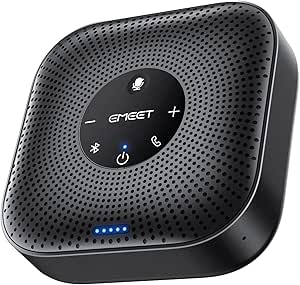 | Best for Flexible Small-to-Midsize Rooms | Microphones: 4 | Voice pickup: 360° | Connectivity: USB-C, Bluetooth 5.0 | VIEW ON AMAZON | See Our Full Breakdown |
| Anker PowerConf S330 USB Speakerphone for Home Office |  | Best Value for a Fixed Desk | Microphones: 4 | Coverage: 360° | Connectivity: USB-C | VIEW ON AMAZON | See Our Full Breakdown |
| Anker PowerConf Speakerphone, Zoom Certified Conference Speaker with 6 Mics |  | Best for Longer Meetings | Microphones: 6 | Coverage: 360° | Connectivity: Bluetooth, USB-C | VIEW ON AMAZON | See Our Full Breakdown |
| EMEET Luna Plus Kit Conference Speaker and Microphone with 8+1 Mics |  | Best for Large Conference Tables | Microphones: 9 total: 8-microphone array plus 1 satellite microphone | Voice pickup: 360° | Daisy-chain meeting size: Up to 25 attendees | VIEW ON AMAZON | See Our Full Breakdown |
| Jabra Speak 510 (2025 Edition) Portable Bluetooth Speaker for Meetings and Calls, Black |  | Best Compact Portable Pick | Audio output: Stereo | Mounting type: Tabletop | Enclosure materials: ABS, metal, plastic, polycarbonate | VIEW ON AMAZON | See Our Full Breakdown |
| Yealink SP92 Conference Speaker and Microphone |  | Best Battery-Powered Small-Room Pick | Audio Output: Mono | Connectivity: Bluetooth 5.3, USB-C, optional BT51C dongle | Battery Life: Up to 20 hours | VIEW ON AMAZON | See Our Full Breakdown |
| Jabra Speak 510 (2025 Edition) Portable USB Bluetooth Speaker |  | Best Plug-and-Call Desk Pick | Audio Output: Stereo | Connectivity: USB and Bluetooth | Microphone: Built-in 360-degree pickup | VIEW ON AMAZON | See Our Full Breakdown |
| conference room speakerphone | Connectivity | Microphones | Audio output |
|---|---|---|---|
| EMEET M0 Plus Conference Speak | USB-C, Bluetooth 5.0 | 4 | — |
| Anker PowerConf S330 USB Speak | USB-C | 4 | Stereo |
| Anker PowerConf Speakerphone | Bluetooth, USB-C | 6 | — |
| EMEET Luna Plus Kit Conference | Bluetooth, USB | 9 total: 8-microphone array plus 1 satellite microphone | — |
| Jabra Speak 510 | Bluetooth | — | Stereo |
| Yealink SP92 Conference Speake | Bluetooth 5.3, USB-C, optional BT51C dongle | — | Mono |
| Jabra Speak 510 | USB and Bluetooth | — | Stereo |
More Details on Our Top Picks
EMEET M0 Plus Conference Speaker and Microphone, 4 Mics, 360° Voice Pickup
The EMEET M0 Plus suits teams that want a single speakerphone for both desk calls and shared-room meetings. Its four microphones with 360° pickup give people around the table a chance to be heard, while USB-C and Bluetooth make it easier to connect to different meeting setups than the wired-only Anker PowerConf S330. The stated battery life of over 10 hours also helps when a room lacks a convenient outlet. Daisy-chain support gives it a path to cover larger groups, though expanding the setup adds equipment and may require compatible conferencing platforms for full functionality. Noise filtering can help with ordinary room sounds, but the product data cautions that very noisy spaces may still compromise calls. I’d choose it for flexibility, not as the strongest option for a large or noisy room.
Pros:- Four microphones provide 360° voice pickup around a shared table.
- USB-C and Bluetooth 5.0 support wired and wireless connections.
- Over 10 hours of stated battery life suits extended meeting days.
- Daisy-chain support allows the setup to expand for larger meetings.
Cons:- Very noisy environments may limit voice clarity.
- Daisy-chain expansion adds setup requirements for larger rooms.
- Full functionality depends on compatible conferencing platforms.
Best for: Small and midsize teams that move between laptop calls and shared meeting rooms and want both Bluetooth and USB-C.
Not ideal for: Teams meeting in consistently noisy rooms or needing a complete large-room setup without adding daisy-chain equipment.
- Microphones:4
- Voice pickup:360°
- Connectivity:USB-C, Bluetooth 5.0
- Battery life:Over 10 hours
- Expansion support:Daisy chain
- Audio processing:Noise filtering
Our verdict“Choose the M0 Plus if you need flexible USB-C and Bluetooth connections for small-to-midsize meetings, with room to expand later.”
Anker PowerConf S330 USB Speakerphone for Home Office
The Anker PowerConf S330 keeps its focus on straightforward, wired conferencing: connect it by USB-C and use its four microphones and 360° coverage for calls at a desk or compact meeting table. That simplicity makes more sense for a home office than the battery-powered EMEET M0 Plus, which adds Bluetooth and room-to-room flexibility. The tradeoff is a stated 3-meter maximum range and no Bluetooth, so people farther from the unit or teams needing wireless pairing should look elsewhere. Stereo output and sound enhancement also make it usable for music between calls, but its listed speaker specifications do not make it a dedicated room-filling system. I’d pick the S330 for a predictable laptop setup; for a shared room that changes configuration, the M0 Plus is better equipped.
Pros:- USB-C plug-and-play setup keeps connection steps simple.
- Four microphones provide 360° voice coverage.
- Stereo output and sound enhancement support calls and music.
- Tabletop format fits a fixed desk or compact meeting table.
Cons:- Wired connection only; Bluetooth is not included.
- The stated maximum range is 3 meters, limiting use in larger rooms.
- The product data does not specify battery operation for untethered meetings.
Best for: Home-office workers or small teams who keep a laptop-connected speakerphone in one place and prefer a simple USB-C setup.
Not ideal for: Teams that need Bluetooth, a battery-powered option, or microphone coverage beyond the stated 3-meter range.
- Microphones:4
- Coverage:360°
- Connectivity:USB-C
- Maximum range:3 meters
- Audio output:Stereo
- Mounting type:Tabletop
- Item weight:8 ounces
Our verdict“Choose the S330 for a fixed desk or compact meeting table where USB-C simplicity matters more than wireless range.”
Anker PowerConf Speakerphone, Zoom Certified Conference Speaker with 6 Mics
For buyers who prioritize coverage and time away from an outlet, the Anker PowerConf is the stronger fit than the wired PowerConf S330. It has six microphones for 360° pickup, AI noise reduction and echo cancellation, plus up to 24 hours of stated call time. That mix is useful when meetings run long or several people sit around the speakerphone. Bluetooth and USB-C provide more placement choices than the S330’s USB-C-only connection, and the unit can charge other devices through PowerIQ. Those extras come with tradeoffs: Anker notes that setup can feel complex, and the device may be bulky for frequent carrying. Its noise processing is a useful feature, but does not make it a substitute for a room system in every large space. I’d choose it for longer calls, not minimal portability.
Pros:- Six microphones provide 360° voice pickup.
- AI noise reduction and echo cancellation target common call distractions.
- Up to 24 hours of stated call time supports long meeting days.
- Bluetooth and USB-C offer flexible connection options.
Cons:- Its bulk may make it less convenient to carry than a compact portable model.
- Some users may find setup more involved.
- Full functionality depends on compatible conferencing platforms.
Best for: Teams with long meetings that want 360° pickup, Bluetooth or USB-C connection options, and extended stated call time.
Not ideal for: Frequent travelers seeking a compact speakerphone or buyers who want the simplest possible setup.
- Microphones:6
- Coverage:360°
- Connectivity:Bluetooth, USB-C
- Call time:Up to 24 hours
- Battery capacity:5200 mAh
- Noise processing:AI noise reduction and echo cancellation
- Additional feature:PowerIQ device charging
Our verdict“Choose the Anker PowerConf for long meetings where six-microphone coverage and extended call time matter more than compact size.”
EMEET Luna Plus Kit Conference Speaker and Microphone with 8+1 Mics
The EMEET Luna Plus Kit is the lineup’s clearest choice for a large room: its eight-microphone array plus a satellite microphone is designed for 360° pickup, and the description says daisy-chaining can support meetings with up to 25 attendees. That gives it a broader-room role than the four-microphone M0 Plus or the six-microphone Anker PowerConf. Noise reduction and echo cancellation are also listed to help keep conversation intelligible. The cost of that reach is a more involved setup: expanded coverage requires an additional cable purchase, and the listing says expanded coverage is wired. Its stated 10-hour battery life is useful, though shorter than the Anker PowerConf’s 24-hour call time. I’d choose this kit for a larger table, while smaller teams are likely better served by a simpler speakerphone.
Pros:- Eight microphones plus a satellite microphone are aimed at broad 360° room pickup.
- Daisy-chain configuration is described for meetings up to 25 attendees.
- Noise reduction and echo cancellation support clearer conference audio.
- Stated 10-hour battery life supports extended sessions.
Cons:- Daisy-chain expansion requires an additional cable purchase.
- Expanded coverage is limited to wired connections.
- The larger-room setup may be more than small teams need.
Best for: Teams hosting meetings of up to 25 people who need a satellite microphone and daisy-chain expansion for a larger conference room.
Not ideal for: Small teams that do not need expanded coverage, or buyers who want a fully wireless multi-unit setup without extra cabling.
- Microphones:9 total: 8-microphone array plus 1 satellite microphone
- Voice pickup:360°
- Daisy-chain meeting size:Up to 25 attendees
- Maximum range:66 feet
- Battery life:10 hours
- Connectivity:Bluetooth, USB
- Audio processing:Noise reduction and echo cancellation
- Dimensions:1.43 × 5.11 × 5.11 inches
Our verdict“Choose the Luna Plus Kit when a large conference table needs satellite-microphone coverage and can accommodate a wired expansion setup.”
Jabra Speak 510 (2025 Edition) Portable Bluetooth Speaker for Meetings and Calls, Black
The Jabra Speak 510 is aimed at people who carry a speakerphone between offices, home and travel meetings. Its portable design, included carrying case and Bluetooth connectivity make it easier to bring along than the larger Anker PowerConf, which offers six microphones and a much longer stated call time but may be bulky for travel. Jabra’s listing also cites compatibility with multiple UC platforms, making it a plausible choice for mixed-device teams. The product data supplied here does not specify battery life, wireless range or microphone count, so buyers cannot compare those details directly with the EMEET M0 Plus or Anker models. It also lacks the stated expansion capability of the EMEET options. I’d choose it when portability and quick setup lead; room-scale coverage is harder to judge from the available specifications.
Pros:- Portable design includes a carrying case.
- Bluetooth supports wireless connection to compatible devices.
- Designed for compatibility with multiple UC platforms.
- Tabletop form suits meetings in different workspaces.
Cons:- The supplied product data does not state battery life or wireless range.
- The supplied product data does not state microphone count or pickup coverage.
- No expansion capability is listed for larger-room setups.
Best for: Mobile professionals and hybrid workers who carry a speakerphone between workspaces and value Bluetooth pairing and a carrying case.
Not ideal for: Buyers choosing by documented battery life, wireless range, microphone count, or room expansion capability.
- Audio output:Stereo
- Mounting type:Tabletop
- Enclosure materials:ABS, metal, plastic, polycarbonate
- Connectivity:Bluetooth
- Portability:Portable design with included carrying case
- Platform compatibility:Multiple UC platforms
Our verdict“Choose the Jabra Speak 510 when carrying a speakerphone between workspaces matters more than comparing documented range or battery life.”
Yealink SP92 Conference Speaker and Microphone
I rank the Yealink SP92 as the best battery-powered pick for small conference rooms because it balances portability with call-focused hardware. Its built-in microphone array and AI noise cancellation help keep voices intelligible when laptops, keyboards, or hallway noise intrude, and that gives it a clearer purpose than the simpler Jabra Speak 510, which needs external power. The 20-hour battery and USB-C/Bluetooth options make it easy to move from a huddle space to a desk without rewiring. Compared with the Anker PowerConf S330, this model leans more toward mobile professionals who want a compact tabletop unit rather than a fixed office speaker. The tradeoffs are real: audio is mono, coverage is aimed at about eight people, and the optional BT51C dongle may matter if a computer’s Bluetooth is unreliable.
Pros:- AI noise cancellation helps voices stay clear in busy office settings
- 20-hour battery supports all-day portability without constant recharging
- Bluetooth 5.3 and USB-C give flexible wired and wireless connection choices
- Compact 5-inch tabletop footprint is easy to carry between rooms
Cons:- Mono output is less full than stereo speakerphones
- Coverage is better suited to small groups than larger conference tables
- Wireless dongle is optional, so older computers may need extra hardware
Best for: Hybrid teams that run Teams calls in small huddle rooms and need a portable unit with all-day battery.
Not ideal for: Large boardrooms or audio-focused users who want stereo sound and wider coverage.
- Audio Output:Mono
- Connectivity:Bluetooth 5.3, USB-C, optional BT51C dongle
- Battery Life:Up to 20 hours
- Coverage:360-degree microphone coverage for small rooms
- Dimensions:5.04 x 5.04 x 1.37 inches
- Weight:0.28 kg
- Power Source:Rechargeable battery
- Platform Fit:Teams certified; compatible with common UC apps
Our verdict“This pick makes the most sense for small, mobile teams that want a portable Teams-certified speakerphone with long battery life.”
Jabra Speak 510 (2025 Edition) Portable USB Bluetooth Speaker
I place the Jabra Speak 510 as the best plug-and-call desk speakerphone for people who want a familiar, low-fuss call puck rather than a battery-first travel unit. USB and Bluetooth connections give it broad reach across laptops, phones, and common UC apps, while the 360-degree microphone helps a small group sound present without crowding around a headset. Compared with the Yealink SP92, the Jabra feels more like a simple always-ready desk accessory, but it gives up the freedom of built-in battery power. That makes it a better fit for a permanent workstation than for a meeting room where outlets are scarce. Its stereo output is useful for calls and light streaming, yet buyers seeking a dedicated music speaker should keep expectations modest, and the carry case does not make up for the lack of cordless operation.
Pros:- USB and Bluetooth connections make setup quick across laptops and phones
- 360-degree microphone pickup helps small groups join calls without leaning in
- Included carrying case adds protection for desk-to-room transport
- Broad UC compatibility suits mixed-platform offices
Cons:- No built-in battery means it needs a connected power source
- Sound is better for calls than for high-fidelity music
- Its puck-style build may feel bulkier than ultra-compact travel speakerphones
Best for: Desk-based professionals who keep a fixed meeting setup and want quick speakerphone access without charging.
Not ideal for: Road warriors who need a battery-powered speakerphone for rooms without accessible power.
- Audio Output:Stereo
- Connectivity:USB and Bluetooth
- Microphone:Built-in 360-degree pickup
- Mounting:Tabletop
- Enclosure:ABS, metal, plastic, polycarbonate
- Portability:Includes carrying case
- Power:No built-in battery; needs connected power
- Use Case:Conference calls and light streaming
Our verdict“This option is best for desk workers who want a simple, always-ready speakerphone for calls rather than a battery-powered travel unit.”

How We Picked
I ranked these speakerphones around four factors that actually affect daily meetings. Voice pickup coverage came first: how many microphones, what pickup radius, and whether the design captures voices from all sides of the table or just the person facing the device. Platform compatibility and connectivity came second — USB, Bluetooth, and platform certifications like Zoom and Teams determine whether a device just works or fights your IT setup. Room-size fit was third, because the biggest mistake buyers make is undersizing or oversizing a speakerphone for their space. Finally, I weighed portability and power flexibility, including battery life for units that travel between rooms.
The ranking logic follows use case rather than raw specs. Certified, multi-mic models sit higher because they handle the widest range of rooms and platforms. Value-oriented models rank on coverage-per-dollar rather than feature lists. And the two Jabra Speak 510 variants are treated as a single family with two connectivity emphases, since choosing between them depends on whether you lean USB or Bluetooth — a decision I break down below.
| conference room speakerphone | Audio output |
|---|---|
| EMEET M0 Plus Conference Speak | — |
| Anker PowerConf S330 USB Speak | Stereo |
| Anker PowerConf Speakerphone | — |
| EMEET Luna Plus Kit Conference | — |
| Jabra Speak 510 | Stereo |
| Yealink SP92 Conference Speake | Mono |
| Jabra Speak 510 | Stereo |
Factors to Consider When Choosing Conference Room Speakerphone
Before picking a specific model, it helps to understand what actually separates a speakerphone that disappears into your workflow from one that becomes a recurring complaint in every meeting. These are the factors I’d weigh first.Match the Device to Your Room Size
The single most common mistake is buying a speakerphone rated for a huddle room and putting it in a 10-person conference room. Manufacturers quote a pickup radius, and that number is honest only in quiet rooms with people seated close to the device. Beyond that radius, voices get thin and remote participants start asking people to repeat themselves. A 4-mic puck like the EMEET M0 Plus handles roughly a small table comfortably; a 6-mic array stretches that further; and only daisy-chained kits genuinely cover long boardroom tables. If your room seats more than six or eight people around a large table, plan for either a multi-unit kit or a device specifically rated for that footprint. Undersizing saves money once and costs clarity in every meeting after.
Platform Certification Is Not Marketing Fluff
If your company runs on Microsoft Teams or Zoom, a certified device (like the Yealink SP92 for Teams or the Anker PowerConf for Zoom) behaves differently from a generic USB speakerphone. Certification means the platform recognizes the device natively, syncs mute controls with the on-screen button, and avoids the classic embarrassment of a hardware mute that doesn’t actually mute the software. Generic models work everywhere, which is great if you use multiple platforms or switch tools often — but they’re more prone to small integration annoyances. My rule of thumb: if your organization has standardized on one platform, buy certified. If meetings happen across whatever app the client prefers, prioritize a broadly compatible USB-and-Bluetooth model instead.
USB, Bluetooth, or Both — and Why It Matters
Connectivity sounds boring until you’re the person who can’t join a call. USB is the most reliable path for fixed conference rooms because pairing never fails and audio drivers behave consistently across Windows and Mac. Bluetooth wins for portability — pairing to a laptop or phone for an impromptu call in a coffee shop or a hot-desk area. Models offering both, like the Jabra Speak 510 family and the Yealink SP92, give you flexibility but check whether the Bluetooth supports the multipoint connection you need. One overlooked detail: if you plan to use a speakerphone with a room PC that lives in a cabinet, check cable length or you’ll be buying extensions later.
Noise Handling and Echo Cancellation Quality
Every model here claims noise cancellation, but the quality gap is real and shows up in predictable places: keyboard clatter, HVAC hum, side conversations, and the echo that appears when the speaker feeds back into the microphones. AI-based noise suppression — as on the Yealink SP92 — does a better job isolating voices from steady background noise than basic echo cancellation alone. Full-duplex audio (being able to talk over each other without clipping) is another spec worth checking, because half-duplex devices cut off the first syllable when someone interrupts. If your room has hard walls and glass, budget for stronger noise handling — reflective surfaces punish weak echo cancellation more than any other factor.
Battery Power vs. Always-Plugged-In
Some buyers assume battery life is a universal good, but it usually signals a device designed for portability rather than room duty. Battery models like the Yealink SP92 (rated around 20 hours of call time) and the Jabra Speak 510 shine for people who move between rooms, travel, or work from hybrid setups. The tradeoff is that portable units often cap out on maximum speaker volume, which matters in a larger room with people seated far from the device. A permanently powered USB unit never dies mid-meeting, which is the failure mode nobody plans for. Decide honestly whether the device lives in one room or travels — that answer eliminates half the lineup immediately.
Expansion: Daisy Chaining for Growing Teams
If your team is growing or your meetings occasionally expand beyond the usual attendees, look at whether a speakerphone supports daisy chaining — connecting two units to widen mic coverage. The EMEET Luna Plus kit takes this approach, effectively doubling pickup range without buying into a full installed AV system. This is the middle path between a $100 puck and a professional ceiling-mic installation costing thousands. The mistake to avoid is assuming any two speakerphones can be chained; most single units can’t. If expansion is plausible within a year or two, buying into an expandable ecosystem early is cheaper than replacing a non-expandable unit later.
Frequently Asked Questions
Do I need a 6-mic or 8-mic speakerphone, or is a 4-mic model enough?
It depends almost entirely on table size and seating habits. A 4-mic unit like the EMEET M0 Plus covers a small table where everyone sits within a few feet of the device, which describes most home offices and 2–4 person huddle rooms accurately. Six-mic and 8+1-mic arrays earn their keep when people are seated at the far ends of a longer table or when voices arrive from widely separated angles. The difference isn’t volume — it’s how consistently remote participants hear people at the table’s edges. If more than four or five people will regularly share one device, step up to the bigger array.
The two Jabra Speak 510 (2025 Edition) listings look almost identical — which one should I buy?
You’re right that they’re essentially the same hardware; the listings differ in how connectivity is emphasized and bundled. If your primary setup is a laptop in a fixed location, the USB-focused listing is the safer match, since wired USB remains the most dependable connection for scheduled meetings. If you rotate between a phone, a laptop, and different rooms, the Bluetooth-forward variant better matches how you’ll actually use it. Rather than agonizing over the listing copy, check the included accessories and connectivity details on each — that’s where the practical difference lives. Either way, you get the same core audio performance Jabra is known for.
Is Microsoft Teams or Zoom certification worth paying extra for?
If your organization runs meetings primarily on one certified platform, yes — the premium pays for itself in avoided friction. Certified devices handle mute synchronization, native device recognition, and call controls that generic models leave to the software, which prevents the classic ‘I thought I was muted’ moment. Where certification stops mattering is in mixed-platform environments: consultants and agencies jumping between Zoom, Teams, Google Meet, and whatever a client prefers get more value from a broadly compatible USB-and-Bluetooth device than a single-platform certification. Match the certification to the platform your meetings actually live on, not the one your IT policy says you should use.
Can one of these speakerphones replace a full conference room audio installation?
For rooms up to roughly eight people around a single table, a well-chosen speakerphone genuinely replaces installed audio — that’s exactly the market these devices were built for. Beyond that, physics starts to work against you: pickup radius limits, speaker volume ceilings, and echo from reflective surfaces all degrade the experience as rooms grow. The middle path is a daisy-chainable system like the EMEET Luna Plus kit, which stretches coverage without the cost and cabling of ceiling microphones and DSP hardware. If your meetings regularly exceed 10 people or happen in an L-shaped or glass-walled room, budget for installed audio instead of fighting a portable unit past its design limits.
How important is battery life if the speakerphone will live in one room?
For a permanently placed device, battery life is close to irrelevant — keep it plugged in via USB and it will never matter. In that scenario, prioritize pickup range, certification, and speaker volume over battery specs. Battery life becomes a genuine feature when the device travels: hot-desking, moving between meeting rooms, or taking calls from a hotel room while paired to a phone. The one caution is that battery-equipped models sometimes throttle maximum speaker volume to conserve power, which can hurt in larger fixed rooms. Decide where the device will live 90% of the time and let that answer the battery question for you.
Conclusion
For most buyers, the Anker PowerConf with six microphones is the best overall choice — its mic array covers small-to-mid rooms well, Zoom certification removes integration headaches, and it balances price against capability better than anything else here. The EMEET M0 Plus is my value pick for small rooms and budget-conscious teams who still want genuine 360° pickup. For growing teams or larger tables, the EMEET Luna Plus Kit is the premium play, because daisy chaining solves coverage problems the single units can’t. The Jabra Speak 510 (2025 Edition) is the best pick for beginners and travelers — dead simple, portable, and dependable whether you favor USB or Bluetooth. Finally, the Yealink SP92 is the specific-needs pick for Teams-certified offices that want AI noise cancellation and battery freedom in huddle rooms, while the Anker PowerConf S330 suits solo home-office workers who don’t need to fill a shared space. Match the device to your room, your platform, and whether it travels — that single decision narrows this list faster than any spec sheet.
Fall Picks
fall essentials
As an affiliate, we earn on qualifying purchases.