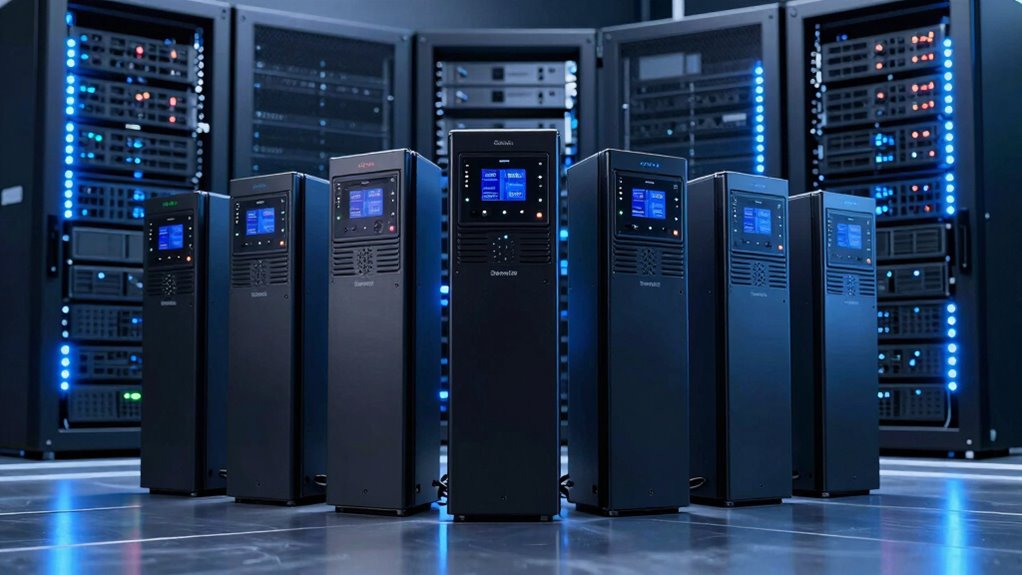

For most small server setups, I’d start with the APC Smart-UPS SMC1500C: it pairs 900W capacity with SmartConnect monitoring in a tower format. The SMC1500-2UC is the rackmount pick for space-conscious installations, while the SMT3000C is better suited to heavier loads that need substantially more output. The main tradeoffs are runtime and headroom versus size, rack space, and the complexity of managing a larger unit. Pure sine wave output and automatic voltage regulation also matter when matching a UPS to server power supplies and uneven input power. Read on for how these seven options differ and which one fits your load.

Get the latest gadgets delivered free with Prime
- Fast, free delivery on millions of items
- Prime Video, Amazon Music and more included
- Member-only deals all year
Complete the kit



Key Takeaways
- SMC1500C is the most balanced pick here for a small server setup that needs SmartConnect monitoring and 900W capacity without a rackmount form factor.
- The SMC1500-2UC offers similar 900W capacity in a 2U rackmount design; choose it for rack fit rather than more power.
- The SMT3000C leads this lineup in rated capacity at 2700W, making it the clearest choice for heavier combined server loads.
- CyberPower PR1500LCD supplies 1500W, more output than the 900W APC 1500VA models, so watt ratings reveal a meaningful difference hidden by similar VA labels.
- Vertiv PowerUPS 200 PSA6E-1500LVT and CyberPower CP1500PFCLCD offer alternatives to APC, but buyers should compare their monitoring and management needs against the SmartConnect-equipped models.
| APC Smart-UPS 1000VA/600W Line-Interactive UPS with SmartConnect (SMC1000C) |  | Best for Small Server Closets | Capacity: 1000VA / 600W | Waveform: Pure sine wave | Output Outlets: 8 × NEMA 5-15R (6 battery-backed) | VIEW ON AMAZON | See Our Full Breakdown |
| APC Smart-UPS 1500VA/900W Rackmount UPS (SMC1500-2UC) |  | Best Rackmount Pick | Capacity: 1500VA / 900W | Waveform: Pure sine wave | Topology: Line Interactive | VIEW ON AMAZON | See Our Full Breakdown |
| Vertiv Liebert PowerUPS 200 PSA6E-1500LVT UPS Battery Backup 1500VA with AVR |  | Best Warranty Coverage | Capacity: 1500VA | Model: PSA6E-1500LVT | Voltage Regulation: AVR (Automatic Voltage Regulation) | VIEW ON AMAZON | See Our Full Breakdown |
| CyberPower CP1500PFCLCD PFC Sinewave UPS Battery Backup and Surge Protector |  | Best Value Pick | Capacity: 1500VA / 1000W | Output Waveform: Sine wave | Outlets: 12 NEMA 5-15R (6 battery-backed) | VIEW ON AMAZON | See Our Full Breakdown |
| APC Smart-UPS SMT3000C 3000VA/2700W Sine Wave UPS with SmartConnect |  | Best for Serious Server Loads | Capacity: 3000VA / 2700W | Waveform: Pure sine wave | Input Voltage: 120V | VIEW ON AMAZON | See Our Full Breakdown |
| CyberPower PR1500LCD 1500VA/1500W Sine Wave UPS Battery Backup |  | Best Raw Wattage Value | Capacity: 1500VA / 1500W | Form Factor: Mini-tower | Topology: Line-interactive | VIEW ON AMAZON | See Our Full Breakdown |
| APC Smart-UPS 1500VA/900W Line Interactive UPS with SmartConnect (SMC1500C) |  | Best for Remote Monitoring | Power Capacity: 1500VA / 900W | Waveform: Pure sine wave | Topology: Line-interactive | VIEW ON AMAZON | See Our Full Breakdown |
| smart ups for server | Warranty | Capacity | Voltage Regulation | Waveform |
|---|---|---|---|---|
| APC Smart-UPS 1000VA/600W Line | 2 years unit, 2 years battery | 1000VA / 600W | Automatic Voltage Regulation (AVR) | Pure sine wave |
| APC Smart-UPS 1500VA/900W Rack | 2 years unit, 2 years battery | 1500VA / 900W | Automatic Voltage Regulation (AVR) | Pure sine wave |
| Vertiv Liebert PowerUPS 200 PS | 3 years full-unit advanced replacement | 1500VA | AVR (Automatic Voltage Regulation) | — |
| CyberPower CP1500PFCLCD PFC Si | 3 years including battery | 1500VA / 1000W | Automatic Voltage Regulation (AVR) | — |
| APC Smart-UPS SMT3000C 3000VA/ | 3 years unit, 2 years battery | 3000VA / 2700W | Automatic Voltage Regulation | Pure sine wave |
| CyberPower PR1500LCD 1500VA/15 | 3 years including battery | 1500VA / 1500W | — | — |
| APC Smart-UPS 1500VA/900W Line | 2 years repair/replace; 2 years battery | — | — | Pure sine wave |
More Details on Our Top Picks
APC Smart-UPS 1000VA/600W Line-Interactive UPS with SmartConnect (SMC1000C)
Not every server deployment needs 3000VA of headroom, and the SMC1000C makes its case on restraint. With pure sine wave output and AVR at a 1000VA capacity, it covers a compact rack, a NAS, or a network edge cabinet without paying for wattage that goes unused. Compared with the CyberPower CP1500PFCLCD, it gives up half the battery-backed outlets and the color LCD, but it adds cloud-based SmartConnect monitoring, which matters when the closet is in a building nobody visits daily. The tradeoff is real, though: only six of eight outlets are battery-backed, and the extended SmartConnect features run on a trial basis for recent registrations. For a single-server or networking setup, this capacity-to-price balance is hard to beat in the lineup.
Pros:- Pure sine wave output safe for active PFC power supplies
- AVR corrects voltage sags and swells without draining the battery
- SmartConnect enables remote monitoring and alerts from anywhere
- Energy Star certified for lower operating overhead
Cons:- Only 6 of 8 outlets provide battery backup
- SmartConnect full features are limited to a 6-month trial for recent registrations
- 600W capacity caps how much server hardware it can support
Best for: Small offices or home labs running one server, a NAS, or network gear in a compact closet
Not ideal for: Buyers running multiple servers or high-wattage workstations — 600W output will be exceeded quickly
- Capacity:1000VA / 600W
- Waveform:Pure sine wave
- Output Outlets:8 × NEMA 5-15R (6 battery-backed)
- Voltage Regulation:Automatic Voltage Regulation (AVR)
- Monitoring:SmartConnect remote monitoring
- Warranty:2 years unit, 2 years battery
- Certification:Energy Star
Our verdict“A right-sized pick for modest server closets where remote monitoring matters more than raw capacity.”
APC Smart-UPS 1500VA/900W Rackmount UPS (SMC1500-2UC)
When the server lives in a proper rack, a tower UPS sitting beside it is wasted floor space. The SMC1500-2UC solves that with a clean 2U rackmount chassis and included support rails, delivering the same pure sine wave and AVR protection as its tower sibling, the SMC1500C, but in a form factor that belongs next to your servers. Against the Vertiv Liebert PowerUPS 200, it trades a shorter warranty (2 years versus 3) for SmartConnect firmware updates over the network and a $150,000 connected equipment policy — meaningful coverage if expensive hardware hangs off it. The caveat: batteries are not user-hot-swappable as conveniently as Vertiv’s, and the SmartConnect trial limitation applies here too. For racked deployments, this remains the natural fit in this batch.
Pros:- 2U rackmount design with included support rails
- SmartConnect handles remote monitoring, notifications, and firmware updates
- $150,000 connected equipment protection policy
- Pure sine wave output with AVR for sensitive server power supplies
Cons:- SmartConnect offered as a 6-month trial for units registered after August 1, 2023
- Warranty is shorter than the Vertiv’s 3-year advanced replacement coverage
- Only 6 outlets may feel tight for dense rack configurations
Best for: IT admins with 2U of free rack space who want monitored, policy-backed protection for servers and switches
Not ideal for: Desktop or floor-standing setups — the rackmount form factor and rails add cost with no benefit
- Capacity:1500VA / 900W
- Waveform:Pure sine wave
- Topology:Line Interactive
- Output Outlets:6 × NEMA 5-15R
- Form Factor:2U Rackmount
- Voltage Regulation:Automatic Voltage Regulation (AVR)
- Warranty:2 years unit, 2 years battery
- Connected Equipment Policy:$150,000
Our verdict“The obvious choice when your servers are already racked and you want cloud monitoring plus strong equipment coverage.”
Vertiv Liebert PowerUPS 200 PSA6E-1500LVT UPS Battery Backup 1500VA with AVR
The Liebert PowerUPS 200 stands out in this lineup for one thing the APC models don’t match: a three-year full-unit advanced replacement warranty. If the unit fails, Vertiv ships a replacement rather than leaving you to troubleshoot — a genuinely different ownership experience compared with APC’s standard repair-or-replace terms on the SMC1500-2UC. Its user-replaceable batteries also mean you can refresh the unit in minutes instead of replacing the whole UPS, though you’re locked into buying packs directly from Vertiv. The four LED runtime indicators are refreshingly simple compared with the CyberPower’s tilting LCD — quick to read, nothing to navigate. The tradeoff is the absence of cloud monitoring entirely; if remote alerts across multiple sites matter, this is the wrong pick.
Pros:- 3-year full-unit warranty with advanced replacement
- User-replaceable batteries extend service life cheaply
- AVR stabilizes output during brownouts and surges
- Dedicated mute button and LED indicators keep operation simple
Cons:- Replacement batteries must be purchased directly from Vertiv
- No remote or cloud-based monitoring capability
- Alarm volume is loud before it’s muted
Best for: Buyers who prioritize long warranty protection and simple on-site maintenance over cloud features
Not ideal for: Remote or unattended sites that depend on cloud-based alerts — there’s no network monitoring platform here
- Capacity:1500VA
- Model:PSA6E-1500LVT
- Voltage Regulation:AVR (Automatic Voltage Regulation)
- Battery Type:User-replaceable
- Indicators:4 LED battery capacity indicators
- Alarms:Mute button
- Warranty:3 years full-unit advanced replacement
Our verdict“Best for buyers who want the strongest warranty terms and easy battery swaps rather than remote management.”
CyberPower CP1500PFCLCD PFC Sinewave UPS Battery Backup and Surge Protector
For most small-server buyers, the CP1500PFCLCD delivers the features that actually matter — sine wave output for active PFC power supplies, AVR, and a tilting color LCD — at a friendlier price than the APC alternatives. Where the SMC1000C offers only eight outlets and cloud monitoring, this model packs twelve outlets plus USB-A and USB-C charging, and its 3-year warranty covers the battery too, something APC splits into a shorter separate term. The connected equipment guarantee here is the largest in this batch at $500,000. The compromises: only six of those twelve outlets are battery-backed, and the 5-foot cord can force awkward placement. There’s also no remote cloud monitoring — the LCD is your window into the system. For hands-on setups, that trade is easy to accept.
Pros:- Sine wave output compatible with active PFC power supplies
- 12 outlets plus USB-A and USB-C charging ports
- 3-year warranty includes the battery
- Tilting color LCD shows power and battery status at a glance
Cons:- Only 6 of 12 outlets provide battery backup
- 5-foot power cord limits placement flexibility
- No remote monitoring or network management
Best for: Budget-conscious buyers protecting a workstation-server or home lab who don’t need cloud monitoring
Not ideal for: Unattended or remote server rooms that rely on remote alerts — local display only
- Capacity:1500VA / 1000W
- Output Waveform:Sine wave
- Outlets:12 NEMA 5-15R (6 battery-backed)
- USB Charging:1 USB-A, 1 USB-C
- Display:Tilting color LCD (up to 22 degrees)
- Voltage Regulation:Automatic Voltage Regulation (AVR)
- Warranty:3 years including battery
- Connected Equipment Guarantee:$500,000
- Safety Certification:UL listed
Our verdict“The smart money pick if you want sine wave protection and a long battery-inclusive warranty without paying for cloud features.”
APC Smart-UPS SMT3000C 3000VA/2700W Sine Wave UPS with SmartConnect
When a single 1500VA unit can’t hold the load, the SMT3000C is the answer in this lineup. With 2700W of continuous output, it carries multiple servers, switches, and storage in one tower — the SMC1500-2UC would need a companion unit to match it. Its temperature-compensated charging is a standout for battery longevity, adjusting charge voltage to ambient conditions rather than cooking the cells in a warm closet. Note the practical detail: it uses a NEMA 5-30P plug, so you’ll need a 30-amp circuit — not a standard wall outlet. That, plus its tower footprint and six-hour recharge time, makes it overkill for a home lab. The battery warranty also runs a year shorter than the unit warranty, an odd split at this tier.
Pros:- 2700W capacity supports multiple servers on one unit
- Temperature-compensated charging extends battery life
- SmartConnect remote monitoring for unattended server rooms
- Includes both 5-15R and 5-20R outlets for mixed equipment
Cons:- Requires a NEMA 5-30P 30-amp circuit, not a standard outlet
- Battery warranty is a year shorter than the unit warranty
- 6-hour recharge time leaves a long vulnerability window after an outage
Best for: Small businesses running several servers or dense networking stacks on a dedicated 30-amp circuit
Not ideal for: Home labs and standard-office setups — the NEMA 5-30P plug and tower bulk demand infrastructure most don’t have
- Capacity:3000VA / 2700W
- Waveform:Pure sine wave
- Input Voltage:120V
- Input Connector:NEMA 5-30P
- Output Outlets:8 × NEMA 5-15R, 2 × NEMA 5-20R
- Form Factor:Tower
- Battery Charge Time:6 hours
- Voltage Regulation:Automatic Voltage Regulation
- Warranty:3 years unit, 2 years battery
Our verdict“The heavy-duty choice for multi-server loads, provided your electrical infrastructure can feed its 30-amp plug.”
CyberPower PR1500LCD 1500VA/1500W Sine Wave UPS Battery Backup
Most 1500VA units in this space, including the APC Smart-UPS SMC1500C, deliver only around 900 watts of usable output. The CyberPower PR1500LCD pushes a full 1500 watts, which means it can power hungrier servers or more peripherals before hitting its ceiling — a real advantage if you’re running a tower server with a high-wattage power supply. The removable LCD panel is a thoughtful touch, letting you monitor load and runtime even when the unit is tucked under a desk or in a tight closet, something fixed-panel competitors like the CyberPower CP1500PFCLCD can’t match. Compared with the rackmount APC SMC1500-2UC, this mini-tower trades rack integration for a lower barrier to entry and simpler placement. The tradeoff: remote management is not built in — you’ll need the separately sold RMCARD205 card to get network monitoring, which adds cost and complexity that the SMC1500C includes out of the box.
Pros:- Full 1500W output capacity — higher usable wattage than most 1500VA competitors that cap around 900W
- Sine wave output safely supports Active PFC server power supplies
- Removable LCD panel lets you read status even when the unit is hidden away
- Three-year warranty includes the battery, beating APC’s separate battery coverage
Cons:- Remote network management requires the separately sold RMCARD205 card
- Line-interactive topology offers less isolation from dirty power than online double-conversion units
Best for: Small business owners running power-hungry tower servers or Active PFC power supplies who want maximum wattage headroom and local monitoring without paying for cloud features
Not ideal for: IT admins who need out-of-the-box remote monitoring across multiple sites — network management requires an extra hardware purchase
- Capacity:1500VA / 1500W
- Form Factor:Mini-tower
- Topology:Line-interactive
- Output Waveform:Sine wave
- Outlets:8x NEMA 5-15R (all battery-backed)
- Automatic Voltage Regulation:Yes
- Management:Optional RMCARD205 card; PowerPanel Business Edition software
- Warranty:3 years including battery
Our verdict“This pick makes the most sense for buyers who need serious wattage headroom and strong battery warranty coverage but don’t require cloud-based monitoring on day one.”
APC Smart-UPS 1500VA/900W Line Interactive UPS with SmartConnect (SMC1500C)
Where the APC SMC1500C pulls ahead of similarly priced rivals like the CyberPower PR1500LCD is cloud-based monitoring. The SmartConnect portal gives you remote visibility into power events, battery health, and firmware updates from anywhere, with automatic notifications when something goes wrong — no extra network card purchase required. For anyone managing a server closet from off-site, that alone changes the ownership experience. The $150,000 connected equipment policy adds a layer of financial protection most competitors don’t match, and temperature-compensated charging helps the battery age more gracefully. The tradeoffs are real, though: output is limited to 900 watts versus the PR1500LCD’s 1500, and SmartConnect’s free tier is now only a six-month trial for units purchased or registered after August 2023, so ongoing cloud features may carry a subscription. Compared with the larger SMT3000C, runtime is also tighter for multi-device setups.
Pros:- SmartConnect portal provides remote monitoring, alerts, and firmware updates with no additional hardware
- Pure sine wave output is safe for sensitive server and networking equipment
- $150,000 connected equipment protection policy adds financial peace of mind
- Temperature-compensated battery management extends battery service life
Cons:- SmartConnect is only a six-month free trial for units purchased or registered after August 1, 2023
- 900W output ceiling is notably lower than 1500VA-class rivals like the CyberPower PR1500LCD
Best for: IT managers and home-lab owners who want browser-based remote visibility into a single server or network rack without buying a network management card
Not ideal for: Buyers running power-hungry hardware near or above 900W, or anyone unwilling to pay for cloud monitoring after the six-month trial ends
- Power Capacity:1500VA / 900W
- Waveform:Pure sine wave
- Topology:Line-interactive
- Outlets:8x NEMA 5-15R (6 battery backup + surge, 1 switchable group)
- Automatic Voltage Regulation:Yes
- Remote Monitoring:APC SmartConnect portal (6-month free trial for units registered after Aug 1, 2023)
- Warranty:2 years repair/replace; 2 years battery
- Connected Equipment Policy:$150,000
Our verdict“This model is better suited to buyers who prioritize out-of-the-box remote visibility and equipment protection over raw wattage capacity.”

How We Picked
I ranked these UPS systems around server-relevant needs: rated watt capacity, output type, form factor, voltage regulation, and available monitoring. Watt capacity matters because the server’s actual draw—not the UPS’s VA label—sets the usable load ceiling. Pure sine wave output can suit active PFC power supplies, while AVR can help address input voltage swings without immediately switching to battery. I also weighed whether each model offers a useful fit for a tower setup, a rack, or a higher-load installation.
The SMC1500C takes the top spot for balancing 900W capacity, SmartConnect, and flexible placement; the rackmount SMC1500-2UC follows for buyers who need a 2U unit. The higher-capacity SMT3000C ranks as the premium power choice, not the default for every server. CyberPower’s PR1500LCD stands out for its 1500W rating, while the Vertiv and CP1500PFCLCD round out the list for buyers comparing alternatives and specific fit needs. I treat product names and listed specifications as the basis for comparison; runtime, outlet layout, network management, battery replacement, and rack hardware should be checked for the exact configuration before purchase.
| smart ups for server | Voltage Regulation |
|---|---|
| APC Smart-UPS 1000VA/600W Line | Automatic Voltage Regulation (AVR) |
| APC Smart-UPS 1500VA/900W Rack | Automatic Voltage Regulation (AVR) |
| Vertiv Liebert PowerUPS 200 PS | AVR (Automatic Voltage Regulation) |
| CyberPower CP1500PFCLCD PFC Si | Automatic Voltage Regulation (AVR) |
| APC Smart-UPS SMT3000C 3000VA/ | Automatic Voltage Regulation |
| CyberPower PR1500LCD 1500VA/15 | — |
| APC Smart-UPS 1500VA/900W Line | — |
Factors to Consider When Choosing Smart Ups For Servers
Choosing a server UPS starts with the equipment it must keep running and the way you plan to shut it down. The ratings and features in this roundup help narrow the field, but your load, available space, and monitoring setup determine whether a particular unit is a sensible match.
Size by Watts and Required Runtime
Add the measured or manufacturer-stated watt draw of every device that will connect to battery-backed outlets. Leave headroom for startup surges and future equipment, since running near the UPS limit can shorten runtime and restrict expansion. VA ratings describe apparent power, while the watt rating is the limit most directly tied to the real load; compare both. Then decide how long the server needs to stay online: enough time for a graceful shutdown is a different target from riding out a long outage. Check runtime charts at your expected load rather than assuming a larger VA number guarantees a particular backup window. A UPS cannot replace a generator or a plan for extended outages.
Match Output to Server Power Supplies
Check the input requirements for every server and network device, including whether its power supply uses active power factor correction. A pure sine wave output is a prudent match for many modern server supplies, but compatibility should still be confirmed with the equipment maker. Avoid judging output quality from the product family name alone; look for the exact model specification. If a UPS has stepped or simulated output, check whether the server vendor approves it before relying on battery mode. Also confirm the voltage and frequency expected at your site, especially when comparing models with different voltage variants. This compatibility check can eliminate otherwise capable units before you spend time comparing extras.
Plan the Rack or Tower Installation
Measure the intended location, including depth, clearance for cables, airflow, and access to replace the battery. A rackmount UPS saves floor space but consumes rack units and may need rails or mounting hardware suited to the rack; confirm what is included. A tower model can be simpler to place beside a small server, though it may be awkward in a dense rack. UPS weight matters when a rack is already heavily loaded, so check both the unit’s weight and the rack’s capacity. Think through outlet orientation and cord reach before installation, since a tight cable bend can block nearby equipment. The best form factor is the one that fits safely and remains serviceable.
Choose Monitoring and Shutdown Behavior
Smart monitoring is useful only if it fits the way you manage servers. Check whether the UPS reports status locally, through a network service, or through a vendor account, and whether any required network card or subscription is separate. For unattended systems, confirm that your operating system or hypervisor can receive an outage signal and shut down workloads in the right order. A management feature that cannot communicate with your server adds little protection during a long outage. Consider whether you need alerts from outside the building or only a local USB connection. Before deployment, verify the monitoring method against your security rules and network access policies.
Account for Battery Service and Lifecycle
A UPS battery is a replaceable component with a finite service life, so check replacement availability, procedure, and whether replacement can happen without moving the entire system. Batteries need periodic inspection, and temperature can affect their useful life; a hot equipment closet can make maintenance more frequent. Look up how the unit signals battery faults and whether it supports self-tests that fit your maintenance schedule. Factor the time needed for a replacement into your outage plan, since the UPS may provide little or no backup protection while the battery is unavailable. For critical servers, keep a documented replacement process and test shutdown behavior after service. Battery serviceability can matter more over several years than a small difference in headline capacity.
Decide When More Capacity Is Worth It
Paying for a higher-capacity UPS makes sense when measured load, planned expansion, or required runtime calls for it. Extra capacity can create room to add equipment, but it does not automatically deliver longer runtime under every load or make battery maintenance disappear. Start with present and near-term demand, then compare runtime curves at that load across suitable models. If the server room has multiple independent circuits or separate failure domains, one large UPS may not offer the resilience of appropriately separated power protection. Avoid buying on VA alone, since two units with similar VA ratings can have different watt limits. The right step up is the smallest model that meets your load and runtime plan with practical headroom.
Frequently Asked Questions
Is a 1500VA UPS enough for a server?
It depends on the server’s actual watt draw and how long it must run during an outage. In this lineup, several 1500VA models are rated at 900W, while the CyberPower PR1500LCD is rated at 1500W, so the VA label alone does not settle the question. Add the server, storage, and network equipment you want protected, then compare that total with the UPS watt limit and runtime chart. Leave room for load changes and startup demand. If graceful shutdown is the goal, size for enough runtime to notify systems and complete the shutdown process.
Should I choose a rackmount UPS or a tower model?
Choose rackmount when the UPS will live in an equipment rack and its depth, weight, and mounting requirements fit that rack. The APC SMC1500-2UC gives a 2U option with 900W capacity, while the tower SMC1500C offers the same stated watt capacity in a different installation format. A rack unit saves floor space but uses rack capacity and can make battery service less convenient in a crowded cabinet. A tower can be easier to place in a small office, but needs stable floor or shelf space. Measure the actual location and cable clearance before deciding.
Do I need pure sine wave output for a server?
Many modern server power supplies use active power factor correction, for which pure sine wave output is often the safer match. Several options here explicitly list pure sine wave output, including the rackmount APC and CyberPower models. Confirm the server manufacturer’s requirements rather than assuming every power supply behaves the same on battery. If a UPS lists another waveform type or omits that detail, seek its exact specification before connecting critical equipment. Testing the shutdown and transfer behavior during planned maintenance can help catch incompatibility before an outage.
Is SmartConnect or network monitoring worth choosing?
Monitoring earns its place when someone can act on the alerts or when software can trigger an orderly shutdown. SmartConnect on the APC SMC and SMT models can be useful for remote visibility, while local management may be enough for a server attended on site. Check how the monitoring connects, whether extra hardware or account setup is required, and whether it meets your network policy. Most important, make sure the UPS can communicate with the server’s operating system or management stack. Without a tested shutdown path, remote status alone may not protect data during an extended outage.
When is the APC SMT3000C worth choosing over a 1500VA model?
The SMT3000C’s 2700W rating makes it the strongest fit in this group for a substantially heavier combined load or planned expansion. It is excessive for a lightly loaded single server if a smaller UPS already provides the needed shutdown window. Compare runtime at your measured load, not just the maximum output rating, and check the unit’s physical footprint and electrical requirements. A larger UPS also means more weight and a battery system that needs its own service plan. Choose it when the load and runtime figures justify the added capacity.
Conclusion
For most small server setups, I recommend the APC Smart-UPS SMC1500C as the best overall: it combines 900W capacity with SmartConnect and a tower format. The SMC1500-2UC is my rack pick for buyers who need a 2U installation, while the SMT3000C is the premium choice for heavier loads up to its 2700W rating. For value, I’d compare the CyberPower PR1500LCD first if its 1500W rating suits the workload and its management features meet your needs. Beginners with one server should start by measuring load and checking runtime, then look at the SMC1500C for a straightforward balance of capacity and monitoring. For an alternative with AVR, consider the Vertiv PowerUPS 200; for any specific need, verify the exact model’s runtime, outlets, management method, and installation fit before choosing.
Halloween Picks
halloween
As an affiliate, we earn on qualifying purchases.