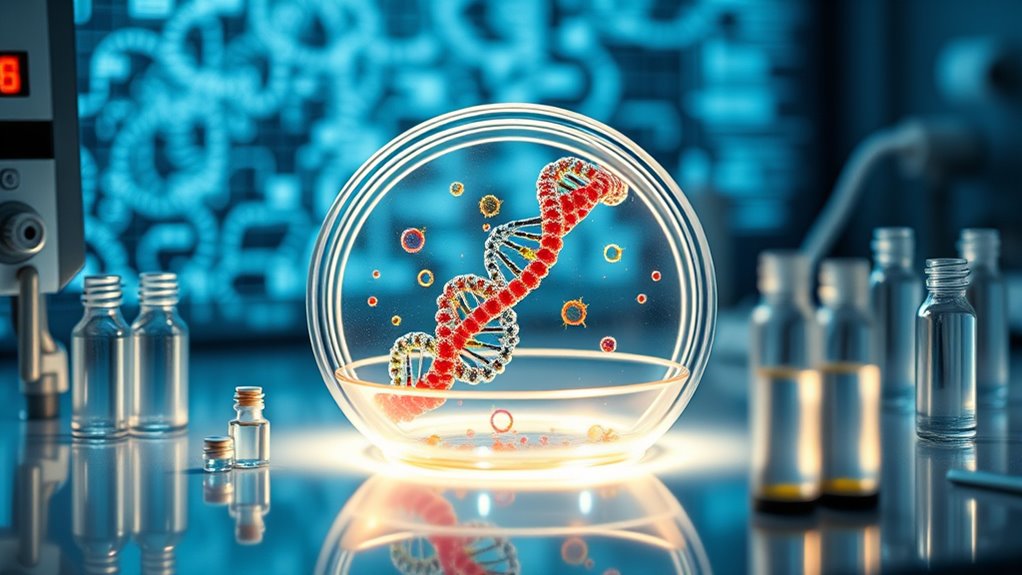

Imagine a future where your entire data center fits inside a shoebox, thanks to DNA storage. This revolutionary method encodes information into biological molecules that are incredibly dense and durable. As technology advances, it could transform how we store and protect data, making traditional systems seem bulky and outdated. But how soon might this become a reality, and what challenges remain before DNA becomes the new standard?

Get the latest gadgets delivered free with Prime
- Fast, free delivery on millions of items
- Prime Video, Amazon Music and more included
- Member-only deals all year
Key Takeaways
- DNA storage offers extremely high data density, significantly reducing physical space needed for large data volumes.
- Biological molecules can store data for thousands of years, providing durable long-term solutions in a compact form.
- Synthesizing DNA to encode digital information allows for miniaturized data repositories, shrinking traditional data centers.
- Molecular encryption enhances security, enabling safe storage within small, portable DNA samples.
- DNA data storage can transform data management, making massive amounts of data accessible in a shoebox-sized package.
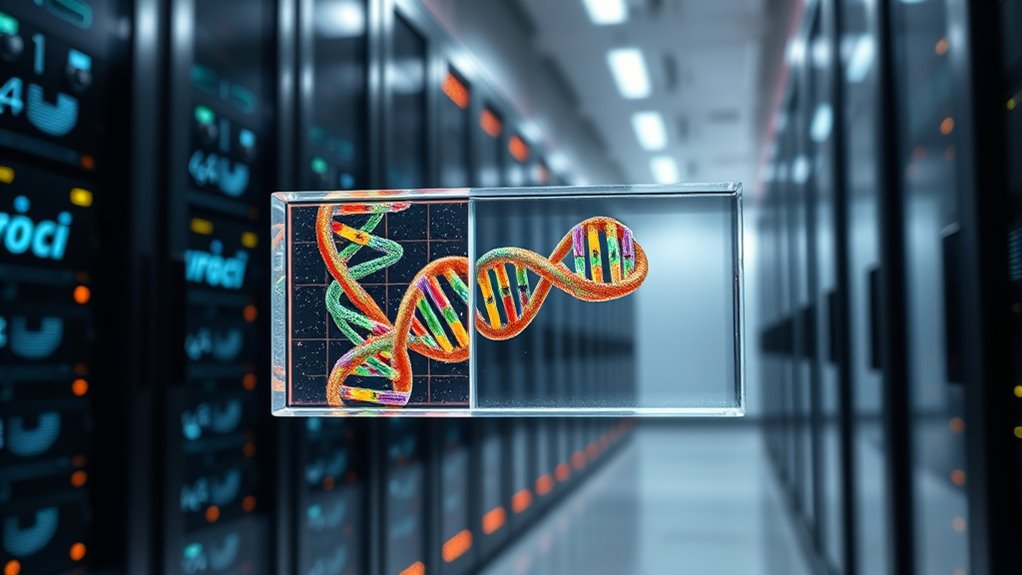
As digital data continues to grow exponentially, traditional storage methods struggle to keep up with the demand for capacity and longevity. That’s where DNA data storage comes into play, offering a revolutionary solution that could shrink entire data centers into a shoebox. Unlike hard drives or cloud servers, DNA uses the biological molecule itself to encode information, providing an incredibly dense and durable medium. This shift isn’t just about packing more data into less space; it’s about transforming how we think about storing digital information for the long term.
One of the key innovations driving this technology is molecular encryption. Instead of relying solely on digital algorithms, scientists are exploring ways to encode data directly into the molecular structure of DNA. This process involves translating binary code into sequences of nucleotide bases—adenine, thymine, cytosine, and guanine—that form the DNA strands. These sequences serve as a biological equivalent of encrypted data, offering an extra layer of security because the information is embedded within a natural molecule. The concept of molecular encryption guarantees that data remains protected even if the physical DNA is accessed, making it a highly secure storage method.
To create these DNA strands, biopolymer synthesis plays an essential role. During biopolymer synthesis, scientists assemble DNA sequences with precision, attaching the correct bases in the right order to represent specific data. This process is akin to writing a complex code into a biological script, allowing massive amounts of information to be stored in a tiny, stable molecule. Once synthesized, the DNA can be preserved for thousands of years under proper conditions, far surpassing the lifespan of traditional storage devices. Additionally, advances in biopolymer synthesis are making the process faster and more cost-effective, moving DNA data storage from experimental labs toward commercial viability. Understanding the technology behind DNA synthesis is crucial to appreciating its future potential.
The ability to encode data into DNA and utilize molecular encryption techniques means that your digital files could be stored in a form that’s both highly secure and incredibly dense. Imagine shrinking a data center, which now takes up acres of space, into a box small enough to fit in your hand. The process involves sequencing the data into DNA, synthesizing the biopolymer strands, and then storing or transmitting it just like any other biological material. Retrieval involves sequencing the DNA and decoding the original information. As the technology advances, it’s likely you’ll see DNA data storage become an essential part of data management, especially for archiving critical information that needs to last for centuries.
As an affiliate, we earn on qualifying purchases.
Conclusion
Imagine fitting an entire library into a sugar cube—that’s what DNA data storage promises. As you watch your massive data center shrink to a tiny shoebox, you realize the future is here. With DNA holding up to 215 petabytes per gram, it’s like compressing centuries of information into a molecule. Embrace this breakthrough, and you’ll be part of a revolution that makes space, cost, and security worries a thing of the past.
As an affiliate, we earn on qualifying purchases.
As an affiliate, we earn on qualifying purchases.
As an affiliate, we earn on qualifying purchases.
Halloween Picks
halloween
As an affiliate, we earn on qualifying purchases.