
TL;DR

Get the latest gadgets delivered free with Prime
- Fast, free delivery on millions of items
- Prime Video, Amazon Music and more included
- Member-only deals all year
Infleqtion says it ran its Tiqker optical atomic clock continuously aboard the U.S. Navy support vessel RV Merlin for more than two weeks during the Maritime Big Play Pacific exercise and related BARB-26 activity. The test exposed the system to maritime temperature changes and sustained vibration; its performance results and any Navy plans for integration have not been disclosed.
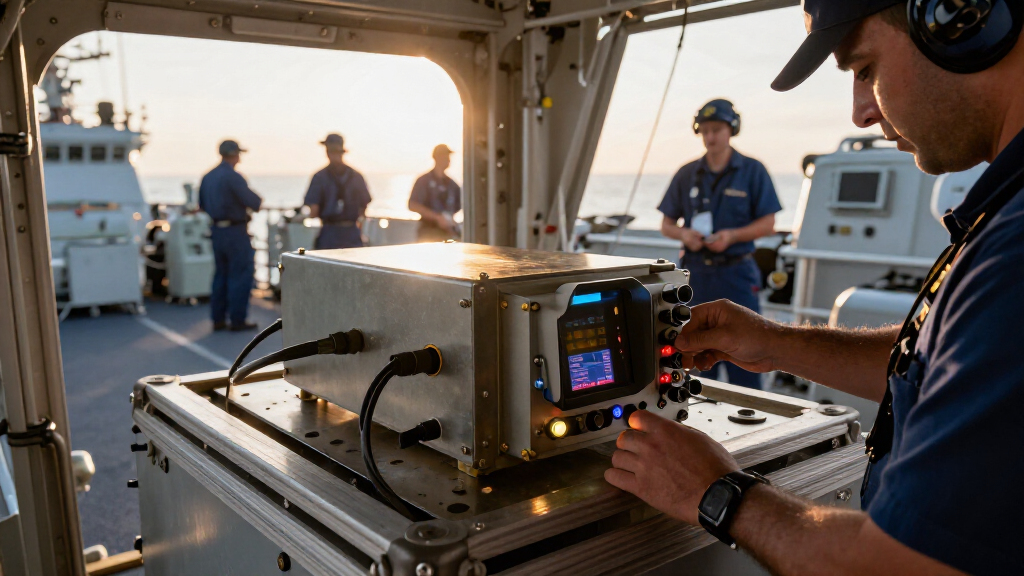
Infleqtion operated its Tiqker optical atomic clock aboard the U.S. Navy support vessel RV Merlin for more than two weeks during the Maritime Big Play Pacific exercise, the company said. The at-sea demonstration, which also supported the Navy’s BARB-26 exercise, tested the clock in maritime conditions and was intended to inform possible future naval integration; no detailed performance results or adoption decision were announced.
The company said Tiqker ran continuously aboard the RV Merlin in the Southern California operating area. The trial exposed the system to temperature swings and sustained vibration, conditions relevant to equipment used at sea. Infleqtion described the activity as an evaluation of precision timing in a maritime operational environment, rather than announcing that the Navy had selected or deployed the clock.
The demonstration took place during Maritime Big Play Pacific (MBP-P), an exercise sponsored by the Office of the Under Secretary of War for Research & Engineering, with participation from the U.S. Navy, U.S. Marine Corps and AUKUS partners from Australia and the United Kingdom, according to the company. It also supported BARB-26, a Navy exercise focused on emerging subsea and seabed warfare capabilities.
Infleqtion says Tiqker can provide a local timing reference without relying on GPS signals. It identifies potential uses in synchronizing communications, radar and other onboard systems when satellite signals are unavailable, jammed or spoofed. Those are proposed applications; the source material does not report measured accuracy, comparisons with existing clocks, or operational outcomes from this exercise.
Timing Without Satellite Signals
Navigation and coordinated military operations depend on accurate timing, including when systems communicate or combine information from multiple platforms. A clock that can maintain a stable local reference could, in principle, give forces another option when GPS-derived timing is disrupted. The relevance extends beyond navigation: synchronized communications and radar can be important to maintaining coordination across ships and other equipment.
But the exercise report establishes a trial under maritime conditions, not proof that Tiqker is ready for routine naval use. The company has not published the test’s accuracy figures or explained how the clock compared with equipment already in service. The result that matters for readers is that the system was operated at sea for an extended period; whether it can provide a practical, dependable advantage will depend on results and follow-on evaluation that have not been made public.
Products Worth Considering

DJI Mic 3 Wireless Microphone System (2 Transmitters, 1 Receiver, Charging Case)

EcoFlow DELTA 3 Classic Portable Power Station, 1024Wh, 1800W

Bose SoundLink Flex (2nd Gen) Portable Bluetooth Speaker
As an affiliate, we earn on qualifying purchases.
Earlier Tiqker Field Trials
The RV Merlin trial follows earlier demonstrations of Tiqker outside a laboratory. Infleqtion reports that in 2025 the clock was deployed aboard the UK Royal Navy’s uncrewed submarine testbed, XV Excalibur, during multiple dives. The company also reports UK flight trials in 2024 aboard QinetiQ’s RJ100 Airborne Technology Demonstrator, in collaboration with QinetiQ and BAE Systems.
These prior activities provide context for the Navy exercise: the company has been testing the clock in different transport and operating environments. They do not, on the information supplied, establish that Tiqker has been adopted by the UK or U.S. armed forces. The latest demonstration adds an extended surface-vessel test to that reported history.
“The Navy needs dependable timing to navigate, communicate and coordinate operations in the field.”
— Matthew Kinsella, Infleqtion chief executive
Infleqtion has not released quantitative performance data from the RV Merlin trial, such as timing stability, accuracy, drift, or how the device performed against existing systems. The account says Tiqker operated continuously for more than two weeks and encountered temperature changes and sustained vibration, but does not provide specific measurements or independent verification.
It is also unclear whether the Navy has requested additional testing, set requirements for the clock, or considered a procurement or integration pathway. The company describes the demonstration as a way to gather data and inform future integration. That language does not confirm that the Navy has endorsed the system or plans to install it on operational platforms.
Further Evaluation at Sea
The next step identified by Infleqtion is using operational data from the exercise to advance consideration of Tiqker’s integration into naval platforms. The company has not announced a timetable, a follow-on trial, or a Navy decision. Any assessment of the clock’s military value will depend on further results, including whether it can meet requirements for reliability and performance in field conditions.
Readers should watch for published test measurements and statements from the Navy or exercise sponsors about subsequent evaluation. Until those details appear, the confirmed development is the extended at-sea demonstration, while adoption and mission-level benefits remain unestablished.
Key Questions
What did Infleqtion test during the Navy exercise?
It operated its Tiqker optical atomic clock aboard the support vessel RV Merlin for more than two weeks, according to the company.
What were MBP-P and BARB-26?
The demonstration took place during the Navy’s Maritime Big Play Pacific exercise and also supported BARB-26, a Navy exercise focused on emerging subsea and seabed warfare capabilities.
Why could an optical atomic clock matter to the Navy?
Infleqtion says Tiqker is designed to provide a local timing reference that does not depend on GPS. The company identifies potential uses in synchronizing communications, radar and onboard systems when satellite signals are unavailable or disrupted.
Has the U.S. Navy adopted Tiqker?
No adoption was announced in the source report. Infleqtion described the demonstration as an opportunity to collect operational data and inform possible future integration.
Were the clock’s test results published?
The source material does not provide detailed performance measurements, such as accuracy or drift. It reports that the clock operated continuously for more than two weeks amid temperature changes and sustained vibration.
Source: thequantuminsider.com