
📊 Full opportunity report: Marketplaces Bring Businesses And Empty Small-Town Storefronts Together on IdeaNavigator AI — validation score, market gap, and execution plan.

Get the latest gadgets delivered free with Prime
- Fast, free delivery on millions of items
- Prime Video, Amazon Music and more included
- Member-only deals all year
TL;DR
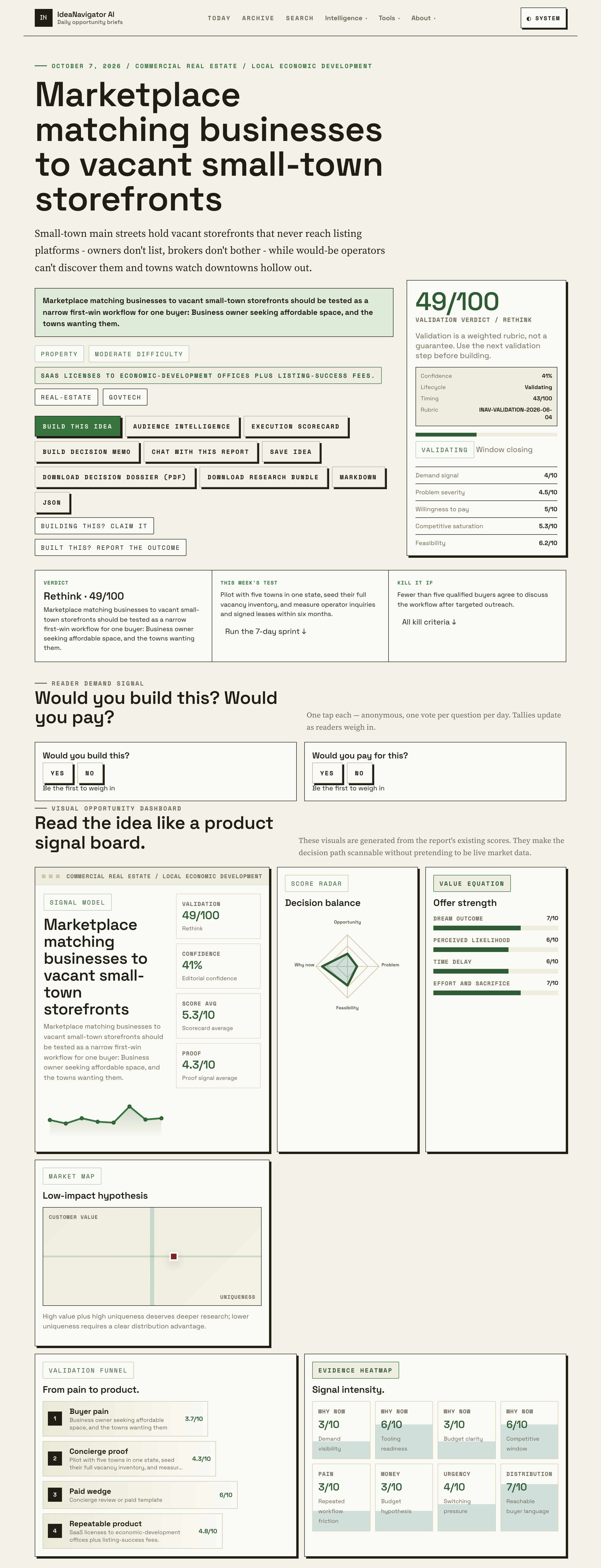
A proposal outlines an online marketplace to help business operators find vacant small-town storefronts and connect with local economic-development offices. It recommends testing the idea in five towns and tracking inquiries and signed leases over six months; no pilot launch or results are reported.
IdeaNavigator AI has proposed a marketplace that would connect business operators with vacant small-town storefronts, routing interested operators to local economic-development offices and any available grant programs. The concept remains a proposal: it recommends a five-town pilot, but provides no evidence that a platform has launched or that towns have signed up.
The proposed service would let towns and property owners list empty storefronts with photos, floor area, rent and information about incentive programs. Operators could browse listings by town profile and foot-traffic data, then contact the relevant local development office through the marketplace. The proposal says available grants could be attached to those matches.
The suggested paying customers are economic-development offices, through software licenses, and potentially property owners or other participants through fees tied to successful listings. No pricing, fee terms, platform budget or revenue estimates are provided. The proposal does not identify a developer or report commitments from municipalities, owners or businesses.
To test the idea, IdeaNavigator AI recommends selecting five towns in one state, gathering a complete inventory of their vacant storefronts and measuring operator inquiries and signed leases over six months. Those are proposed evaluation measures, not results from a completed trial. The material does not specify how a lease would be attributed to the marketplace or how the towns would verify that the inventory is complete.
Testing a Route to Main Street Leases
The concept addresses a practical information gap: available commercial spaces may not be publicly listed, while prospective operators can have difficulty learning what is vacant, what it costs and whether local incentives are available. Bringing those details together could make the search process easier for both sides, if owners and towns provide accurate, current listings and operators use the service.
For towns, the potential payoff would be more than online visibility. A successful match could help fill empty premises and bring activity to a downtown commercial district. But the proposal supplies no evidence yet of increased occupancy, business formation or foot traffic. A pilot would need to establish whether the marketplace generates leases that would not otherwise have happened, rather than simply collecting inquiries or duplicating existing local services.
The recommended six-month measurement period gives the proposal a concrete early test. Tracking inquiries alongside signed leases could show whether interest progresses to occupancy. Results would also matter to economic-development offices weighing software costs against the staff time needed to gather listings, maintain data and support prospective tenants.
commercial storefront listing software
As an affiliate, we earn on qualifying purchases.
As an affiliate, we earn on qualifying purchases.
The Proposed Listing and Matching Process
The idea is framed around two groups: business owners seeking affordable space and towns that want to attract businesses. Its stated problem is that some storefront owners do not list vacancies on commercial platforms and brokers may not pursue smaller markets, leaving operators without an easy way to discover spaces. The proposal offers no survey or market data quantifying how often this happens.
It presents remote-work migration and economic-development grant funding as reasons to test the concept now. These are the proposal’s rationale, not documented measures of demand or proof that specific grant funds are available to support a marketplace or its users. The suggested product combines basic property listings with town information, foot-traffic data and connections to local incentive programs.
The recommended pilot would focus on one state rather than launching broadly. That could make it easier to work with a small group of local offices and assemble listings, but the proposal does not name a state, towns, grant programs or a timeline. It also does not describe how the marketplace would source or update foot-traffic data.
As an affiliate, we earn on qualifying purchases.
Demand, Data and Pilot Partners
No marketplace launch, participating towns or signed leases are reported. It is also unclear whether owners would agree to list spaces, whether listings would include reliable rents and availability dates, and how the platform would keep that information current.
The proposal does not provide evidence for the scale of unmet demand, identify available grants or say which offices would administer them. It leaves open how foot-traffic data would be obtained and presented, what counts as a successful match, and how fees would be charged. Without those details, the commercial viability of the service and its likely effect on storefront vacancies remain untested.
As an affiliate, we earn on qualifying purchases.
A Five-Town Trial Would Test Results
The next step proposed is to recruit five towns in one state, work with local officials and property owners to assemble a full vacancy inventory, and open the listings to prospective operators. Over six months, organizers would track inquiries and signed leases. The proposal gives no launch date or named partners, so it is not clear whether that recruitment has begun.
If a trial proceeds, useful reporting would include how many storefronts are listed, how often information is updated, how many operators contact owners or development offices, and how many inquiries lead to signed leases. Towns would also need to explain the fees and grant arrangements and how they judge whether any leases resulted from the marketplace. No pilot results or follow-up milestones have been announced.
Source: IdeaNavigator AI
economic development grant application guide
As an affiliate, we earn on qualifying purchases.
As an affiliate, we earn on qualifying purchases.
Key Questions
Has the marketplace launched?
No launch is reported. The marketplace is presented as a proposal, with a five-town pilot recommended as a way to test it.
How would the service work?
Towns and property owners would list storefront details such as photos, size, rent and incentive programs. Operators could browse by town information and foot-traffic data, then be connected with a local economic-development office.
Who would pay for the marketplace?
The proposed revenue model is software licenses for economic-development offices and listing-success fees. Pricing and the terms for any success fee have not been specified.
How would the idea be evaluated?
The proposal recommends a six-month trial in five towns in one state, measuring operator inquiries and signed leases. No trial results are available.
Source: IdeaNavigator AI
Halloween Picks
halloween
As an affiliate, we earn on qualifying purchases.