
TL;DR
Play games included with Prime
Start a Prime free trial and play with Amazon Luna on your devices.
As an affiliate, we earn on qualifying purchases.
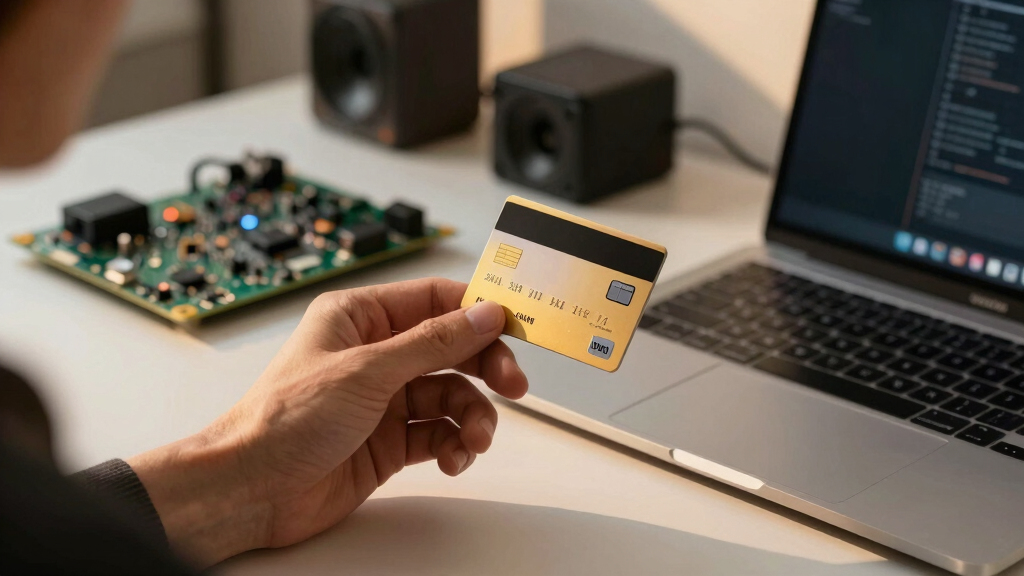
A hobbyist has created a working computer the size of a credit card, built around an ESP32-C3, with an e-paper display and NFC. The project demonstrates extreme space constraints and potential applications in digital wallets, security, and hacking tools.
A hobbyist developer has built a fully functioning computer the size of a credit card, featuring an ESP32-C3 microcontroller, an e-paper display, and NFC capabilities. This breakthrough demonstrates the feasibility of ultra-compact, standalone devices for various applications, from digital wallets to security tools.
The project, shared on Hacker News and social media, involves a custom-made flexPCB, hand-etched using a DIY lithography process with a 3D printer serving as a mini-fabrication tool. The prototype maintains a thickness of around 1mm, comparable to real credit cards, and includes core components such as a microcontroller, display, and battery. The developer emphasizes that the current prototype is fragile and a work-in-progress, with ongoing efforts to improve durability and battery life. The device can potentially serve as a minimalist wallet, NFC key, or portable hacking tool, with the developer planning further testing and refinement.
Why It Matters
This development pushes the boundaries of miniaturized electronics, opening new possibilities for discreet, portable computing devices. It could impact digital security, personal identification, and IoT applications by providing a standalone, customizable platform in a familiar form factor. The DIY nature also highlights the potential for individual innovation outside traditional manufacturing constraints.
DIY credit card size microcontroller kit
As an affiliate, we earn on qualifying purchases.
As an affiliate, we earn on qualifying purchases.
Background
Previous concepts of credit-card-sized electronics have often relied on off-the-shelf modules or larger form factors. The recent surge in DIY PCB fabrication and small-scale electronics has enabled hobbyists to experiment with ultra-compact devices. This project builds on these trends, combining custom PCB etching, component miniaturization, and creative assembly techniques to achieve a fully functional computer within the size constraints of a standard credit card.
“The core concept works. No external power. No hidden electronics outside the card. Just a ridiculously thin computer.”
— the developer
“Spent months developing this, and the moment it almost disappeared when I removed all fixtures was the most magical.”
— the developer
e-paper display for microcontroller projects
As an affiliate, we earn on qualifying purchases.
As an affiliate, we earn on qualifying purchases.
What Remains Unclear
It is not yet clear how durable the prototype will be in daily use, nor how long the battery will sustain typical operation. Further testing is ongoing to evaluate these aspects, and commercial viability remains uncertain at this stage.
NFC development board for DIY projects
As an affiliate, we earn on qualifying purchases.
As an affiliate, we earn on qualifying purchases.
What’s Next
The developer plans to continue testing for durability, optimize battery life, and refine the manufacturing process. Future updates are expected as prototypes improve, with potential for small-scale production and broader application demonstrations.
ultra thin portable hacking tool
As an affiliate, we earn on qualifying purchases.
As an affiliate, we earn on qualifying purchases.
Key Questions
What are the main components used in the device?
The device is built around an ESP32-C3 microcontroller, an e-paper display, NFC module, and a small battery, all assembled on a custom DIY flexPCB.
What are potential uses for this credit card-sized computer?
Possible applications include digital wallets, NFC keys, tickets, security tokens, offline password managers, and portable hacking or pentesting tools.
How durable is the prototype for everyday use?
The current prototype is fragile, with ongoing efforts to improve its robustness. Durability in daily use has not yet been fully tested or confirmed.
When might this project be available for wider adoption?
The developer has not announced a commercial release date but plans to continue development and testing before considering broader availability.
Source: Hacker News
Fall Picks
fall essentials
As an affiliate, we earn on qualifying purchases.