
The future of passwords is shifting toward biometric authentication and passkeys that offer stronger security and convenience. Instead of relying on forgotten or stolen passwords, you’ll use your fingerprint, face, or iris for quick access. Passkeys use cryptographic techniques to protect your data without transmitting sensitive info, reducing risks like phishing. As these methods become widespread, you’ll find logging in easier and more secure—if you keep exploring, you’ll discover more about how this transformation is shaping digital security.
Key Takeaways
- Passkeys use cryptographic keys stored locally, reducing risks of credential theft and phishing.
- Biometrics provide quick, seamless authentication tied to individual physical traits, enhancing security.
- Transition from passwords to passkeys and biometrics improves both security and user convenience.
- Future authentication will prioritize biometric and passkey methods, making passwords largely obsolete.
- Devices and services will increasingly adopt secure, user-friendly login solutions based on advanced technologies.

Have passwords truly kept your digital life secure, or are they becoming an outdated safeguard? For years, you’ve relied on passwords to protect everything from your emails to banking accounts. But with increasing cyber threats and data breaches, it’s clear that traditional passwords may no longer be enough. That’s where biometric authentication and passkey implementation come into play, revolutionizing how you secure your digital presence.
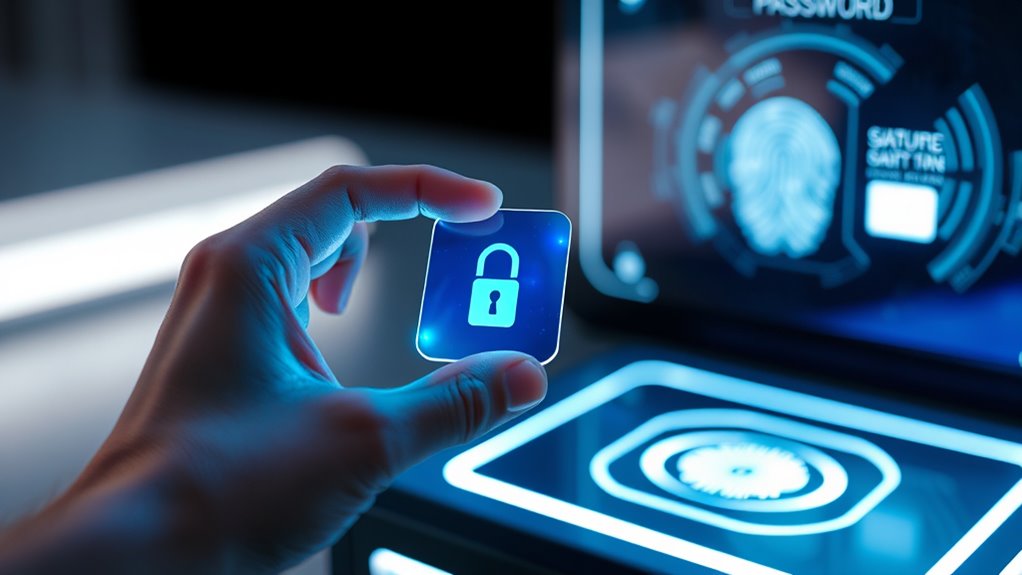
Biometric authentication uses your unique physical traits—like fingerprints, facial recognition, or even iris scans—to verify your identity. Unlike passwords, which can be guessed, stolen, or forgotten, biometric data is inherently tied to you. This makes it markedly harder for hackers to impersonate you. Plus, biometric authentication offers a quick and seamless user experience; instead of typing complex passwords, you simply scan your fingerprint or glance at your device. It’s intuitive, fast, and adds an extra layer of security that traditional passwords simply can’t match.
Biometric authentication offers a quick, secure, and seamless way to verify your identity.
Passkey implementation is another innovation aiming to replace or supplement passwords altogether. Passkeys leverage cryptographic techniques to authenticate your identity without transmitting sensitive data that can be intercepted. When you use a passkey, your device creates a unique cryptographic key that stays stored locally and is never shared with servers. This dramatically reduces the risk of credential theft and phishing attacks. Implementing passkeys across platforms means that your login process becomes more secure while also becoming more convenient—no need to remember complex passwords or manage password managers for every account. Instead, a simple biometric verification or device PIN can authorize access effortlessly.
As more services adopt biometric authentication and passkey implementation, the traditional password begins to feel increasingly obsolete. You’ll likely notice a shift towards more secure, user-friendly login methods that prioritize your convenience without sacrificing security. The move toward biometric authentication means that your unique biological features become your password, making it nearly impossible for anyone else to access your accounts without your consent. Meanwhile, passkeys reduce reliance on memorization and prevent attacks that exploit weak or reused passwords.
In the near future, you can expect your devices and online services to prioritize these advanced authentication methods, making your digital life safer and simpler. The integration of biometric authentication and passkey implementation signals a move away from passwords that can be stolen or cracked. Instead, you’ll benefit from security solutions that are built around you—your biometrics and cryptographic keys—delivering protection that’s both robust and easy to use. The future of passwords is clear: it’s more secure, more convenient, and more aligned with how you interact with technology today. Additionally, enhanced security features like these can help mitigate risks associated with password reuse and weak credentials.

Digital Persona 88003-001U.are.u 4500 Reader 70" Cable
Target Applications – Desktop PC security, Mobile PCs, Custom applications
As an affiliate, we earn on qualifying purchases.
As an affiliate, we earn on qualifying purchases.
Frequently Asked Questions
How Secure Are Biometric Authentication Methods Against Hacking?
Biometric authentication methods are pretty secure, but they aren’t foolproof. You should know that encryption vulnerabilities can expose your data if not properly protected. Also, biometric spoofing is a risk—hackers might use fake fingerprints or facial features. While advanced encryption and anti-spoofing measures help, no system is entirely immune. Stay cautious, keep your devices updated, and consider multi-factor authentication for better security.
Will Passkeys Replace Traditional Passwords Completely?
Imagine a world where passwords are as obsolete as dial-up internet. Passkeys are poised to replace traditional passwords completely, enhancing user convenience and reducing password complexity. They offer a more secure, frictionless experience, making login processes smoother and safer. As technology advances, you’ll find that passkeys become the new standard, simplifying security while keeping your accounts protected without the hassle of remembering complex passwords.
What Are the Privacy Implications of Using Biometrics?
Using biometrics can enhance security, but it also raises privacy risks. Your biometric data, like fingerprints or facial scans, is unique and permanent, making it vulnerable if stored insecurely. If hackers access this data, it can’t be changed like a password. You need to trust that companies protect your biometric data properly, as misuse or breaches could compromise your privacy and lead to identity theft.
How Accessible Are Passkeys for People With Disabilities?
Ironically, passkeys aim to simplify access, but accessibility challenges still exist. If you rely on assistive technology, you might find passkeys less accommodating, especially for those with disabilities. While they promise convenience, their compatibility with various assistive devices isn’t perfect yet. So, for some, the future of login security might still require maneuvering hurdles, making accessibility a work in progress rather than a universal solution.
What Is the Timeline for Widespread Adoption of Passkeys?
You can expect widespread adoption of passkeys within the next few years as digital identity becomes more secure and user convenience improves. Tech companies and platforms are actively integrating passkeys, making them more accessible and easier to use. By 2025 or 2026, you’ll likely see most online services offering passkeys as a standard authentication method, markedly reducing reliance on passwords and enhancing your overall digital security.

Fingerprint Sensor Fingerprint Scanner 10 * 8 * 2 R307 Optical Fingerprint Module Reader Sensor Access Control Attendance Recognition Device JTLB
As an affiliate, we earn on qualifying purchases.
As an affiliate, we earn on qualifying purchases.
Conclusion
Imagine a world where your fingertips and face unseal your digital doors effortlessly, no more fumbling with passwords or worrying about breaches. Passkeys and biometrics paint a future where security feels natural, almost like a handshake or a friendly nod. As technology evolves, you’ll glide through online spaces smoothly, your identity secured by something uniquely you. Embrace this future—where convenience and safety become your everyday experience, like a trusted friend guiding you home.

Yubico – YubiKey 5C NFC – Multi-Factor authentication (MFA) Security Key and passkey, Connect via USB-C or NFC, FIDO Certified – Protect Your Online Accounts
POWERFUL SECURITY KEY: The YubiKey 5 NFC is the most versatile physical passkey, protecting your digital life from…
As an affiliate, we earn on qualifying purchases.
As an affiliate, we earn on qualifying purchases.

Mantra MFS 110 L1 Biometric Single Fingerprint Scanner | Aadhaar Authentication Device | Latest Updated RD Service | High Securety and Fast scanning | Reliable and Durable
MFS110 L1 USB Fingerprint Scanner
As an affiliate, we earn on qualifying purchases.
As an affiliate, we earn on qualifying purchases.