
🔍 Read the full analysis: The Promise And Limits Of AI In Space, Seen Through A Satellite Haiku on ThorstenMeyerAI.com

Get the latest gadgets delivered free with Prime
- Fast, free delivery on millions of items
- Prime Video, Amazon Music and more included
- Member-only deals all year
TL;DR
A satellite built by Google and Planet generated a haiku using Google’s Gemma 4 model on an onboard TPU, according to Google. The test shows that AI computing can run in orbit at small scale, but power, heat, radiation, launch costs and satellite links remain major hurdles.
Google says a small satellite built with Planet has run its Gemma 4 AI model on a Google TPU in orbit and sent a haiku back to a ground station, marking the first reported result from Project Suncatcher. The October test shows that AI inference can run on a satellite, but it does not establish that large-scale computing in space is practical or economical.
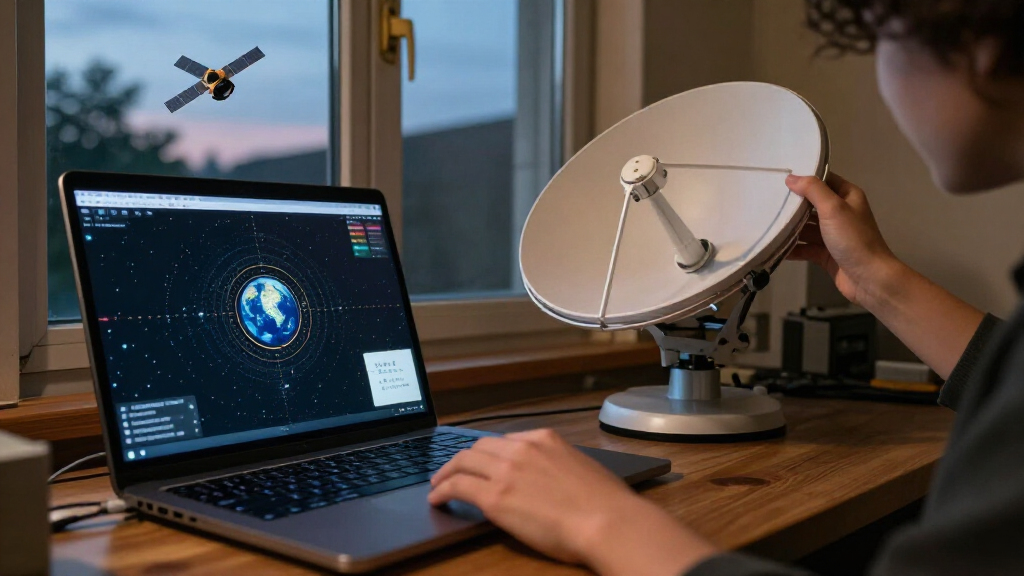
The satellite launched on October 1, 2026, aboard SpaceX’s Transporter-18 rideshare mission. After roughly three weeks of commissioning, engineers sent it a prompt during a ground-station pass as it traveled over Svalbard, Norway. Google said the satellite returned the poem: “Blue marble below / Data streams in silent grace / Starlight feeds my core.”
The spacecraft uses a standard Planet satellite platform and carries four TPUs, according to TechCrunch. Its power generation is limited to about 1 kilowatt, so it can activate only one chip at a time. TechCrunch reported that the chip ran in bursts of about 20 minutes during the test. Google described the result as its “Hello World” moment for the project and said the satellite was operating as expected.
Google’s next tests are intended to examine how TPUs perform under thermal stress and radiation exposure. The company’s stated next milestone is two interconnected satellites in 2027, with more power and optical links between them. That would test a central element of Suncatcher’s plan: linking satellites so they can work together, rather than treating each spacecraft as a separate computing unit.
Infographic 01 · What flew and what it did
One satellite, four chips, one haiku
Google’s Project Suncatcher prototype is the first test of whether its AI data center chips can work in orbit. Here is what is on board and how it got there.
- 4 Nov 2025Project Suncatcher announcedResearch post and preprint; plan: two prototypes with Planet by early 2027
- 1 Oct 2026Prototype launchedSpaceX Transporter-18 rideshare, built with Planet; peer-reviewed paper in Joule
- Oct 2026About three weeks of commissioningHost and TPU trays powered up, early machine learning tests
- Week of 26 Oct“Hello World”First prompt to Gemma 4; the haiku came down during a pass over Svalbard, Norway
- NextHeat and radiation tests in orbitHow the TPUs behave under thermal stress and real space radiation
- 2027Twin interconnected satellitesMore power and laser links between satellites (Google, TechCrunch)
Scale check
The satellite vs. one power deal on Earth
890 MW = 890,000 kW, about 890,000 times the prototype (my arithmetic). The prototype bar is drawn at a visible minimum; to scale it would be invisible.
Not the first AI chip in orbit
Starcloud-1, launched November 2025 (CNBC)
- Carried one Nvidia H100, a data center GPU
- Trained a small language model in orbit
- Ran Google’s open model Gemma up there in December 2025
- Google’s claim is narrower: the first response from a data center class TPU in orbit
Sources: Google, 30 Oct 2026 · Google, 1 Oct 2026 · Google Research, 4 Nov 2025 · TechCrunch, 30 Oct 2026 · TechCrunch, 1 Oct 2026 · Google and Constellation, 6 Oct 2026 · CNBC, 10 Dec 2025.
Powered by Thorsten Meyer AI
What One Orbital TPU Shows
The test establishes a limited but concrete capability: a commercial AI model can respond to a prompt using a chip in orbit, and the result can be returned to Earth. It is an early demonstration, not evidence that orbital systems can perform the sustained, high-volume computing workloads handled by terrestrial data centers.
Google’s broader interest is partly about energy. The company argues that solar panels in a suitable orbit could produce up to eight times more energy than comparable panels on Earth. That is a company estimate, not a measurement of the prototype’s overall efficiency or cost. The tiny satellite’s roughly one-kilowatt capacity is also far removed from the power demands of data-center-scale computing.
The economics remain a major constraint. In its research, Google estimates that a kilowatt of orbital capacity would cost about $14,700 a year in launch costs at current prices. Its modeled figure falls to about $810 a year if launch costs reach $200 per kilogram, which Google says is close to the electricity cost for U.S. data centers. That lower-cost scenario depends on a substantial reduction in launch prices; it is not the cost of the current demonstration.
Products Worth Considering

Jackery Explorer 1000 v2 Portable Power Station

Jackery Explorer 300 Portable Power Station, 292Wh

Bose QuietComfort Headphones (2nd Gen), Wireless Noise-Cancelling Over-Ear Headphones, Black
As an affiliate, we earn on qualifying purchases.
From Research Paper to Orbit
Google introduced Project Suncatcher in a research post and preprint paper on November 4, 2025. The proposal centers on solar-powered satellites carrying TPUs and connected by high-speed laser links. Google initially described a learning mission with Planet involving two prototype satellites by early 2027. The single-satellite test arrived sooner, but does not yet test the planned network.
The October launch followed Google’s publication of a peer-reviewed version of its research in the journal Joule. Google’s paper sketches a future cluster of 81 satellites flying within a radius of about one kilometer at an altitude near 650 kilometers. It also reports a bench test in which a pair of optical transceivers reached 1.6 terabits per second. That figure comes from a test of the link hardware; it is not a demonstrated data rate between working satellites in orbit.
The test is not the first time an AI-capable chip or model has been used in space. CNBC reported that Starcloud launched a satellite carrying an Nvidia H100 GPU in November 2025 and later ran and queried Google’s Gemma model there. Google’s narrower claim is that its satellite produced the first AI response from a data-center-class TPU in orbit. Suncatcher’s proposed use of linked satellites is a distinct part of its plan.
““As the satellite passed by Svalbard, Norway, the downlinked poem confirmed success.””
Costs and Orbital Risks Remain
The haiku test does not show how well a satellite can sustain demanding workloads over long periods, or how its performance changes as chips face radiation and temperature swings. The system’s short operating bursts and limited power also leave open how much useful work a larger orbital cluster could deliver.
Several practical issues remain unresolved: the cost of launching and replacing hardware, repairs that cannot readily be performed in orbit, heat management in a vacuum, and reliable communication with both other satellites and ground stations. Space debris adds risk; the source material cites about 47,000 tracked objects in orbit, though it does not specify a date for that count. Google’s projected costs and energy advantages are estimates, and the company has not demonstrated that the proposed cluster can meet them.
It is also too early to tell whether linked satellites can maintain the speed and reliability needed for shared AI workloads. Google’s reported optical-link result came from a bench test, while its planned in-orbit link test remains ahead.
Two-Satellite Test Planned for 2027
Google says it plans to move to a pair of interconnected satellites in 2027, if the current tests progress as intended. The company says the next work will assess chip performance under radiation and thermal stress; TechCrunch reports that the two-spacecraft mission is expected to generate more power and test optical links between satellites.
That mission should provide a clearer measure of whether the links can support computing across spacecraft in orbit. Until then, the confirmed result is narrower: one satellite ran a prompt on one TPU and returned a short response. Google has not provided a demonstrated schedule or final cost for a larger constellation.
Key Questions
What did Google’s satellite do?
Google says it ran Gemma 4 on an onboard TPU and returned a haiku to a ground station during a pass over Svalbard.
Does this mean Google has put a data center in space?
No. The prototype carries four TPUs but can run only one at a time, with about 1 kilowatt of power. It is a small test, not a full data center.
Was this the first AI system in orbit?
Not according to the source material. CNBC reported that Starcloud launched an Nvidia H100 GPU in 2025 and later ran Google’s Gemma model. Google’s claim is specifically about a response from a data-center-class TPU in orbit.
Why is Google exploring AI computing in space?
Google argues that solar panels in some orbits could produce more energy than on Earth. Its research also proposes linking satellites into computing clusters, but the energy and cost advantages have not been established for a working large-scale system.
What happens next?
Google says it will test the TPU’s response to radiation and thermal stress, with a two-satellite linked mission planned for 2027. That mission is expected to test optical communication between spacecraft.
Source: ThorstenMeyerAI.com