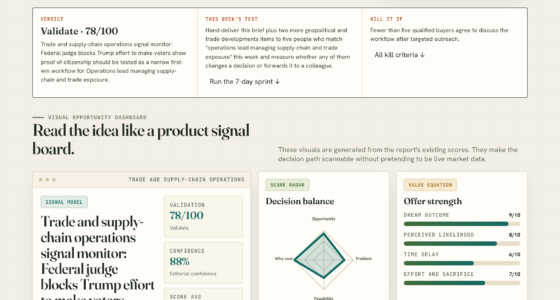

📊 Full opportunity report: Trade And Supply Chain Watch: Canada Sets To Mirror US Tariffs on IdeaNavigator AI — validation score, market gap, and execution plan.

Get the latest gadgets delivered free with Prime
- Fast, free delivery on millions of items
- Prime Video, Amazon Music and more included
- Member-only deals all year
TL;DR
Canada has announced it will implement tariffs equivalent to US tariffs if trade talks with the US collapse. This decision signals a potential escalation in trade tensions and impacts supply-chain planning. The move is confirmed but the timing of implementation remains uncertain.
Canada has announced it will implement tariffs equal to US tariffs ‘dollar-for-dollar’ if trade talks with the United States break down. This move signals a potential escalation in trade tensions and could significantly impact supply-chain operations. The decision was confirmed by Canadian trade officials as a contingency plan amid ongoing negotiations.
According to trade sources, Canada has indicated it will respond to US trade policies by imposing tariffs equivalent to those enacted by the US, should negotiations fail. This stance was publicly clarified following recent tensions in bilateral trade discussions. The announcement aligns with Canada’s broader strategy to safeguard its economic interests amid rising US protectionist measures. For more on related trade issues, see Felony Data Deletion At Borders.
While the specific timeline for implementing these tariffs remains unclear, officials emphasize that the decision is a preparatory measure rather than an immediate action. Experts note that this escalation could lead to increased costs across supply chains, affecting industries reliant on cross-border trade, such as automotive, agriculture, and technology sectors.
Trade analysts highlight that this move reflects a broader pattern of retaliatory measures seen in recent US-Canada trade disputes, with Canada signaling its readiness to match tariffs ‘dollar-for-dollar’ as a form of deterrence or leverage in ongoing negotiations.
Implications for Cross-Border Trade and Supply Chains
This development matters because it signals a potential escalation in US-Canada trade tensions, which could lead to increased tariffs, higher costs, and disrupted supply chains across multiple industries. For businesses managing international trade operations, this announcement underscores the importance of monitoring diplomatic developments closely. If enacted, the tariffs could slow trade flows, increase prices, and force companies to reevaluate sourcing and inventory strategies, impacting economic stability and competitiveness.
cross-border trade supply chain tools
As an affiliate, we earn on qualifying purchases.
As an affiliate, we earn on qualifying purchases.
Recent US-Canada Trade Negotiation Dynamics
Trade relations between the US and Canada have been strained recently due to US protectionist policies and ongoing disputes over tariffs and trade rules. The US has enacted tariffs on various Canadian imports, prompting Canada to consider retaliatory measures. Historically, Canada has responded to US tariffs with similar countermeasures, but the recent announcement indicates a more formalized plan to match tariffs dollar-for-dollar if negotiations fail. The timing comes amid broader global trade tensions and shifts in US trade policy under recent administrations.
Previous trade disputes have seen Canada implement tariffs on US goods in response to US tariffs, but this latest move marks a potential escalation that could deepen economic friction. The Canadian government has emphasized that this is a contingency, not an immediate action, but it underscores the fragility of current trade relations.
As an affiliate, we earn on qualifying purchases.
Timing and Implementation Details Still Unclear
It is not yet clear when Canada would enact these tariffs or what specific goods would be targeted. Officials have described the move as a contingency plan, and no formal timeline for implementation has been announced. The actual response will depend on the course of ongoing negotiations and US trade policies.
international trade compliance products
As an affiliate, we earn on qualifying purchases.
As an affiliate, we earn on qualifying purchases.
Monitoring Diplomatic Developments and Potential Tariff Rollout
The next steps include closely following US and Canadian trade negotiations for signs of breakdown or resolution. Canadian officials may finalize specific tariffs if talks fail, and affected industries will need to prepare for potential cost increases and supply chain disruptions. Trade analysts expect further statements from government officials and possible formal tariff announcements in the coming weeks.
supply chain risk management tools
As an affiliate, we earn on qualifying purchases.
As an affiliate, we earn on qualifying purchases.
Key Questions
What triggers Canada’s decision to implement tariffs?
Canada’s plan to implement tariffs is contingent on the breakdown of trade negotiations with the US. If talks fail, Canada has indicated it will respond with tariffs dollar-for-dollar.
Which industries could be most affected by these tariffs?
Industries heavily reliant on cross-border trade, such as automotive manufacturing, agriculture, and technology, are most vulnerable to potential tariffs and supply chain disruptions.
When might these tariffs be enacted?
The exact timing remains unclear. Canadian officials have described the tariffs as a contingency measure, with implementation depending on the progression of trade negotiations.
Could this lead to a trade war between the US and Canada?
While the move signals increased tensions, whether it escalates into a full trade war depends on subsequent negotiations and responses from both governments. Currently, it is a preparedness measure rather than an active tariff policy.
How might businesses prepare for this development?
Businesses should monitor diplomatic signals, reassess supply chain dependencies, consider alternative sourcing options, and prepare for potential cost increases if tariffs are enacted.
Source: IdeaNavigator AI
Halloween Picks
halloween
As an affiliate, we earn on qualifying purchases.