
📊 Full opportunity report: The Intersection Of AI And Manufacturing: Siemens' Strategic Focus on ThorstenMeyerAI.com — validation score, market gap, and execution plan.
TL;DR
Siemens is making a strategic shift toward physical AI for manufacturing, partnering with NVIDIA to develop an industrial AI platform and digital twin technology. The move emphasizes proprietary data and domain expertise, aiming to transform factory operations.
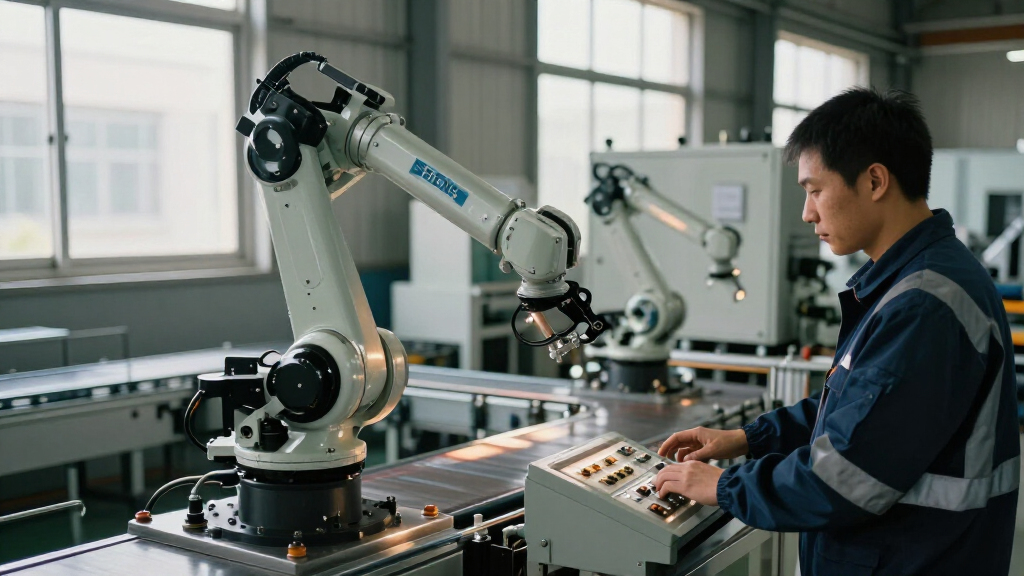
Siemens has revealed a significant strategic pivot towards industrial AI, emphasizing physical-world applications over chatbots or language models. The company announced at CES 2026 the development of the Industrial Foundation Model (IFM) and a partnership with NVIDIA to create an Industrial AI Operating System designed to embed AI across manufacturing and industrial processes. This move aims to leverage Siemens’ extensive domain expertise and proprietary data to reshape factory automation and engineering.
Siemens’ Industrial Foundation Model is designed to process and interpret complex industrial data, including 3D models, engineering drawings, sensor telemetry, and PLC logic, to optimize manufacturing workflows. Announced at Hannover Messe 2025 and emphasized at CES 2026, the model aims to serve as a physical AI backbone for factories.
The partnership with NVIDIA centers on building a comprehensive AI platform that accelerates simulation, enables generative digital twins, and supports real-time optimization. Key features include GPU-accelerated simulation, physics-based AI models, and digital twin tools like NVIDIA PhysicsNeMo, with the first fully AI-driven factory set to launch in Erlangen, Germany, in 2026. Early applications include PepsiCo’s facility simulations and industrial copilots across supply chains.
Siemens asserts that its proprietary industrial data, accumulated over decades, and its domain expertise provide a competitive edge. The company emphasizes that physical AI, grounded in real-world data, will generate more durable value than general-purpose language models, which are less applicable to factory environments.
The factory floor,
not the chat window.
Siemens’ bet: the biggest untapped AI value is physical — machines, factories, infrastructure — and 175 years of industrial data plus NVIDIA compute beats any frontier lab there. The vehicle: an Industrial Foundation Model and an “Industrial AI Operating System.”
A different language than text
Proprietary + physical data no frontier lab can scrape — the same “specialist beats generalist” logic this week keeps documenting, applied to steel and silicon.
Honest bull / bear
Bull
- Proprietary physical data no lab can replicate
- Domain expertise IS the barrier to entry
- Customers (PepsiCo, Audi) already in the base — warm motion
- Generative simulation: digital twins that engineer, not just mirror
Bear
- The “OS” runs substantially on NVIDIA’s stack — American silicon under a European champion
- No validated performance metrics or timelines disclosed at CES
- Geological sales cycle: decade-scale replacement
- “Industrial AI” now crowded (Palantir, Qualcomm moving in)

Building Industrial Digital Twins: Design, develop, and deploy digital twin solutions for real-world industries using Azure Digital Twins
As an affiliate, we earn on qualifying purchases.
As an affiliate, we earn on qualifying purchases.
Implications of Siemens’ Focus on Physical AI in Manufacturing
This development signals a major shift in industrial technology, where AI is expected to directly influence factory operations, engineering, and supply chains. Siemens’ approach leverages its extensive industrial data and domain knowledge, potentially setting a new standard for manufacturing automation. The partnership with NVIDIA accelerates this transition by providing the necessary computational infrastructure and simulation capabilities.
For industry players, Siemens’ strategy could lead to more intelligent, adaptable factories that improve efficiency, reduce downtime, and enable real-time decision-making. However, reliance on NVIDIA’s hardware and software also raises questions about technological sovereignty and vendor lock-in, especially for European customers concerned about dependency on American technology.

How to Start a Manufacturing Business – A Step by Step Guide to Starting a New Small Manufacturing Company (AI for Entrepreneurs)
As an affiliate, we earn on qualifying purchases.
As an affiliate, we earn on qualifying purchases.
Background of Siemens’ Industrial AI Strategy
Siemens has a long history of automation and industrial software leadership, with decades of accumulated data from manufacturing plants, engineering designs, and operational telemetry. The company’s previous initiatives focused on automation hardware, control systems, and digital twins. The recent emphasis on AI represents an evolution towards integrating machine learning directly into physical processes.
The announcement at Hannover Messe 2025 introduced the concept of the Industrial Foundation Model, positioning Siemens as a pioneer in physical AI. The partnership with NVIDIA, announced at CES 2026, builds on this foundation, aligning with broader industry trends of adopting AI for manufacturing and supply chain optimization. Competitors such as GE and Honeywell are also investing in industrial AI, but Siemens emphasizes its proprietary data and domain expertise as key differentiators.
“Industrial AI is no longer a feature; it’s a force that will reshape the next century.”
— Roland Busch, Siemens CEO
Mastering C++26 and CUDA 13.2 Development: Building High-Performance GPU-Accelerated Applications for AI, HPC, and Real-Time Systems (The Future-Ready Programmer Series Book 10)
As an affiliate, we earn on qualifying purchases.
As an affiliate, we earn on qualifying purchases.
Uncertainties Surrounding Siemens’ Industrial AI Roadmap
While Siemens announced ambitious plans and partnerships, specific details about deployment timelines, hardware requirements, and performance metrics remain undisclosed. The first fully AI-driven factory is slated for 2026, but the actual operational capabilities and ROI are still unverified by independent sources. Additionally, the reliance on NVIDIA’s infrastructure raises questions about vendor lock-in and geopolitical implications, especially for European customers.
It is also unclear how quickly Siemens’ physical AI solutions will penetrate existing factories, given the lengthy upgrade cycles typical in industrial environments.

Johnson Controls A99BB-25C Temperature Sensor, PVC Cable
Product Type:Electronic Component
As an affiliate, we earn on qualifying purchases.
As an affiliate, we earn on qualifying purchases.
Next Steps in Siemens’ Industrial AI Deployment
Siemens plans to launch the Erlangen factory as a showcase for its AI-driven manufacturing approach in 2026, followed by broader rollout and customer pilots. The company will also introduce Digital Twin Composer and expand its industrial copilots across supply chains. Monitoring the performance, adoption rate, and customer feedback will be critical in assessing the success of this strategy.
Further developments are expected as Siemens and NVIDIA refine their platform, publish validation results, and potentially expand to other industrial sectors. Industry observers will watch for independent validation of performance claims and real-world ROI.
Key Questions
How does Siemens’ industrial AI differ from general-purpose AI models?
Siemens’ industrial AI is tailored to process physical data such as 3D models, sensor telemetry, and engineering drawings, leveraging proprietary domain knowledge. Unlike general-purpose models focused on language or text, Siemens’ models aim to optimize manufacturing and engineering processes directly.
What role does NVIDIA play in Siemens’ industrial AI strategy?
NVIDIA provides the AI infrastructure, simulation libraries, and physics-based models that underpin Siemens’ platform. The partnership includes GPU-accelerated simulation, generative digital twins, and the development of the Industrial AI Operating System.
When will the first AI-driven factory be operational?
The first fully AI-driven, adaptive manufacturing site at Siemens’ Erlangen plant is expected to launch in 2026, serving as a blueprint for future implementations.
Are there concerns about dependence on NVIDIA technology?
Yes, Siemens’ reliance on NVIDIA’s hardware and software raises questions about vendor lock-in and technological sovereignty, especially for European clients wary of dependency on American technology providers.
What are the potential benefits of Siemens’ physical AI approach?
Potential benefits include increased manufacturing efficiency, real-time process optimization, reduced downtime, and improved product quality through intelligent automation and digital twin applications.
Source: ThorstenMeyerAI.com