TL;DR
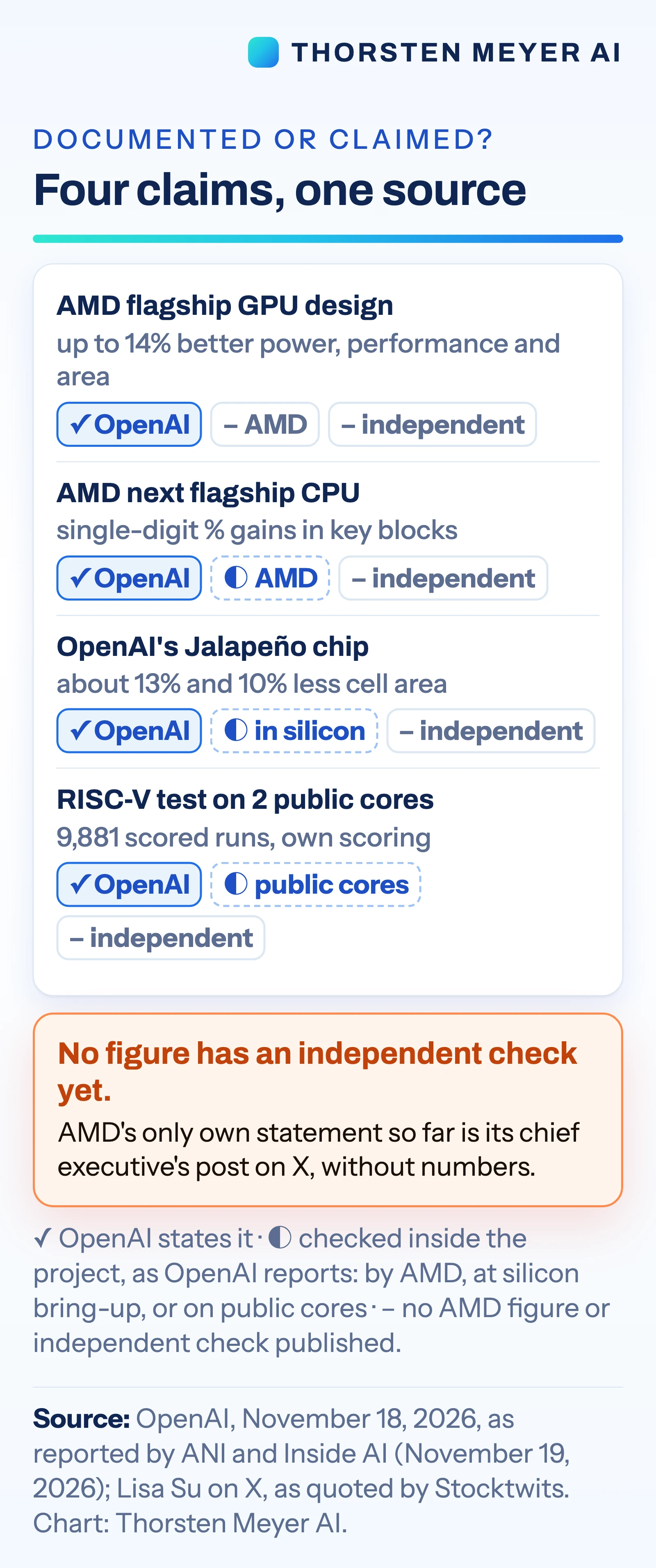
OpenAI said its models rewrote parts of AMD chip designs and achieved up to 14% improvement in power, performance and area against heavily optimized baselines. The figure is an OpenAI-reported best case; the company has not identified the blocks measured or published an average, and no independent audit is available.
OpenAI said November 18 that its models rewrote portions of AMD chip designs, reporting up to 14% improvement in power, performance and area, or PPA, on an AMD flagship GPU design. The company said some model-generated changes are in a design AMD has sent for manufacturing, but it did not disclose which GPU blocks produced the 14% result or provide an average across the design.

Get the latest gadgets delivered free with Prime
- Fast, free delivery on millions of items
- Prime Video, Amazon Music and more included
- Member-only deals all year
The reported work focused on register-transfer-level (RTL) code, written in SystemVerilog to describe how chip circuits behave. OpenAI says its models proposed rewrites and Synopsys design tools checked whether they preserved the original behavior and evaluated their PPA trade-offs. The company described the comparison as being against “heavily optimised baselines.”
OpenAI’s account includes several distinct results. For AMD’s flagship GPU design, it reported up to 14% better PPA, without naming the blocks measured or stating the typical gain. For key blocks in AMD’s next flagship CPU, OpenAI said AMD verified single-digit percentage gains. It also said AMD included some generated changes in a design submitted for manufacturing and placed other changes in production design files for future versions.
OpenAI reported separate results on its own Jalapeño inference chip: model-proposed changes reduced standard-cell area by about 13% in one unit and 10% in another, with the results validated after early chips came back, according to the company. These figures concern specific units on OpenAI’s chip and should not be read as results for AMD’s GPU. OpenAI also described tests on two open-source processor cores, PicoRV32 and Ibex, totaling 9,881 scored runs across five models.
AI Models Enter Chip Design
If the reported gains hold up, model-assisted RTL work could help chip teams find design changes that improve power, performance or area while preserving a circuit’s behavior. Those trade-offs matter because they affect how much computing a chip can deliver, how much energy it uses and how much silicon it occupies. OpenAI said it achieved what it called “roughly a year of progress in less than 5 months” on AMD work, though it did not provide enough detail to independently assess that comparison.
The report also points to a feedback loop: AI tools are being used to help design hardware that may later run AI systems. AMD’s statement that some changes entered a design sent for manufacturing suggests the work has moved beyond a purely exploratory exercise, according to OpenAI. The practical scale of the benefit remains uncertain because the headline percentage is a best-case figure, and no chip-wide average has been disclosed.
Products Worth Considering

Samsung 32 Odyssey G5 QHD Gaming Monitor

Amazon Kindle Scribe (16GB) with Premium Pen, Tungsten

LG 27GS60QC-B Ultragear 27-inch Curved Gaming Monitor (QHD, 180Hz, 1ms, 1000R)
As an affiliate, we earn on qualifying purchases.
From RTL Rewrites to Silicon
RTL is an early stage in chip design. Engineers describe a circuit’s behavior in code, then synthesis tools translate that description into logic gates. Later stages arrange and connect those gates for manufacture. A rewrite can preserve the circuit’s intended function while changing its implementation, but the final impact depends on how the design performs through the rest of the chip-development process.
OpenAI’s November 18 post, titled “Advancing chip design with OpenAI models,” is the primary source for the company’s claims. The source article says an automated request to the post was refused and relies on reporting by ANI, The Decoder and Inside AI for details. AMD has a financial relationship with OpenAI: since October 2025, OpenAI has held a warrant for up to 160 million AMD shares, which vests as AMD chips are deployed. That relationship is relevant context when weighing claims made by OpenAI about work involving AMD.
The Missing Measurement Details
The 14% figure is an “up to” result, not a stated average or a promise of a 14% gain across the GPU. OpenAI has not named the blocks involved, explained how many designs or versions were assessed, or provided the underlying measurements and comparison data. The source material also does not specify how the three PPA measures were combined in the reported figure.
No independent audit of the results has been published. The available account relies largely on OpenAI’s description, including its report of AMD’s verification of CPU gains. It remains unclear which specific changes are in the manufacturing submission, whether they will yield the same gains in finished chips, and when AMD will share its own figures.
AMD’s Manufacturing Follow-Up
The next concrete milestone is the outcome of manufacturing and later testing for the AMD design that OpenAI says includes some model-generated changes. Further detail from AMD or OpenAI could clarify which blocks changed, how gains were measured and whether the results carry through to finished hardware. Until then, the reported GPU result remains a company-reported best case, while the manufacturing and CPU claims await more public evidence.
Key Questions
What does the 14% figure refer to?
It is OpenAI’s reported maximum improvement in power, performance and area on an AMD flagship GPU design compared with what the company called heavily optimized baselines. OpenAI has not provided a design-wide average.
Did AMD confirm a 14% gain?
The source material attributes the 14% GPU figure to OpenAI. OpenAI separately said AMD verified single-digit gains in key blocks of its next flagship CPU. AMD has not published its own detailed figures.
How did the models contribute?
OpenAI says its models rewrote portions of SystemVerilog RTL. Synopsys design tools then checked whether the changes preserved behavior and assessed their power, performance and area trade-offs.
Are the changes already in AMD products?
OpenAI says some changes were included in a design AMD sent for manufacturing, with others added to production design files for future versions. The source material does not identify the design or say when finished products will be available.
Has anyone independently checked the results?
No independent audit has been published, according to the source material. The results and the description of AMD’s verification are reported through OpenAI’s account; public details are not sufficient to reproduce or independently assess the headline figure.
Source: Thorsten Meyer AI