
TL;DR
On November 18, Fed Governor Christopher Waller said the Fed may need to raise its key rate by half a percentage point at its December 8-9 meeting unless it signals another increase in January. The proposal is Waller’s view, not a committee decision; inflation data, jobs figures and other officials’ views will shape the debate.
Federal Reserve Governor Christopher Waller said on November 18 that the Fed may need to raise its benchmark interest rate by half a percentage point at its December 8-9 meeting unless it clearly signals another increase in January. The proposal reflects Waller’s own view; the committee has made no decision. A larger increase would raise borrowing costs for households and businesses, while the labor market has been characterized by officials as having low hiring and low layoffs.

Get the latest gadgets delivered free with Prime
- Fast, free delivery on millions of items
- Prime Video, Amazon Music and more included
- Member-only deals all year
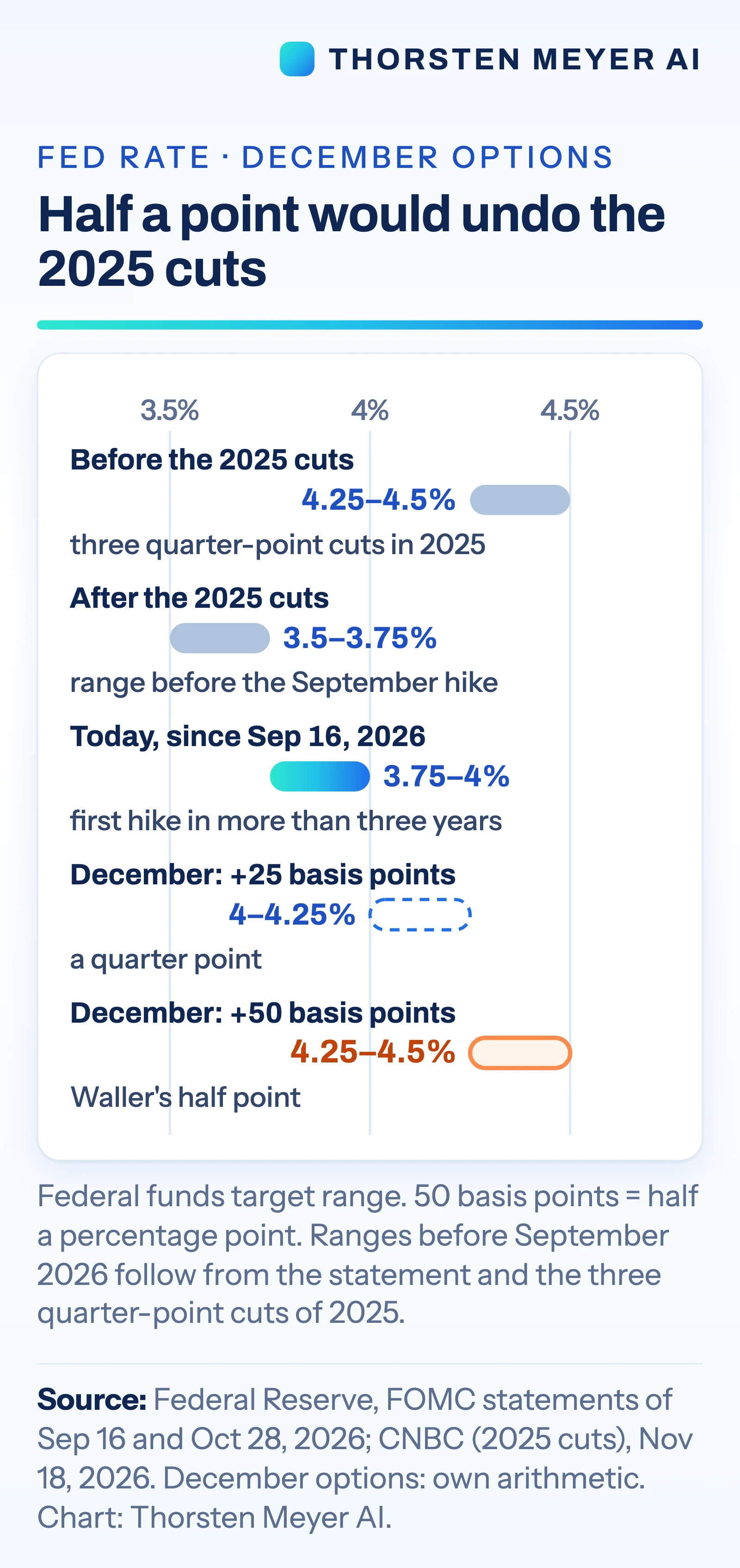
In a live CNBC interview, Waller said he was “very, very concerned about inflation” and that it was “headed in the wrong direction” and spreading. He said the Fed could instead raise rates by a quarter point in December and signal another move in January. If policymakers did not give that signal, he argued, “you have to go 50 [basis points] in December.” A basis point is one-hundredth of a percentage point, so 50 basis points equals half a percentage point.
Waller’s stated concern comes as the personal consumption expenditures price index, the Fed’s preferred inflation gauge, stood 3.6% above its year-earlier level in September, compared with the Fed’s 2% goal. In a November 10 speech, Waller said a half-point increase “should be considered” if core consumer prices rose around 0.3% in October. CNBC reported that October core CPI rose 0.3%, citing Bureau of Labor Statistics data. That is a separate measure from PCE inflation.
Waller also referred to reversing the three quarter-point rate cuts the Fed made in 2025, saying policymakers might need to go beyond those increases before inflation starts falling. He is one of 12 FOMC voters, and the Fed states that his public remarks represent his own views, not necessarily those of his colleagues. The Fed’s October meeting minutes said “a couple of participants” thought a move larger than a quarter point could merit consideration if inflation data were unfavorable.
Higher Rates Reach Jobs and AI
A rate increase would affect financing costs across the economy, although the size and timing of any effects are uncertain. Businesses may face higher costs for loans and debt, which can lead them to delay investment or hiring. Data centers require substantial capital, and developers often rely on borrowing to fund construction.
Fed Vice Chair for Supervision Michelle Bowman said AI-related debt “is on track to exceed $800 billion this year.” She also said higher rates already “appear to be holding back investment” at newer and medium-sized AI firms. Those are Bowman’s assessments; they do not specify how a December increase would affect spending or employment. Higher rates could slow price growth while adding pressure to investment and a labor market officials describe as having low hiring and low layoffs.
October unemployment was 4.1%. Waller and the October meeting minutes describe a “low hire, low fire” market, where workers who lose jobs may take longer to find new ones. The proposal presents a policy trade-off between addressing inflation and the potential effects of higher rates on investment and hiring.
Products Worth Considering

Jackery HomePower 3000 Portable Power Station, 3072Wh

Apple AirPods Pro 3 Wireless Earbuds with Active Noise Cancellation

Bose QuietComfort Wireless Bluetooth Noise-Cancelling Headphones, Cypress Green
As an affiliate, we earn on qualifying purchases.
Inflation and the Fed Debate
The Federal Open Market Committee sets the federal funds rate, which influences short-term borrowing costs and feeds into wider financial conditions. A half-point increase would be larger than the quarter-point moves often used, but Waller’s comments do not establish that the committee will take that step. His suggested alternative—one quarter point in December followed by another in January—would depend on a clear signal to markets.
Other officials have expressed caution. New York Fed President John Williams said, “I don’t think the situation calls for dramatic action.” CNBC also reported that Fed Chair Kevin Warsh has opposed forward guidance of the kind Waller described, on the grounds that it can constrain policymakers. The October minutes show that some participants were open to considering a larger move under unfavorable inflation conditions, while the committee’s overall position remains to be determined.
The evidence cited in the debate covers different periods and measures: September PCE inflation, October core CPI, October unemployment and officials’ assessments of AI financing. The Fed’s next decision will come after more economic data, so the November interview is an argument about what policymakers should do, not an announcement of a rate path.
““I’m very, very concerned about inflation. It’s kind of headed in the wrong direction, and it’s spreading out.””
— Christopher Waller, in a November 18 CNBC interview
The Committee Has Not Voted
It remains unknown whether the FOMC will raise rates in December, by how much, or whether it will signal a January move. Waller has one vote among 12, and the remarks reported by CNBC are his own. The Fed’s published list of speeches checked on November 19 did not include a transcript of the interview, so the quoted interview comments are attributed to CNBC’s reporting.
The economic outlook could also change before the meeting. The September PCE figure and October core CPI reading are different inflation measures, and neither alone determines the decision. The source material does not establish how much a possible rate increase would affect employment, AI investment or the timing of inflation’s return to the Fed’s 2% goal.
Data Before the December Meeting
The Fed is due to receive the October PCE inflation data on November 25, followed by the November jobs report before its December 8-9 meeting. Those releases will give officials additional information on prices and employment as they weigh whether to adjust rates.
The committee’s decision and any statement about January will show whether Waller’s proposal gains support. Until then, his remarks describe one governor’s preferred response to inflation, while the eventual rate decision and its consequences for hiring and AI financing remain unsettled.
Key Questions
Has the Fed decided to raise rates by half a point in December?
No. Waller proposed that move, but the FOMC has not announced a decision. The committee is scheduled to meet December 8-9.
What would a 50-basis-point increase mean?
It would raise the federal funds rate by half a percentage point. That rate influences borrowing costs across the economy, though the effect on any individual loan or business is not specified here.
Why is Waller calling for a larger increase?
He said inflation concerned him because it was moving in the wrong direction and spreading. September PCE inflation was 3.6% higher than a year earlier, above the Fed’s 2% goal.
How could higher rates affect AI companies and workers?
Higher borrowing costs could make it harder to finance investment, including data center construction. Bowman said higher rates already appear to hold back investment at some newer and medium-sized AI firms; the effect on jobs from any December decision is not yet known.
What information comes before the Fed meeting?
The October PCE inflation report is due November 25, and the November jobs report is also expected before the December 8-9 meeting. Both will inform the committee’s discussion.
Source: Thorsten Meyer AI