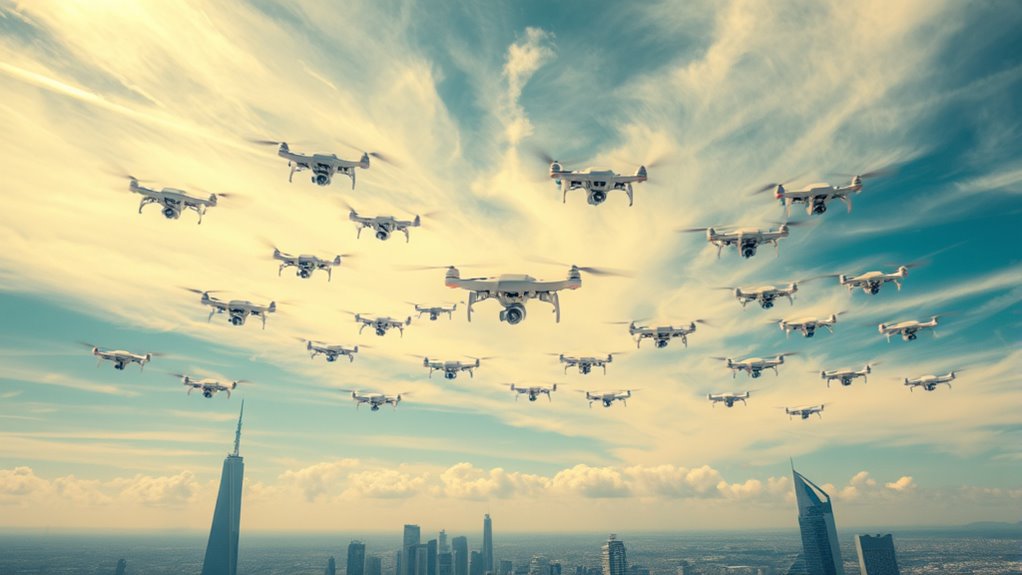

Autonomous drones use AI to control their flights by combining GPS, sensors, and real-time data processing. You’ll see them identify obstacles instantly with machine learning and computer vision, then adapt their routes by scanning the environment. They make decisions on the fly, whether to fly around, over, or stop, all without human input. To see how these intelligent systems work together to keep skies safe and efficient, keep exploring this fascinating technology.

Get the latest gadgets delivered free with Prime
- Fast, free delivery on millions of items
- Prime Video, Amazon Music and more included
- Member-only deals all year
Key Takeaways
- AI enables obstacle detection and real-time risk assessment through machine learning and computer vision.
- Autonomous drones utilize GPS and sensors for precise navigation and route planning.
- They actively sense environments to adapt flight paths, avoiding obstacles dynamically.
- AI-powered systems facilitate safe operation in complex, low-light, and cluttered environments.
- Continuous technological advancements allow drones to make independent decisions, enhancing safety and efficiency.

Have you ever wondered how drones can fly and complete tasks without human control? The secret lies in advanced technology that combines sophisticated drone navigation with AI obstacle detection. These systems allow autonomous drones to operate smoothly and safely, even in complex environments. Drone navigation involves a combination of GPS, sensors, and real-time data processing. This setup helps the drone understand its position, plan routes, and adjust its path on the fly. As a result, the drone can fly from point A to point B efficiently, avoiding obstacles and optimizing its route without direct human intervention.
AI obstacle detection plays a vital role in this process. It enables the drone to identify objects, people, or structures in its flight path instantly. Using machine learning algorithms and computer vision, the drone analyzes data from cameras and sensors, distinguishing between obstacles and safe spaces. If something appears suddenly—like a bird or a moving vehicle—the drone’s AI quickly assesses the risk and makes real-time decisions to steer clear. This capability reduces accidents and increases reliability, especially in unpredictable environments such as urban areas or disaster zones.
When you see an autonomous drone in action, it’s not just following a preset route but actively sensing and reacting to its surroundings. Its AI obstacle detection system continuously scans the environment, providing the drone with an understanding of its immediate surroundings. This process involves mapping obstacles and predicting potential collisions, which helps the drone decide whether to fly around, over, or stop. The synergy between drone navigation and AI obstacle detection ensures the drone can adapt to changing conditions on the spot, without human input.
Moreover, these technologies enable autonomous drones to take on diverse tasks—delivery, surveillance, inspection, or search and rescue—because they can navigate complex terrains and avoid hazards efficiently. The integration of AI in obstacle detection means that drones can operate in low-light, cluttered, or dynamic environments that would challenge traditional systems. This adaptability is what makes autonomous drones so promising for a wide range of applications.
In essence, the combination of advanced drone navigation and AI obstacle detection creates a flying experience where drones can think, adapt, and act independently. They navigate safely through intricate environments, making decisions in real time that previously required human pilots. As this technology continues to evolve, autonomous drones are set to become even smarter, opening new possibilities for industries and changing how we see aerial operations altogether. The integration of sensors and real-time data processing plays a crucial role in enhancing autonomous drone capabilities, enabling more precise and reliable operation in diverse environments.
autonomous drone with obstacle detection
As an affiliate, we earn on qualifying purchases.
As an affiliate, we earn on qualifying purchases.
Frequently Asked Questions
How Is Drone Safety Ensured During Autonomous Operations?
You guarantee drone safety during autonomous operations by relying on sensor integration, which constantly monitors the environment for obstacles and hazards. When a threat is detected, emergency protocols automatically activate, guiding the drone to land safely or avoid collisions. Regular system updates and rigorous testing also help maintain safety standards, so your drone operates reliably and securely, even in complex or unpredictable conditions.
What Are the Privacy Concerns Related to Autonomous Drone Surveillance?
Privacy breaches from autonomous drone surveillance threaten your personal space more than a hurricane. You worry about data security and your information falling into the wrong hands. These drones capture images, videos, and sensitive data, raising concerns about misuse or unauthorized access. To protect your privacy, strict regulations and encryption are essential, ensuring that the skies stay safe without invading your personal boundaries or compromising your data security.
How Do Drones Communicate With Each Other in Swarm Formations?
You see that drones in a swarm communicate using inter drone protocols, which enable seamless data exchange. They utilize swarm coordination techniques like decentralized algorithms, allowing each drone to adapt and respond quickly. These methods guarantee the entire formation stays synchronized, avoiding collisions and maintaining precise movements. By continuously sharing information through radio signals or Wi-Fi, the drones coordinate smoothly, functioning as a unified system without relying on a central controller.
What Regulations Govern the Use of Autonomous Drones Internationally?
You should know that international treaties like the Convention on Certain Conventional Weapons and regulatory frameworks from organizations such as ICAO govern autonomous drone use worldwide. These regulations set standards for safety, privacy, and airspace management. As a drone operator, you need to stay updated on these laws, ensuring compliance across borders, especially when operating in multiple countries, to avoid legal issues and promote responsible flying.
How Is AI Technology Evolving to Improve Drone Navigation Accuracy?
You see AI technology advancing through sensor fusion and machine learning, which substantially improve drone navigation accuracy. Sensor fusion combines data from GPS, cameras, and inertial sensors, helping drones understand their environment better. Meanwhile, machine learning algorithms analyze this data in real-time, enabling drones to adapt to complex conditions and avoid obstacles more effectively. Together, these innovations make autonomous drones safer, more precise, and reliable for various applications.
As an affiliate, we earn on qualifying purchases.
Conclusion
As you watch these autonomous drones take to the skies, it’s clear they’re the new pilots of a digital future. With AI guiding every move, they’re like a flock of birds working in perfect harmony, steering complex skies effortlessly. This technology transforms how we see flight — no longer just machines, but intelligent explorers shaping tomorrow’s world. Embrace this evolution, because the sky isn’t the limit; it’s just the beginning of what’s possible.
As an affiliate, we earn on qualifying purchases.
As an affiliate, we earn on qualifying purchases.
Halloween Picks
halloween
As an affiliate, we earn on qualifying purchases.