
As AI growth accelerates, your data centers need efficient power and cooling to operate reliably and prevent hardware failures. Proper systems help you cut operational costs, improve processing speeds, and reduce energy waste, which benefits the environment too. Advanced cooling techniques lower energy use and increase hardware lifespan. Good infrastructure design and emerging tech make systems more sustainable and cost-effective. To discover more about crucial strategies for managing AI infrastructure, keep exploring this essential topic.
Key Takeaways
- Ensures AI hardware operates reliably and efficiently, preventing failures and maintaining high performance.
- Reduces energy waste and operational costs through effective cooling and power management.
- Minimizes environmental impact by lowering energy consumption and carbon footprint.
- Supports scalable growth of AI systems with sustainable infrastructure design.
- Advances in hardware and cooling technologies enhance AI capabilities and infrastructure sustainability.
Have you ever wondered what powers the incredible AI systems transforming our world? At the core, it’s the complex infrastructure that keeps these systems running smoothly—specifically, the power supply and cooling solutions. As AI models become more sophisticated and data demands grow, focusing on energy efficiency and hardware reliability becomes essential. Without proper power and cooling, these systems risk underperformance, hardware failures, and increased operational costs.
Energy efficiency isn’t just a buzzword; it’s a necessity. AI data centers consume enormous amounts of electricity, and the more efficient your systems are, the less energy they waste. Improved power management reduces operational costs and minimizes environmental impact, which is a significant concern for large-scale AI operations. You want to avoid unnecessary energy drain that could lead to higher electricity bills and increased carbon footprints. Streamlined power supply systems and smarter energy usage protocols help guarantee that your hardware operates at peak efficiency, translating to faster processing speeds and better overall system performance. Additionally, implementing effective cooling techniques can significantly reduce energy consumption by decreasing the need for heavy cooling loads. Proper infrastructure design plays a crucial role in optimizing both power and cooling efficiency, ensuring sustainability and cost-effectiveness for AI data centers. Recognizing the importance of energy management protocols can further enhance overall system reliability and environmental sustainability. Moreover, advancements in energy-efficient hardware can lead to further reductions in operational costs and environmental impact.

APC UPS Battery Backup for Power Outages, 600VA/330W Surge Protector, 7 Outlets, USB Charging, BE600M1 Uninterruptible Power Supply for Computers, Wi-Fi Routers, and Home Office Electronics
KEEP YOUR COMPUTER, WI-FI AND ROUTER RUNNING THROUGH POWER OUTAGES: Supplies short‑term battery power during outages to maintain…
As an affiliate, we earn on qualifying purchases.
As an affiliate, we earn on qualifying purchases.
Frequently Asked Questions
How Does Power Consumption Impact AI Model Development Costs?
Power consumption directly impacts your AI model development costs because higher energy use increases expenses for running and cooling servers. By focusing on energy savings, you can substantially reduce these costs, making your projects more affordable. Efficient power management lowers operational expenses, helps avoid overheating issues, and streamlines your infrastructure. Ultimately, controlling power consumption enables cost reduction, accelerates development timelines, and enhances your AI project’s overall profitability.
What Innovations Are Improving Cooling Efficiency in Data Centers?
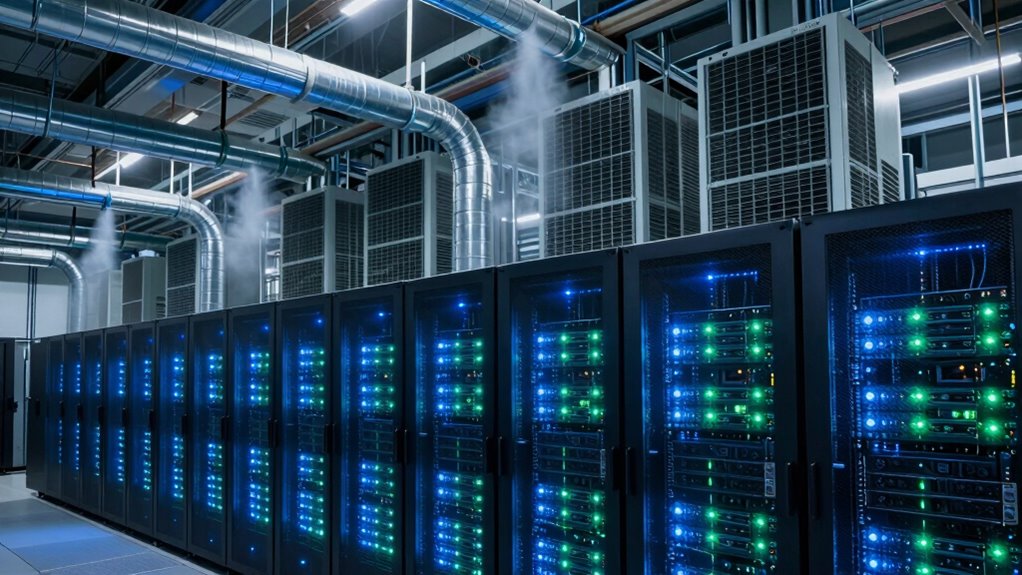
You’ll find liquid cooling innovations transforming data center efficiency. Liquid cooling uses water or other coolants directly on hardware, markedly reducing energy needed for traditional air conditioning. Plus, many data centers now incorporate renewable energy sources like solar or wind power, decreasing environmental impact and cooling costs. These advancements help maintain ideal operating temperatures more sustainably, enabling you to support expanding AI workloads without excessive energy consumption or cooling expenses.
How Do Power and Cooling Challenges Affect AI Deployment Speed?
You might think power and cooling issues slow down AI deployment, but strategic energy storage and advanced thermal management actually speed things up. By efficiently managing heat and energy, data centers reduce downtime and allow faster access to new AI models. This means quicker deployment, less operational disruption, and more reliable performance. Overcoming cooling challenges release rapid AI growth, helping you stay ahead in the competitive tech landscape.
Are There Environmental Concerns Related to Ai’s Energy Use?
Yes, there are environmental concerns related to AI’s energy use. As you expand AI capabilities, you increase energy consumption, which can raise your carbon footprint if powered by non-renewable sources. To mitigate this, you should prioritize renewable energy sources like solar or wind. Reducing AI’s environmental impact involves balancing technological growth with sustainable energy practices, ensuring AI advancements don’t harm the environment or contribute to climate change.
What Are Future Trends in AI Hardware Energy Efficiency?
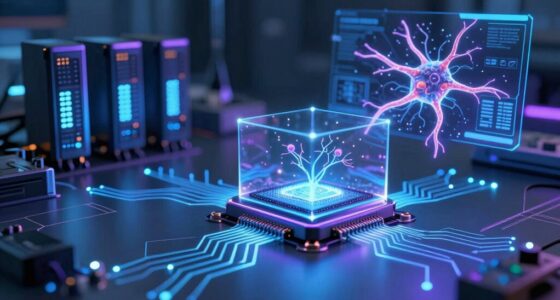
You’ll see future AI hardware focus on quantum optimization and neuromorphic chips, which could reduce energy consumption by up to 90%. These innovations mimic brain processes and harness quantum mechanics, making AI more efficient. As a result, your AI systems will run faster and cooler, cutting costs and environmental impact. Expect these trends to revolutionize AI performance while markedly lowering power demands in the coming years.

Clyxgs Water Cooling Radiator, 12 Pipe Aluminum Heat Exchanger Radiator with Tube for PC CPU Computer Water Cool System DC12V 120mm
✅ Product Name: Water Cooling Radiator; Size: 155 x 120 x 27 mm / 6.1'' x 4.7'' x…
As an affiliate, we earn on qualifying purchases.
As an affiliate, we earn on qualifying purchases.
Conclusion
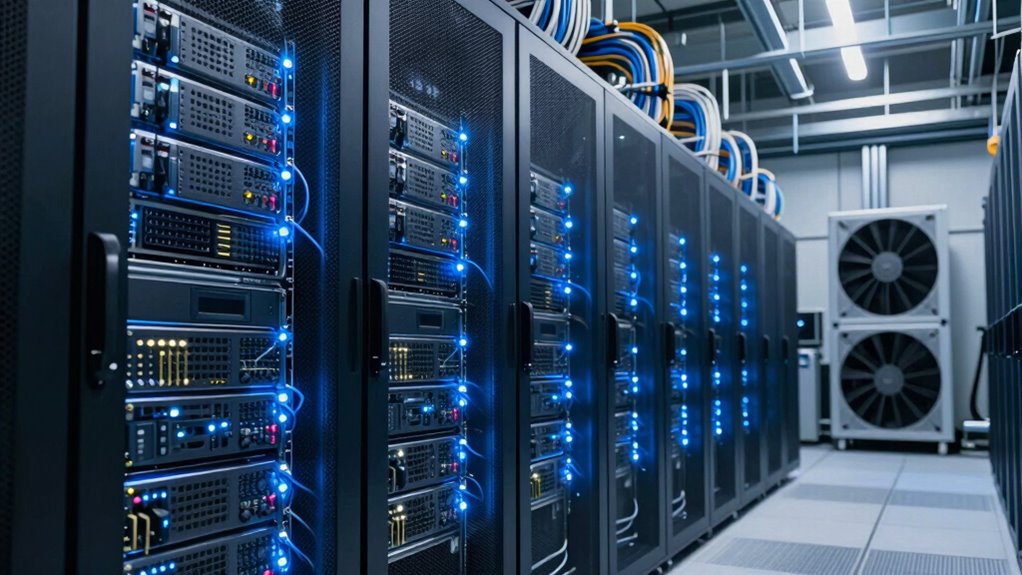
As you watch a bustling data center, cables crisscross like veins, and cooling fans hum steadily, it’s clear that power and cooling are the heartbeat of AI’s growth. Without them, servers would overheat, and progress would stall—like a city suddenly running out of electricity on a sweltering day. So, just as a well-oiled machine keeps moving, reliable power and cooling keep AI advancing, ensuring this technological surge continues smoothly, fueling innovation with every watt and breeze.

Jgstkcity Rack Mount PDU Power Strips,8 Outlet Surge Protector,Individual Switches,1.5U Rackmount Server Racks,14AWG Heavy Duty Extension Cord,2700J,15A 125V 1875W (Standard Power Cord, 6 FT Cable)
Heavy-Duty Rackmount Power Solution – Enhance your data center, network server, or computer room with our 1.5U Rackmount…
As an affiliate, we earn on qualifying purchases.
As an affiliate, we earn on qualifying purchases.

Two Channel SXM2 Expansion Board Builts for Data Center GPUs Featuring Advanced 300G Cooling Solution Servers GPU Accelerators Board
Engineered for, the SXM2 two GPU expansion baseboard 300G supports two SXM2 GPUs ( V100) with integrated NVLink…
As an affiliate, we earn on qualifying purchases.
As an affiliate, we earn on qualifying purchases.