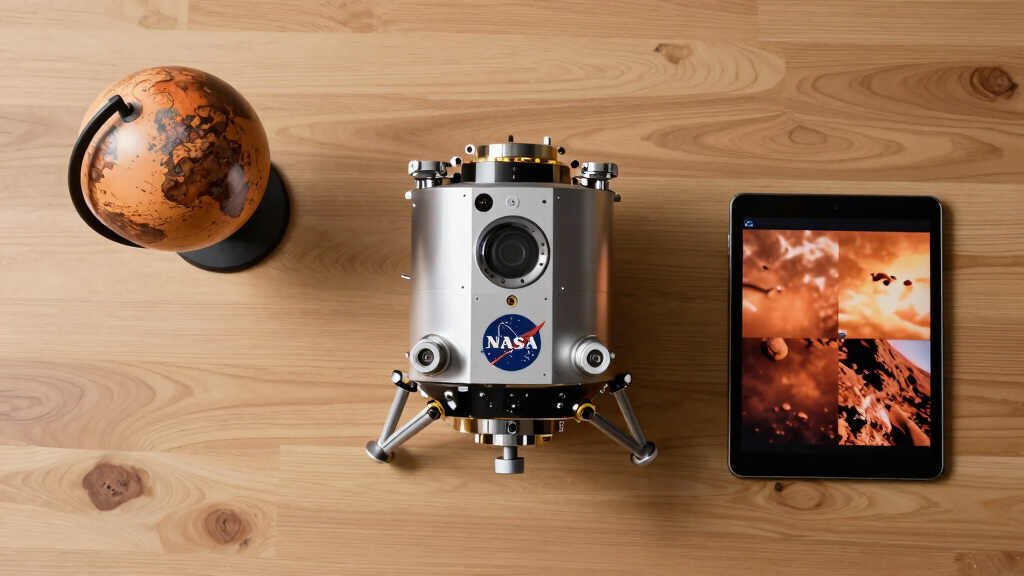

TL;DR
NASA’s Psyche spacecraft successfully completed a planned gravity assist maneuver around Mars on May 15, increasing its speed and adjusting its trajectory toward asteroid 16 Psyche. This maneuver is critical for conserving fuel on its six-year mission to study the metal-rich asteroid, which could reveal insights into planetary core formation.
NASA’s Psyche spacecraft executed a planned gravity assist maneuver around Mars on May 15, passing within 2,800 miles of the planet to boost its velocity and refine its trajectory toward asteroid 16 Psyche. This maneuver is vital for conserving fuel and ensuring the spacecraft stays on its six-year, 2.2-billion-mile journey to the metallic asteroid, which is expected to be reached in July 2029.
The spacecraft approached Mars at a speed of approximately 12,300 mph, with its closest approach occurring around 3:30 PM Eastern time. During the flyby, Psyche came within 2,800 miles of Mars, significantly closer than its moons Phobos and Deimos, which orbit at distances of 3,700 miles and 12,470 miles, respectively. The maneuver was part of a planned trajectory adjustment to utilize Mars’s gravity to increase the spacecraft’s speed, which is now approximately 10,710 mph.
NASA confirmed that Psyche’s cameras captured images of Mars during the flyby, which will be transmitted back via the Deep Space Network over the coming days and weeks. These images will be made available on the mission’s official channels. The spacecraft’s trajectory was carefully calculated to maximize the gravity assist effect while maintaining safety margins for the spacecraft’s instruments.
Why It Matters
This gravity assist is a critical step in Psyche’s mission, enabling it to conserve fuel needed for its long journey and detailed study of asteroid 16 Psyche. Understanding this metallic asteroid could provide unique insights into planetary core formation and the early history of the solar system, as Psyche is believed to be part of the exposed core of a protoplanet.
By studying Psyche, scientists hope to gain information about planetary differentiation and the processes that formed terrestrial planets like Earth. The mission’s success could also inform future asteroid exploration and planetary science missions, making this maneuver an important milestone in space exploration.

Postage Stamp Space Shuttle Atlantis 1/300 Die-Cast Metal Spacecraft Model – Officially Licensed NASA Collectible for Adult Collectors Ages 14+
Authentic NASA Spacecraft Replica – Detailed 1/300 scale model of the legendary Space Shuttle Atlantis featuring realistic NASA…
As an affiliate, we earn on qualifying purchases.
As an affiliate, we earn on qualifying purchases.
Background
Launched in late 2023, Psyche is on a six-year journey covering approximately 2.2 billion miles to reach its target asteroid. The mission aims to orbit Psyche for two years, during which it will map the surface, analyze surface composition, and gather data to understand its metallic nature. The use of gravity assists from planets like Mars is a common technique to extend spacecraft range and efficiency, especially for missions traveling across vast distances in the solar system.
This is the first major gravity assist for Psyche, which has been approaching Mars since early May and has been capturing images of the planet. The maneuver was planned months in advance, with NASA engineers calculating the optimal approach to maximize the velocity boost while maintaining safety for the spacecraft.
“The gravity assist maneuver around Mars was successfully executed, providing Psyche with a significant speed boost and trajectory correction necessary for its journey to the asteroid.”
— NASA Mission Operations
“Using Mars’s gravity to assist Psyche helps us conserve fuel and ensures we stay on schedule for arrival in 2029.”
— NASA Jet Propulsion Laboratory

Space Adventure CST-100 1/48
Authentic Space Capsule Replica – Detailed 1/48 scale model of the CST-100 Starliner, inspired by real low-Earth orbit…
As an affiliate, we earn on qualifying purchases.
As an affiliate, we earn on qualifying purchases.
What Remains Unclear
It is not yet clear how the gravity assist will precisely affect Psyche’s trajectory over the coming months, or if any unforeseen navigational adjustments will be needed before arrival at the asteroid.

Moebius Models 936 Mars Attacks! Martian Figure
Model Kit
As an affiliate, we earn on qualifying purchases.
As an affiliate, we earn on qualifying purchases.
What’s Next
NASA will continue to monitor Psyche’s trajectory and transmit the images captured during the flyby. The spacecraft will now proceed along its planned route, with trajectory corrections if necessary, to arrive at asteroid 16 Psyche in July 2029. The mission team will also prepare for the two-year orbiting and data collection phase.

National Geographic Mega Space Activity Kit – Glow in The Dark Science Craft Kit for Kids with 100+ Pieces, Launch a Rocket, Create Glowing Constellations, Paint a Solar System & More
100+ PIECE SPACE ACTIVITY KIT – Discover the wonders of space with this all-in-one kit! Packed with over…
As an affiliate, we earn on qualifying purchases.
As an affiliate, we earn on qualifying purchases.
Key Questions
Why did NASA perform a gravity assist with Mars?
To increase Psyche’s speed and adjust its trajectory, conserving fuel for the long journey to the asteroid.
How close did Psyche get to Mars?
It passed within approximately 2,800 miles of Mars during the flyby.
What will Psyche do once it reaches the asteroid?
It will orbit Psyche for about two years, mapping its surface and analyzing its composition to learn about its metallic nature and origin.
When is Psyche expected to arrive at the asteroid?
In July 2029, with the mission’s primary science operations beginning shortly thereafter.